
Most homeowners believe a coat of waterproof paint can stop a foundation leak, but fighting hydrostatic pressure with a brush is a losing battle against physics. It’s exhausting to deal with recurring mold growth or the persistent fear that a heavy storm might finally compromise your home’s structural integrity. You deserve a dry, usable space that remains stable regardless of the weather outside. Effective basement waterproofing isn’t about temporary patches; it’s about engineering a system that manages water before it can damage your foundation.
You likely feel overwhelmed by conflicting terminology and the technical complexity of modern building codes. This guide clarifies the process by focusing on validated methods like Interior Basement Drainage Systems and Sump Pump Installation. We’ll explore how the 2026 NJ REAL rules have shifted the standards for flood elevation and why the ASTM D8425 standard is now the benchmark for material quality. You’ll learn exactly how to protect your property from the ground up, ensuring long-term peace of mind and total structural protection.
Key Takeaways
- Identify how hydrostatic pressure and expansive clay soils force moisture through concrete pores and compromise foundation walls.
- Compare exterior excavation with interior basement waterproofing systems to determine the most cost-effective and permanent protection strategy.
- Discover the technical mechanics of sub-floor perimeter drain tiles and how they integrate with modern sump pump installations.
- Recognize early warning signs of structural damage, including efflorescence and specific foundation crack patterns that require immediate attention.
- Learn why a professional diagnostic inspection is essential for creating a customized plan that addresses both water intrusion and structural integrity.
Understanding the Primary Causes of Basement Seepage and Moisture
Water intrusion in a basement is rarely a random occurrence. It is the result of specific environmental forces acting on your home’s foundation. To implement effective basement waterproofing, you must first understand the mechanics of how water moves through soil and masonry. Most moisture problems begin with the soil composition surrounding your home and how it was handled during original construction.
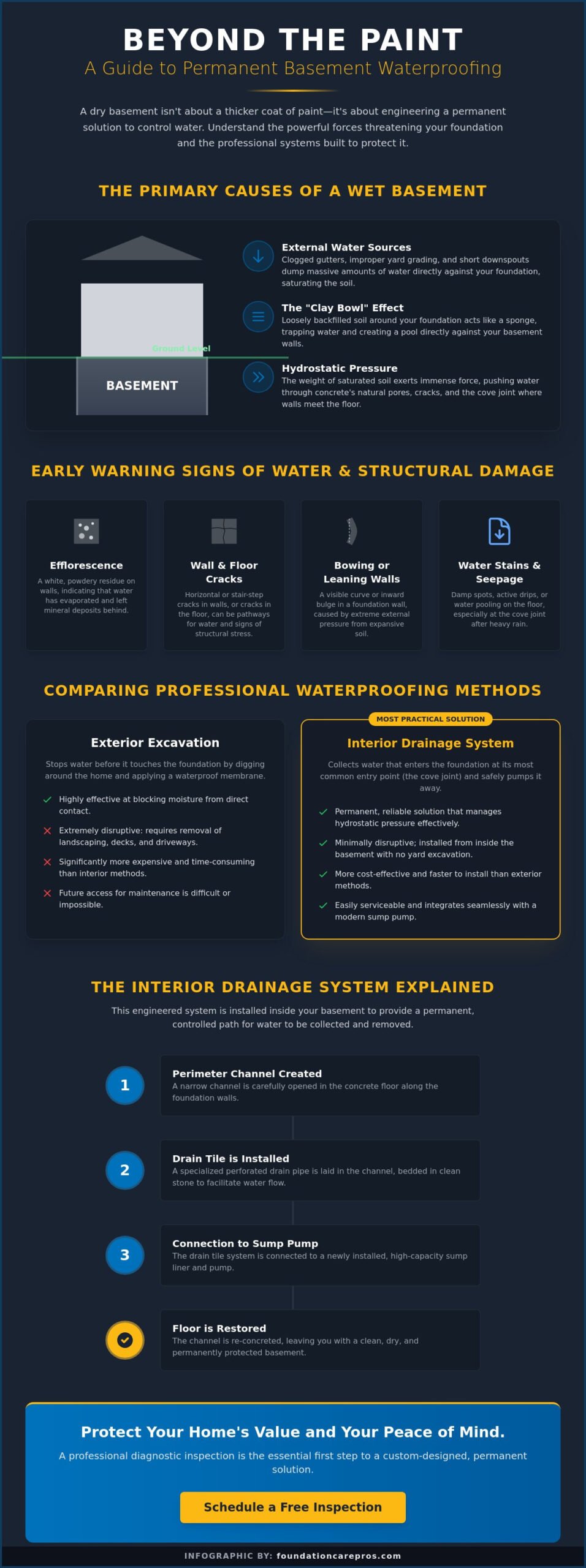
When your home was built, the soil around the foundation was excavated and later backfilled. This backfilled soil is looser and more porous than the undisturbed, virgin earth surrounding it. It creates what engineers call the “clay bowl effect,” where water collects in the looser soil directly against your foundation walls. In regions with clay-rich soil, this problem is amplified. Clay expands significantly when wet, exerting immense lateral pressure that can push foundation walls inward or cause them to crack.
As water accumulates in this “bowl,” it creates hydrostatic pressure. This is the physical force exerted by standing water against your foundation. Concrete is naturally porous. Under enough pressure, water molecules are forced through the microscopic pores of the masonry. Basement waterproofing techniques are designed to mitigate this pressure before it causes permanent damage. Additionally, capillary action allows moisture to “wick” upward through concrete blocks, similar to how a sponge absorbs liquid. This often leads to water vapor transmission, where moisture moves through the wall as a gas even if a liquid leak isn’t visible.
The Role of Hydrostatic Pressure in Foundation Failure
The weight of water in the soil can exert thousands of pounds of force against your home. This pressure often forces water through the cove joint, which is the point where the wall meets the floor. You might notice floor cracks or water bubbling up from the ground during heavy rain. Over time, persistent pressure leads to more than just moisture; it can cause structural bowing or shifting. Understanding the types of foundation cracks and what they mean is the first step in diagnosing whether your issue is purely hydrostatic or a sign of advancing structural failure.
External Factors: Grading, Gutters, and Downspouts
Surface water management is your first line of defense. If your yard’s grading slopes toward the house, you’re inviting water to pool against the foundation. Gutters and downspouts play a vital role in this ecosystem. Clogged gutters overflow, dumping hundreds of gallons of water directly into the “clay bowl” during a storm. Downspout extensions should terminate at least 10 feet away from the foundation to ensure water is discharged safely. Maintaining these systems reduces the workload on your basement waterproofing solution and protects your structural integrity.
Comparing Professional Basement Waterproofing Methods
Professional basement waterproofing requires a strategic choice between positive-side and negative-side pressure management. Positive-side waterproofing involves exterior intervention to stop water before it ever contacts the foundation. Negative-side systems manage water that has already passed through the masonry. While both methods have their place in structural engineering, the choice between them usually depends on the home’s age, landscape, and the severity of water intrusion. Adhering to Basement Health Association standards ensures that whichever method you choose, the focus remains on long-term structural preservation rather than a quick fix.
Interior Drainage vs. Exterior Excavation
Exterior waterproofing requires full excavation down to the foundation footing. Crews install waterproof membranes and exterior French drains to redirect water. This method is highly effective but comes with significant drawbacks for existing homes. It requires removing porches, landscaping, and driveways to access the walls. For most residential properties, Interior Basement Drainage Systems offer a more practical, permanent solution. These systems are installed inside the basement perimeter, capturing water at the cove joint and directing it to a sump pump. This approach avoids yard disruption while providing a controlled environment for water management. If you’re unsure which path is right for your property, consulting with a specialist in structural diagnostics can help determine the most efficient route.
The Myth of Waterproof Paints and Coatings
Retailers often market “waterproof” masonry paints as a simple solution to seepage. This is a fundamental misunderstanding of hydrostatic pressure. These coatings create a surface-level membrane on the interior wall. Because concrete is porous, water continues to enter the wall from the outside, becoming trapped behind the paint. Eventually, the pressure builds until the paint bubbles, peels, and flakes away. This failure is often accompanied by efflorescence, a white, powdery salt deposit that indicates mineral-rich water is actively moving through your foundation. Trapping moisture inside the wall can also accelerate the deterioration of the concrete itself, leading to more significant structural concerns over time. Surface treatments don’t solve the problem; they merely hide it until the damage worsens. Following a structured basement leak repair checklist helps homeowners move past these ineffective surface fixes and toward permanent, pressure-managed solutions.
The Mechanics of Professional Interior Drainage and Sump Pumps
Professional basement waterproofing relies on a calculated system of collection and discharge. It’s not enough to simply intercept water; you must move it away from the foundation permanently to prevent structural decay. The process begins with the installation of sub-floor perimeter drain tiles. These are installed in a trench dug along the interior footing, creating a dedicated path for groundwater to follow. A critical component of this setup is the wall flange. This specialized piece bridges the gap between the foundation wall and the floor, effectively capturing seepage that runs down the wall face before it can puddles on the basement floor.
All collected water flows via gravity toward a centrally located sump pit. According to 2026 standards, a professional sump pit should be at least 24 inches deep and 18 inches in diameter. This volume ensures the pump doesn’t cycle too frequently, which can lead to premature motor failure. It is vital to maintain a closed system by using a sealed, bolt-down lid. This prevents soil gases like radon from entering your home and keeps basement humidity levels within a healthy range. As noted in the Basement Health Association guide to waterproofing, managing groundwater through integrated drainage is the most reliable way to handle high water tables without compromising the foundation’s stability.
High-Capacity Sump Pump Systems
Choosing the right pump requires an assessment of your home’s specific water volume and discharge needs. Cast iron housings are the preferred choice for professional installations because they dissipate heat more effectively than plastic models, significantly extending the unit’s lifespan. You should also look for electronic sensor float switches, which are now the 2026 standard due to their lack of moving parts. A single pump is rarely sufficient for total security. Investing in sump pump with battery backup installation provides zero-fail protection during power outages or mechanical failures, ensuring your basement remains dry during the most severe storms.
The Importance of Vapor Barriers and Encapsulation
Liquid water is only one part of the problem. You must also address water vapor transmission. Heavy-duty plastic liners are used to encapsulate the foundation walls, preventing moisture from evaporating into the basement air. These barriers integrate directly with interior basement drainage systems, funnelling any wall seepage behind the liner and into the drain tiles. This dual-action approach manages both liquid leaks and ambient humidity, creating a dry environment that is inhospitable to mold and mildew growth.
Warning Signs of Structural Damage and Water Infiltration
Visible standing water is often the final stage of a long-term failure process. Before a basement floods, your home usually provides several diagnostic signals that the current basement waterproofing is failing. Recognizing these early indicators can prevent a manageable moisture issue from escalating into a full-scale structural collapse. The most common signs are found in the masonry itself. You should regularly inspect your walls for various types of foundation cracks and what they mean, as specific patterns like stair-step or horizontal lines indicate different types of soil stress.
Efflorescence is another critical warning sign. This white, chalky substance appears on concrete or brick walls when water evaporates and leaves behind mineral salts. While it might look like simple dust, it’s a “check engine light” for your foundation. It proves that water is actively migrating through the porous masonry, stripping away structural minerals as it passes. Over time, this saturation weakens the soil beneath your footings. When soil loses its load-bearing capacity due to constant moisture, the foundation can settle unevenly, leading to jammed doors, stuck windows, and cracked drywall in the upper levels of your home.
A persistent musty smell is more than an inconvenience; it’s a sign of high relative humidity and hidden biological growth. Even if you don’t see standing water, moisture is likely trapped behind finished walls or within the hollow cores of concrete blocks. This damp environment is the primary fuel for mold. Because of the “stack effect,” the air in your basement naturally moves upward into your living spaces. This means that any air quality issues in your basement eventually become air quality issues for your entire family. If you are experiencing any of these symptoms, working through a professional basement leak repair diagnostic process can help you identify the root cause and prioritize the most effective corrective action.
Bowed Walls and Lateral Pressure
Long-term water saturation in the soil creates relentless lateral pressure against your foundation. When the pressure exceeds the strength of the wall, the masonry begins to tilt, curve, or “bow” inward. Horizontal cracks are the most dangerous signal in this scenario, as they indicate the wall is failing under the weight of the outside earth. If you notice a curve in your basement walls, you must act quickly. Solutions like professional I-beam wall braces installation can stop the inward movement and stabilize the structure permanently.
Mold Growth and Air Quality Concerns
Mold thrives on organic materials like drywall paper, wood framing, and dust. In a damp basement, these materials act as a constant food source. Many homeowners try to solve this with a portable dehumidifier, but this is a temporary fix. A dehumidifier treats the symptom, not the cause. It cannot keep up with a liquid water intrusion or the constant vapor transmission through untreated walls. True air quality protection requires a comprehensive basement waterproofing strategy that stops the water at the source.
If you have noticed bowing walls or persistent dampness, don’t wait for the next heavy rain to take action. Contact a structural specialist today to schedule a diagnostic assessment of your foundation.
Implementing a Permanent Waterproofing and Foundation Strategy
Solving a moisture problem permanently requires moving past superficial fixes. A standard sales pitch often ignores the underlying physics of your home’s foundation, focusing instead on quick patches that eventually fail. A professional approach to basement waterproofing begins with a technical assessment that treats the home as a complete system. This strategy ensures the solution you implement today remains effective for decades, protecting both your property’s value and its structural integrity.
A dry basement is more than just a storage area; it’s a critical component of your home’s overall health. When you eliminate moisture, you also eliminate the risk of mold and structural decay. This transformation provides a significant return on investment by increasing the usable square footage of your property. Furthermore, a dry basement with a transferable warranty is a major selling point. It provides potential buyers with documented proof that the home is stable and protected, which can significantly increase the final sale price of the asset.
The Professional Diagnostic Process
Experts utilize specific tools to validate the condition of your foundation before recommending a solution. Laser leveling identifies subtle shifts in the floor or walls that the naked eye might miss. Moisture meters detect water presence deep within the masonry, revealing whether the issue is surface seepage or deep-seated hydrostatic pressure acting on the foundation walls. You should always ask a specialist how their proposed plan addresses the specific soil conditions around your home. A one-size-fits-all approach leads to system failure because it fails to account for the unique stresses acting on your foundation walls.
Integrated Stabilization and Moisture Control
Successful projects often combine water management with structural stabilization. If a wall has begun to bow due to lateral pressure, simply installing an Interior Basement Drainage System is only half the battle. You must also stabilize the masonry to prevent further movement. This is where professional I-Beam Wall Braces or carbon fiber straps are utilized to reinforce the structure. Using a single-source contractor for both foundation repair and moisture control ensures these systems work in tandem. Before committing to any repairs, reviewing a detailed foundation stabilization cost guide can help you evaluate quotes with confidence and understand how variables like soil depth and structural load affect the overall investment. Once the structural repairs and basement waterproofing are complete, the final steps involve restoring the space and establishing a simple maintenance routine to keep the system operating at peak efficiency.
Protecting Your Foundation for the Long Term
Permanent basement waterproofing is an investment in the safety and longevity of your property. You’ve learned that surface-level patches cannot withstand the relentless force of hydrostatic pressure. A truly effective strategy requires a combination of high-capacity drainage systems and precise structural stabilization. By recognizing warning signs like efflorescence or bowing walls early, you prevent minor seepage from becoming a catastrophic failure.
Foundation Care Pros has served as a locally owned and operated specialist since 2004. As a member of the Supportworks Network, we provide validated engineering solutions for structural stabilization and moisture control. We focus on accuracy and permanence rather than temporary fixes. Our methodical approach ensures that every component of your system, from the sump pump to the wall braces, works in harmony to keep your basement dry and stable.
Secure your home with a professional basement inspection from Foundation Care Pros today. You can regain the peace of mind that comes with a protected, usable basement space.
Frequently Asked Questions
Is basement waterproofing worth the investment?
Yes, basement waterproofing is a critical investment that preserves your home’s market value and structural safety. It prevents the deterioration of foundation walls and stops mold growth before it compromises your indoor air quality. A dry, stable basement also increases your home’s usable square footage. This adds significant long-term value that often outweighs the initial cost of the installation.
Can I waterproof my basement from the inside myself?
DIY efforts are usually limited to surface sealants and paints, which don’t address the root cause of water intrusion. These coatings eventually bubble and peel because they can’t withstand the constant hydrostatic pressure from the outside soil. Permanent solutions like Interior Basement Drainage Systems require specialized equipment and engineering knowledge. Attempting these complex installations without professional experience can lead to system failure and potential structural damage.
How long does a professional basement waterproofing system last?
A professionally installed drainage system is designed to be a permanent fixture of your home’s foundation. While the drainage channels themselves are built to last for the life of the structure, mechanical components have different lifespans. Submersible sump pumps typically last between 7 and 10 years depending on how often they cycle. You should also plan to replace any backup batteries every 3 to 5 years to ensure the system remains operational during power outages.
Does homeowners insurance cover basement waterproofing or leaks?
Standard homeowners insurance policies typically exclude coverage for gradual water seepage or preventative basement waterproofing measures. Insurance is designed to cover sudden, accidental events like a burst pipe or a failing water heater. It doesn’t cover damage caused by rising groundwater or a lack of maintenance. You should review your policy or speak with your agent to see if you have a specific rider for sump pump failure or sewer backup.
What is the most effective basement waterproofing method?
The most reliable strategy for existing homes involves an Interior Basement Drainage System paired with a high-capacity sump pump. This method effectively manages hydrostatic pressure by capturing water at the cove joint and redirecting it before it reaches the floor. Unlike exterior excavation, this approach is less disruptive to your landscaping and provides a controlled environment for water removal. It’s often the most cost-effective way to achieve a permanently dry space.
How do I know if my basement water problem is structural?
Look for specific indicators like horizontal wall cracks, stair-step patterns in block masonry, or inward bowing to determine if the issue is structural. While simple dampness might just be a drainage issue, movement in the walls suggests the foundation is failing under lateral soil pressure. If you notice these signs, you may need stabilization tools like I-Beam Wall Braces or carbon fiber straps. A professional diagnostic inspection is necessary to verify the safety of the structure.
What is the difference between a French drain and an interior drainage system?
The primary difference lies in the location and the specific type of water the system is designed to manage. An exterior French drain is a trench installed outside the home to redirect surface water away from the foundation. An interior drainage system is installed beneath the basement floor perimeter to capture groundwater that has already reached the foundation footing. Interior systems are generally more effective at preventing floor leaks and cove joint seepage in existing residential buildings.
How much does it cost to waterproof a basement on average?
Total costs depend on the linear footage of the basement perimeter and the complexity of any required structural repairs. Factors such as the number of sump pumps needed and the condition of the existing concrete floor will influence the final price. Homeowners should also consider if additional stabilization, like Foundation Wall Anchors, is necessary to address bowing walls. You should check current industry averages in your region to understand the typical investment required for your specific property size. For a broader view of what structural repairs entail financially, a 2026 foundation stabilization cost comparison can provide useful benchmarks when planning your budget.