
That pooling water in your yard isn’t just a landscaping mess; it’s a hydraulic engine capable of crushing solid concrete. Most homeowners realize too late that the soil surrounding their basement exerts thousands of pounds of force against the foundation. This phenomenon, known as hydrostatic pressure, is the primary reason why even the thickest basement walls eventually bow, crack, or leak. You’ve likely tried the heavy-duty sealants or “waterproof” paints, only to watch them bubble and peel after the first major storm. It’s a stressful cycle that leaves many feeling helpless against the weather.
We understand the frustration of recurring floods and the fear of structural failure. This guide explains the physics of water-driven force and why surface-level fixes can’t withstand the weight of saturated earth. You’ll gain a clear understanding of foundation mechanics and the specific methods required to protect your home permanently. We’ll examine how professional drainage systems and structural reinforcements like I-beam wall braces or carbon fiber straps redirect this energy. By the end, you’ll have the confidence to choose a solution that ensures your foundation remains stable and dry regardless of the rainfall.
Key Takeaways
- Learn how the weight of water in saturated soil creates relentless hydrostatic pressure that can compromise even the strongest concrete walls.
- Identify the “Clay Bowl Effect” and how expansive soils double the physical force pushing against your basement structure.
- Recognize early warning signs of masonry stress, such as efflorescence and hairline cracks, before they escalate into structural failure.
- Understand the “Pressure Relief” philosophy and why redirecting water is more effective than attempting to block it with surface sealants.
- Evaluate the differences between interior and exterior drainage systems to determine the most permanent solution for your home.
What Is Hydrostatic Pressure and How Does It Affect Foundations?
Understanding why your foundation is failing requires a look at the scientific principles governing water behavior. What Is Hydrostatic Pressure refers to the force exerted by a fluid at rest due to the pull of gravity. In a residential context, this is the pressure that stagnant water in the soil exerts against your foundation walls. It isn’t just a matter of dampness; it’s a physical load that can exceed the structural limits of concrete and masonry. This force builds up behind your walls silently, often causing significant structural stress long before you notice a visible leak or a puddle on the basement floor.
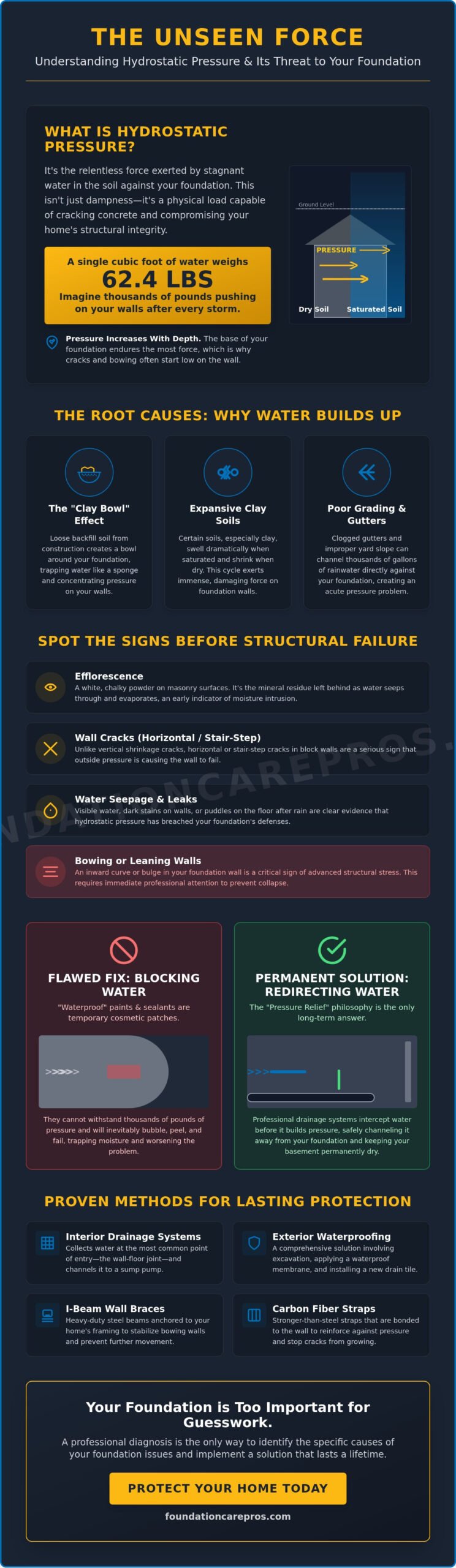
The sheer mass of water is the primary driver of this destruction. A single cubic foot of water weighs approximately 62.4 pounds. When heavy rain or snowmelt saturates the ground around your home, thousands of pounds of water accumulate against the buried portion of your foundation. Because water is non-compressible, it transfers its entire weight directly into any surface it touches. The deeper your basement, the more dangerous this becomes. Pressure increases linearly with depth, meaning the base of your foundation wall withstands far more force than the top. This explains why most structural issues, such as horizontal cracking or inward bowing, typically manifest in the bottom third of the wall.
The Physics of Fluid Dynamics in Soil
Saturated soil doesn’t behave like a solid. It follows Pascal’s Law, which states that pressure applied to a confined fluid is transmitted undiminished in every direction. When water fills the microscopic voids between soil particles in your backfill, it creates a unified front of force. This turns the earth surrounding your home into a heavy, semi-liquid slurry. There’s a critical difference between static moisture, which simply makes a wall damp, and active hydrostatic pressure. Active pressure acts like a hydraulic ram, relentlessly pushing against the foundation until the material reaches its breaking point.
Why Gravity Is Your Foundation’s Biggest Rival
Gravity ensures that water always seeks the lowest possible point in your landscape. For most homes, that point is the excavated area surrounding your basement or crawl space. Gravity pulls water downward, creating vertical pressure on your footings, but it also forces water to push outward, creating lateral pressure against your walls. These two forces work in tandem to displace masonry and widen existing hairline fractures. Hydrostatic pressure is the force of gravity acting through water against a structure.
The Root Causes: Why Water Pressure Builds Around Your Home
Most foundation issues don’t start with the concrete itself; they begin with the soil. When a home is constructed, builders excavate a hole significantly larger than the planned footprint. Once the foundation walls are set, the remaining gap is filled with loose “backfill” soil. This creates what professionals call the “Clay Bowl Effect.” Because this backfill earth is less dense than the undisturbed, virgin soil surrounding it, it acts like a giant sponge. During heavy rain, water naturally flows into this porous zone and gets trapped against your foundation. This is a primary reason Why Water Pressure Builds so aggressively against residential structures.
It’s vital to distinguish between surface water and groundwater. Surface water comes from rain or snowmelt, while groundwater is the existing water level in the earth. If the water table rises due to seasonal changes or local geography, it exerts upward force against your basement slab. This vertical hydrostatic pressure can cause floor cracks and even lift the entire floor. Whether the water is coming from above or below, the result is a relentless hydraulic load that masonry was never designed to withstand on its own.
The Impact of Expansive Clay Soils
Soil composition plays a decisive role in structural health. Clay particles are microscopic and plate-like, allowing them to absorb massive amounts of water at a molecular level. As they saturate, they increase in volume and expand outward. This creates a “Push-Pull” cycle: the soil expands and crushes against the walls in the spring, then shrinks and pulls away during dry summer months. This constant oscillation weakens foundation mortar and creates small gaps. Sandy soils, by contrast, allow water to pass through quickly, making them far less prone to creating dangerous pressure spikes.
External Factors: Gutters, Downspouts, and Grading
Your roof is a massive water collection system. In fact, just one inch of rain on a standard 1,600-square-foot roof produces nearly 1,000 gallons of water. If your gutters are clogged or your downspouts dump water within five feet of your house, you’re saturating the “clay bowl” intentionally. Improper grading that slopes toward the foundation further complicates the issue. While surface-level fixes like cleaning gutters are necessary, they won’t stop deep-earth pressure once the soil is fully saturated. If you notice persistent dampness, a professional foundation assessment can help determine if these external factors have already caused underlying damage.
Signs of Hydrostatic Damage: From Seepage to Structural Failure
Recognizing the early indicators of structural distress allows you to intervene before a full-scale failure occurs. One of the most common visual cues is efflorescence. This white, powdery mineral deposit appears on basement walls as water evaporates, leaving behind salts from the masonry. While often mistaken for mold, efflorescence is a clear diagnostic sign that hydrostatic pressure is forcing moisture through the pores of your concrete. If left unaddressed, this seepage eventually degrades the binder in the mortar, weakening the wall’s internal composition.
Upward pressure from a rising water table also targets the weakest point of your foundation: the basement slab. Most residential floors are only three to four inches thick and lack the reinforcement found in vertical walls. When groundwater pushes upward, it causes floor heaving. You’ll notice this as large, irregular cracks in the floor or sections of the slab that feel uneven. This vertical force is just as destructive as lateral pressure and often requires a dedicated drainage solution to manage the water table beneath the home.
Identifying Different Types of Foundation Cracks
Cracks are the primary way a foundation communicates stress, but their orientation reveals the specific cause. Vertical cracks typically suggest minor soil settlement or natural concrete shrinkage. However, horizontal cracks are the “smoking gun” for lateral force. These usually form in the middle third of the wall where the bending stress is highest. In block foundations, you may see a “stair-step” pattern where the crack follows the mortar joints. For a deeper look at these symptoms, review our types of foundation cracks and what they mean to determine your specific risk level.
The Progression of Wall Failure
Wall failure doesn’t happen overnight; it moves through predictable stages of degradation. In Stage 1, the wall may experience subtle inward movement at the top or bottom, often too slight to see without a level. Stage 2 involves visible mid-wall bulging and shear stress, where the pressure has exceeded the wall’s load capacity. By Stage 3, the structure is in imminent danger of collapse. At this point, the masonry has lost its integrity and requires heavy-duty intervention. We utilize I-Beam Wall Braces or Carbon fiber straps to catch the wall in these early stages, providing the permanent stabilization needed to counteract hydrostatic pressure indefinitely.
How to Relieve and Manage Hydrostatic Pressure Permanently
Stopping water-driven structural damage requires a shift in strategy. You cannot simply block out the force of nature; you must redirect it. Many homeowners attempt to seal cracks with hydraulic cement or apply “waterproofing” paints to the interior. These methods fail because they don’t address the hydrostatic pressure building up on the outside. The only permanent solution is to give the water a path of least resistance, guiding it away from your foundation before it can exert force against the masonry.
Professional water management relies on the “Pressure Relief” philosophy. By installing systems that capture water at the point of entry, we neutralize the hydraulic engine that causes walls to bow and floors to heave. This approach transitions your basement from a sealed box under attack to a managed environment where water is efficiently identified and removed.
Interior Basement Drainage Systems
For existing homes, interior basement drainage systems are the gold standard for long-term protection. This system involves a sub-floor perimeter drain that intercepts water at the “cove joint,” which is the seam where the wall meets the floor. If you have a block foundation, we drill “weep holes” into the bottom course of the blocks. This allows water trapped inside the hollow cores to drain into the system, instantly relieving the internal pressure that leads to mortar degradation and structural instability.
Sump Pump Installation and Redundancy
The sump pump acts as the heart of any dry basement. It collects the water from your drainage system and pumps it safely away from your home. Relying on a single, standard pump is a risk during severe weather or power outages. We recommend a sump pump with battery backup installation to ensure your home remains protected even when the grid goes down. Proper discharge is equally critical; water must be moved far enough away to prevent it from cycling back into the loose soil surrounding your foundation.
Structural Stabilization: I-Beams and Wall Anchors
When hydrostatic pressure has already caused visible bowing or cracking, drainage alone is not enough. The wall’s structural integrity must be restored. We utilize I-Beam wall braces to provide rigid support against lateral force. For early-stage damage, low-profile carbon fiber straps can be bonded to the wall to prevent further movement. If the wall has shifted significantly, foundation wall anchors can be used to pull the structure back toward its original position. To ensure your home is stabilized correctly, contact our structural specialists for a detailed diagnostic assessment.
Why Professional Diagnosis Is the Only Safe Solution
Addressing a compromised foundation requires more than a visual inspection. Because hydrostatic pressure is an invisible force, its true impact often remains hidden behind finished walls or beneath the soil line. Homeowners frequently mistake structural water damage for simple humidity, leading to delayed repairs and increased costs. A professional diagnostic assessment identifies the root cause of the moisture rather than just treating the visible symptoms. This methodical approach ensures that the chosen solution, whether it involves drainage or structural reinforcement, is engineered for the specific conditions of your property.
Attempting to diagnose these issues without technical equipment can lead to dangerous oversights. A structural specialist utilizes laser levels, moisture meters, and soil analysis to map out the pressure zones around your home. This data is critical because water pressure can sometimes mask underlying soil settlement issues. Without a professional’s perspective, you might treat a water problem while a sinking footing continues to destabilize your home. Investing in professional basement waterproofing protects your home equity by providing a validated, permanent record of structural integrity.
The Problem with Surface-Level Sealants
Surface-level sealants are often the first thing homeowners reach for, but they’re a temporary mask for a deep-seated problem. Many “waterproofing” paints are rated for low pressure and inevitably peel within 12 months when subjected to active groundwater. Worse, these coatings trap water inside the concrete. Concrete is naturally porous; when you seal the interior face, hydrostatic pressure continues to force water into the wall’s core. This leads to rebar corrosion. As the steel reinforcement rusts, it expands and causes the concrete to flake or “spall” from the inside out. Think of a sealed basement without drainage as a pressure vessel. It’s essentially a tank waiting to burst because the energy has nowhere to go.
The Foundation Care Pros Approach
Our approach centers on accuracy and long-term security. We don’t believe in one-size-fits-all fixes. Every home sits on a unique combination of soil types and topography, requiring a customized pressure-management plan. Our diagnostic process begins with a comprehensive exterior and interior evaluation to determine exactly where the hydraulic load is highest. We then implement engineered solutions, such as Interior Basement Drainage Systems or I-Beam Wall Braces, that provide a permanent path for water and rigid support for the masonry. This disciplined methodology offers the peace of mind that comes from knowing your home is protected by a solution designed to last as long as the foundation itself.
Secure Your Foundation Against Hydraulic Force
Protecting your home requires a transition from reactive repairs to engineered prevention. We’ve established that hydrostatic pressure is a constant physical load that exploits every weakness in your masonry. Relying on interior sealants or ignoring hairline cracks only allows the weight of saturated soil to compromise your home’s structural integrity. By implementing a managed drainage system and reinforcing walls with I-beam wall braces, you neutralize the threat and ensure long-term stability.
As a member of the Supportworks Network established in 2004, we specialize in permanent solutions like helical piers and I-beam wall braces. Our diagnostic process removes the guesswork, identifying the specific hydraulic conditions affecting your property. Don’t wait for a structural emergency to address these invisible forces. You can restore your peace of mind and protect your property’s value with a validated management plan. We provide the technical expertise needed to stop water-driven failure for good.
Protect your home from hydrostatic damage—schedule your professional inspection today.
Frequently Asked Questions
Can hydrostatic pressure cause a foundation to collapse?
Yes, extreme pressure can lead to total structural failure if left unaddressed. When the lateral force of saturated soil exceeds the load-bearing capacity of your masonry, walls begin to bow inward and will eventually buckle. This is a progressive issue that typically starts with horizontal cracking and advances toward imminent collapse as the structural integrity of the concrete degrades.
How do I know if the water in my basement is from hydrostatic pressure?
Look for water entering at the cove joint, which is the seam where your floor and wall meet. If you see water bubbling up through floor cracks or notice white, powdery efflorescence on the walls, you are likely dealing with hydrostatic pressure. These signs indicate that external weight is physically forcing liquid water through the pores or joints of your foundation.
Will a dehumidifier stop hydrostatic pressure issues?
A dehumidifier only removes moisture from the air; it does nothing to stop the physical force of water pushing against your foundation. While it can help prevent mold by reducing humidity, it won’t prevent walls from bowing or cracks from widening. You must address the liquid water outside the wall to protect the structure from hydraulic force.
Is hydrostatic pressure covered by standard homeowners insurance?
Most standard homeowners insurance policies do not cover damage caused by groundwater or seepage. Insurance typically covers sudden, accidental events like a burst pipe rather than the gradual accumulation of water pressure against a foundation. It’s best to check your specific policy for sump pump failure or flood insurance riders to see if you have additional coverage.
What is the best way to relieve water pressure behind a retaining wall?
Installing weep holes and using a gravel backfill is the most effective way to relieve pressure behind a retaining wall. These features allow water to escape the soil rather than building up behind the structure. Without these drainage paths, the weight of the water will eventually exceed the wall’s design limits and cause it to fail.
How much does it cost to fix hydrostatic pressure damage?
Repair costs vary significantly based on the severity of the damage and the required solution. National averages for foundation repair in 2026 typically range between $5,100 and $11,950, though major structural underpinning or extensive wall stabilization can exceed these figures. A professional assessment is necessary to provide an accurate scope of work for your specific property.
Can I install an interior drainage system myself?
Installing an interior drainage system is a complex structural project that is not suitable for a DIY approach. It requires jackhammering the perimeter of your basement floor, maintaining a precise pitch for water flow, and professional sump pump integration. Errors in this process can lead to foundation undermining or recurring floods that cause even more damage.
Does grading my yard really help with basement water pressure?
Proper grading is a vital first step because it reduces the volume of surface water that reaches your foundation. Ensuring the ground falls a minimum of 6 inches within the first 10 feet of your home helps keep the backfill soil from saturating. While grading manages surface runoff, it won’t stop hydrostatic pressure caused by a rising water table beneath your floor.