
Did you know that 72% of U.S. homes are built on concrete slab foundations that are inherently prone to cracking? Soil shrinkage and swelling drive 52% of these issues annually, often leaving homeowners wondering if a new gap is a minor flaw or a major catastrophe. Understanding the types of foundation cracks and what they mean is the first step in protecting your largest investment from structural failure. It’s natural to feel anxious when you spot a zig-zag line in your masonry or a horizontal split in the basement. You want to avoid technical jargon and high repair costs while ensuring your home remains a stable asset.
This diagnostic guide provides the clarity you need to identify which cracks are cosmetic and which signal a structural emergency requiring immediate stabilization. You’ll learn how to interpret crack direction and width as vital signs of your home’s health. We’ll break down the physics of wall movement and provide a clear roadmap for professional assessment and evidence-based resolution. This methodical approach replaces fear with facts, giving you peace of mind about your property’s long-term security and structural integrity.
Key Takeaways
- Distinguish between minor settlement and active structural movement to prioritize your property’s safety.
- Master the types of foundation cracks and what they mean to determine if a fissure is a cosmetic flaw or an emergency requiring immediate stabilization.
- Apply the “1/4 inch rule” and placement checks to identify high-priority damage near windows, doors, and corners.
- Understand how environmental factors like hydrostatic pressure and expansive soils compromise the integrity of your foundation walls.
- Identify permanent engineering solutions such as I-Beam wall braces and foundation pier systems to halt bowing and movement.
Understanding Foundation Cracks: A Homeowner’s Diagnostic Overview
Foundation cracks are the visible language of a home reacting to environmental stress. While a new gap in your basement wall can be startling, it doesn’t always signal an immediate structural failure. Most cracks result from the natural curing of materials or minor shifts in the earth. However, distinguishing between a harmless blemish and a sign of impending instability is critical for every homeowner. By learning the different types of foundation cracks and what they mean, you can move from a state of uncertainty to one of informed action.
We use a “Watch vs. Worry” philosophy to guide the diagnostic process. A cosmetic crack, such as a thin hairline fracture in a concrete slab, typically requires simple observation. A structural crack, conversely, indicates that the foundation’s load-bearing capacity is being compromised. Identifying these signs early is the only way to prevent minor movement from escalating into a costly emergency. Our goal is to verify the root cause of the movement and determine if the integrity of the structure is at risk.
The Physics of Foundation Stress
Concrete and masonry are engineered to withstand immense compression forces. They excel at supporting the vertical weight of your home. These materials are inherently weak in tension, meaning they pull apart easily when subjected to lateral or uneven pressure. When the soil beneath or around your home shifts, it creates stress points that exceed the material’s internal strength. This often occurs due to Structural Settlement, where the ground can no longer support the weight of the building. Soil pressure, whether from water-saturated earth or expanding clay, dictates the specific patterns these cracks take and reveals where the foundation is struggling to maintain its shape.
Active vs. Dormant Cracks
Dormant cracks are those that have reached a state of equilibrium and stopped moving. These are common in older homes that have finished their initial settling phase. You can monitor a crack for changes over a 6-month period by marking the ends with a pencil or using a crack gauge to track width across seasonal weather cycles. If the crack remains unchanged through heavy rains and dry spells, it’s likely dormant and may only require a professional seal to prevent moisture intrusion. An active crack is one that expands or lengthens over time. Active movement signals that the forces acting on your foundation are unresolved and require professional stabilization to prevent further damage.
Categorizing the 5 Most Common Types of Foundation Cracks
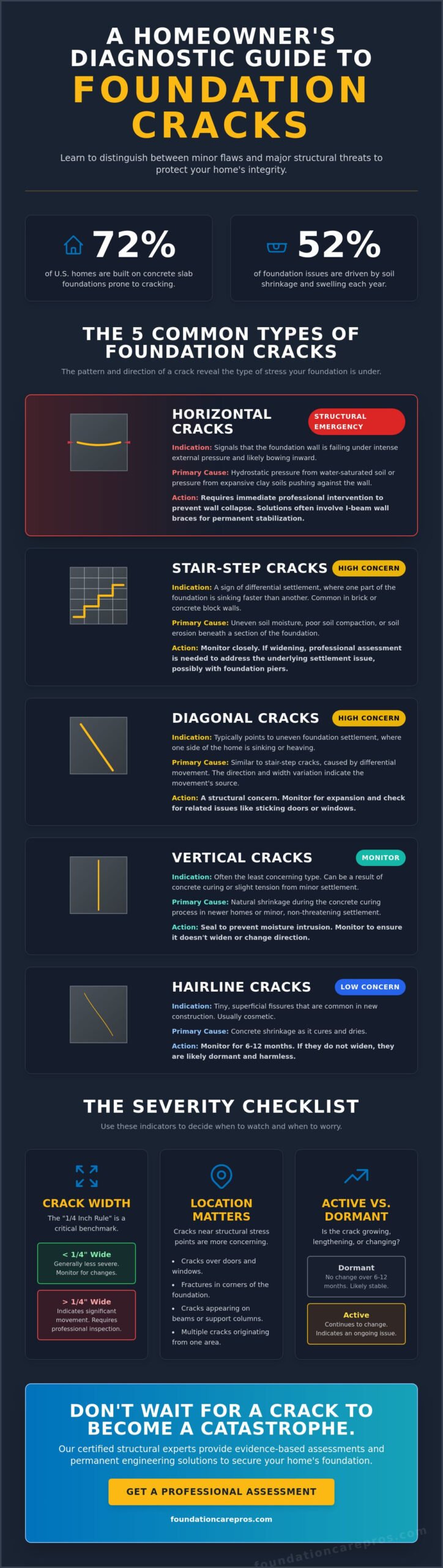
Identifying the orientation of a crack is the most effective way to diagnose the health of your home. Each pattern acts as a signature of the specific stress acting on the concrete or masonry. Understanding these types of foundation cracks and what they mean allows you to distinguish between a natural settling process and a failing wall. Professional diagnostics categorize these movements into five primary patterns: vertical, horizontal, stair-step, diagonal, and hairline.
- Vertical Cracks: These usually appear during the initial curing of concrete or early-stage settlement. They are often the least concerning, though they can allow moisture intrusion if not properly sealed.
- Diagonal Cracks: Fractures that run at a 30 to 75-degree angle often indicate that the foundation is heaving or sinking at one end. These are frequently wider at the top or bottom, showing where the structural movement is most aggressive.
- Hairline Cracks: Common in new construction, these tiny fissures are typically cosmetic results of concrete shrinkage. They require monitoring over a six-month period to ensure they don’t widen into structural threats.
Horizontal Cracks and Wall Bowing
Horizontal cracks signal a critical structural emergency that requires immediate intervention. These lines usually appear mid-height on a basement wall and indicate that the structure is buckling under intense lateral pressure. This movement is frequently caused by hydrostatic pressure, where water-saturated soil pushes against the foundation like a hydraulic jack. If you notice a horizontal split, the wall is likely beginning to bow inward. Addressing this severity level often requires i-beam wall braces installation to halt the inward movement and provide permanent stabilization.
Stair-step Patterns in Masonry
Stair-step cracks are specific to foundations built with brick or concrete blocks. These cracks follow the path of least resistance, zigzagging through the mortar joints rather than breaking through the blocks themselves. This pattern is a definitive sign of differential settlement, indicating that one corner or section of the house is dropping faster than the rest. Homeowners often make the mistake of patching the mortar with new cement. This is a temporary fix that masks the structural issue while the house continues to shift. A professional evaluation can determine if your home requires specialized foundation pier systems to transfer the weight of the structure to stable soil and prevent further sinking.
The Severity Checklist: When to Watch and When to Worry
Diagnostic evaluation requires more than just identifying a shape. You must assess the specific dimensions and location of the fissure to determine the level of risk. While the previous sections categorized the types of foundation cracks and what they mean, this checklist provides a standardized method for homeowners to measure severity. Accurate measurement is the difference between a simple cosmetic patch and an essential structural stabilization. We prioritize three primary factors: width, placement, and secondary symptoms.
The “1/4 inch rule” serves as the industry threshold for professional intervention. Research indicates that approximately 30% of foundation cracks wider than 1/4 inch are indicative of significant structural problems. If you can fit the edge of a credit card into the gap, it has surpassed the cosmetic stage. Placement also dictates urgency. Cracks that originate at the corners of windows and doors, or those that wrap around a corner of the foundation, suggest that the building’s frame is twisting or dropping. These are high-priority indicators of active movement.
The Measurement Scorecard
- Under 1/16 inch: These are hairline or cosmetic fissures. Document the location and monitor for changes over a six-month period.
- 1/16 to 1/8 inch: These mid-range cracks require close monitoring. Check for water seepage during heavy rains and verify if the crack extends through the entire wall.
- 1/4 inch or wider: This is a structural red flag. Call for a professional assessment immediately to prevent further displacement.
Symptoms Beyond the Crack
Foundation issues rarely stay confined to the basement or crawl space. We utilize a “Global House” perspective to verify if the structural integrity of the upper floors is compromised. Structural movement often manifests in the living areas through sticking doors or windows that no longer slide easily in their tracks. Sloping floors or large gaps between the baseboard and the floor indicate that the joists are no longer level. You should also inspect for “nail pops” in the ceiling or cracks in the drywall above door frames. One of the most critical warning signs is a chimney pulling away from the exterior siding. This separation confirms that the foundation is sinking or tilting at the perimeter, requiring immediate stabilization with foundation pier systems.
Water infiltration is the final priority on the checklist. A crack that leaks is always a priority, regardless of its width or direction. Constant moisture weakens the surrounding concrete and accelerates the deterioration of the steel reinforcement inside. If you detect dampness, efflorescence, or active trickling, the priority shifts from observation to moisture management and structural reinforcement.
Identifying the Root Causes Behind Structural Movement
Identifying the types of foundation cracks and what they mean is the first step in a professional diagnostic process. You must look beyond the surface of the concrete to examine the environmental forces acting on your home. Most structural movement isn’t a failure of the building material itself but a reaction to intense soil and water pressure. Understanding these root causes allows you to address the source of the problem rather than just patching the symptoms.
Hydrostatic pressure is the force exerted by a fluid at rest due to the force of gravity. When heavy rain or snowmelt saturates the ground, the weight of that water creates a massive lateral force. This pressure pushes against foundation walls with enough strength to cause bowing and horizontal cracking. Expansive soils, particularly those with high clay content, produce a “sponge effect” that changes with the seasons. These soils swell significantly when they absorb moisture and shrink as they dry out, creating a shifting base that forces the foundation to move.
Foundation settlement occurs when the soil beneath the footing can no longer support the structure’s weight. This happens when the load of the building exceeds the bearing capacity of the earth, often leading to the diagonal or stair-step patterns discussed earlier. Frost heave is another vertical force, occurring when water in the soil freezes and expands, lifting the foundation upward from below. If you suspect that soil movement is compromising your home’s stability, expert verification is the only way to ensure safety. Schedule a professional structural diagnostic to determine the best path for stabilization.
The Role of Moisture and Drainage
Clogged gutters or poor grading concentrate water at the foundation line, which accelerates structural damage. This creates the “clay bowl effect” in new construction. During the building process, the area around the foundation is dug out and then filled with looser backfill soil. This backfill is more porous than the surrounding undisturbed earth, causing it to act like a basin that holds water directly against your basement walls. This concentrated moisture increases hydrostatic pressure and softens the soil supporting your footings.
Soil Consolidation and Voids
Decomposing organic matter or poorly compacted fill dirt creates voids beneath the slab. These empty spaces lead to “point loads,” where the weight of the house is concentrated on specific, unsupported areas rather than being distributed evenly. The foundation eventually cracks as it sinks into these gaps. Tree roots often exacerbate soil shrinkage during droughts by extracting deep-level moisture. This causes the ground to settle and pull away from the footing, leaving the foundation without the lateral or vertical support it requires to stay level.
Professional Stabilization: Engineering a Permanent Solution
Engineering a permanent resolution requires moving beyond visual identification to active structural reinforcement. Once you understand the types of foundation cracks and what they mean, you can select a specialized system designed to counter the specific environmental forces acting on your home. We utilize heavy-duty, galvanized steel systems to ensure long-term stability and permanence. These solutions don’t just hide the damage; they address the underlying soil mechanics that caused the failure in the first place.
Foundation Pier Systems are the standard for addressing structural settlement. These systems utilize helical or push piers to bypass unstable, shifting soil and transfer the weight of your home to competent load-bearing strata or bedrock. For walls that have begun to buckle under the hydrostatic pressure described earlier, wall stabilization is the priority. We implement I-Beam wall braces or carbon fiber straps to halt inward bowing and provide a rigid support structure. These systems are designed to withstand lateral forces that concrete alone cannot manage.
Moisture management is the final component of a comprehensive structural plan. Preventing future cracks requires controlling the water that drives soil pressure. Interior Basement Drainage Systems combined with Sump Pump Installation create a controlled environment that directs water away from the foundation. This proactive approach ensures that the soil around your home remains stable, protecting your investment from the recurring cycles of expansion and contraction that lead to structural fatigue.
Stabilization vs. Cosmetic Patching
Epoxy injection and surface mortar are common DIY fixes, but they fail if the foundation is still moving. A cosmetic patch has no structural strength. It will simply crack again as the wall continues to shift or bow. Structural reinforcement restores the integrity of the building and protects your home’s market value. Professional stabilization often includes transferable warranties, which are essential assets during future home sales. Buyers and inspectors look for validated, engineered solutions rather than temporary cover-ups when evaluating a property’s safety. If you are planning to list your property, understanding the full strategy for selling a house with foundation issues can help you protect your equity and navigate disclosure requirements with confidence.
Choosing the Right Structural System
Selecting the correct hardware depends on the direction and severity of the movement. Helical Piers are the preferred choice for sinking foundations, as they can be screwed deep into the earth to provide vertical lift and support. I-Beam wall braces are the most effective solution for bowed walls, providing a mechanical counter-force against saturated soil. Every home requires a unique diagnostic approach to ensure the repair matches the physics of the movement. Before any work begins, understanding the foundation repair process step by step helps you set accurate expectations for the project timeline and verification requirements. Schedule a professional structural assessment to identify the right solution for your home and secure your foundation’s future.
Securing Your Home’s Structural Future
Protecting your property starts with a clear understanding of the types of foundation cracks and what they mean for your home’s safety. You’ve learned that crack width and direction act as diagnostic vital signs; they distinguish between minor settlement and a structural emergency. Engineered solutions like galvanized steel stabilization systems provide the permanence that cosmetic patches cannot offer. Addressing root causes ensures your foundation remains stable through every season.
We are locally owned and operated structural specialists who focus on evidence-based diagnostics to restore your peace of mind. Don’t let uncertainty regarding your home’s integrity lead to more expensive repairs later. Proactive intervention is the most cost-effective way to preserve your property value. Take the first step toward a permanent solution today.
Get a Professional Foundation Inspection and Stabilization Plan
Your home is your most significant investment. With a professional assessment and a methodical approach to repair, you’ll ensure it remains a safe and stable environment for years to come.
Frequently Asked Questions
Is a horizontal foundation crack serious?
Yes, a horizontal foundation crack is a critical structural emergency that requires immediate professional attention. These fissures typically signal that your foundation walls are buckling under intense lateral pressure from the surrounding soil. This type of movement often leads to total wall failure if not stabilized with I-Beam wall braces or specialized anchors. Unlike vertical cracks, horizontal lines indicate that the wall’s load-bearing capacity is actively compromised and at risk of collapse.
Can I fix foundation cracks myself with epoxy?
You can only use epoxy injection for non-structural, dormant cracks that have completely stopped moving. If the crack is caused by active settlement or hydrostatic pressure, an epoxy seal will eventually fail and pull away from the concrete. Professional stabilization must address the root cause of the movement before any cosmetic sealing is performed. Applying a surface-level patch to a structural issue only masks the damage while the foundation continues to shift beneath the surface.
How much does it cost to repair a structural foundation crack?
The cost of repairing a structural crack depends entirely on the stabilization method required and the severity of the movement. Minor issues might only need reinforcement straps, while significant settlement often requires a comprehensive piering system to transfer the load to stable soil. You should consult a structural specialist for a detailed diagnostic assessment. This evaluation determines the specific engineering requirements for your property’s unique soil conditions and structural needs without relying on surface-level estimates.
What happens if I ignore foundation cracks?
Ignoring foundation cracks allows minor issues to escalate into catastrophic structural failures that are far more expensive to resolve. Small hairline gaps can widen over time, leading to bowed walls, sinking floors, and significant water intrusion in your basement or crawl space. These problems decrease your home’s market value and make it difficult to pass a professional property inspection during a sale. Early intervention is always more cost-effective than waiting for the building’s frame to experience permanent displacement.
Do all new homes have foundation cracks?
Many new homes develop minor hairline cracks as the concrete cures and the structure undergoes its initial settlement phase. These are often cosmetic results of materials drying out and the earth adjusting to the weight of the new building. However, you should still document these fissures and monitor them for any changes in width or length. Understanding the types of foundation cracks and what they mean helps new homeowners distinguish between normal curing and actual structural defects that require stabilization.
How do I know if my foundation crack is active?
An active crack is one that continues to expand, lengthen, or change shape over a period of several months. You can track this movement by marking the ends of the crack with a pencil or using a specialized crack monitor to record changes across different seasons. If the gap widens during heavy rains or dry spells, the forces acting on your foundation are unresolved. Active movement indicates that the soil is still shifting and requires professional intervention to prevent further damage.
Does homeowners insurance cover foundation crack repair?
Homeowners insurance typically does not cover foundation repairs caused by natural soil settlement, earth movement, or poor drainage. Most policies exclude damage resulting from wear and tear or environmental changes that occur over time. Coverage may only apply if the damage was caused by a sudden, covered peril like a major internal plumbing failure or a specific accidental event. You should review your individual policy details with your insurance provider to verify your specific coverage limitations and exclusions.
Can foundation cracks lead to mold growth?
Yes, foundation cracks often act as pathways for moisture and water vapor to enter your basement or crawl space. This increased humidity creates the ideal environment for mold and mildew to flourish on organic materials like wood joists and drywall. Managing the structural integrity of your foundation is a critical step in maintaining healthy indoor air quality. Implementing interior drainage systems and sump pumps can help manage this moisture and prevent mold from taking hold in your home’s lower levels.