
Most homeowners hope a new crack in the basement is just the house settling, but a horizontal line across your foundation is actually a sign that your home is losing a fight against the earth itself. You may find yourself wondering, is a horizontal foundation crack serious? The answer is almost always a definitive yes. You likely feel a sense of dread when you spot a long, level fracture in your concrete blocks or poured walls. You’re right to be concerned about the safety of your family and the potential for high repair costs.
This guide will help you identify why these cracks are structural emergencies. You’ll learn how to diagnose the pressure behind them before a total wall collapse occurs. We will examine the role of hydrostatic pressure and the professional stabilization methods, such as I-beam wall braces or carbon fiber straps, that can permanently secure your property. Understanding these signs now can prevent a catastrophic failure later.
Key Takeaways
- Learn why the answer to “is a horizontal foundation crack serious” is almost always yes, as these fractures indicate a critical loss of structural integrity.
- Identify hydrostatic pressure as the primary driver behind wall failure and understand how saturated soil exerts thousands of pounds of force against your home.
- Differentiate between natural vertical settling and dangerous lateral movement to avoid misdiagnosing a failing foundation wall.
- Use a simple checklist and common household items to measure crack width and evaluate the immediate risk of wall collapse.
- Explore engineered solutions like I-beam wall braces and carbon fiber straps that provide permanent stability instead of temporary, cosmetic surface patches.
Defining the Horizontal Foundation Crack: Is it a Structural Emergency?
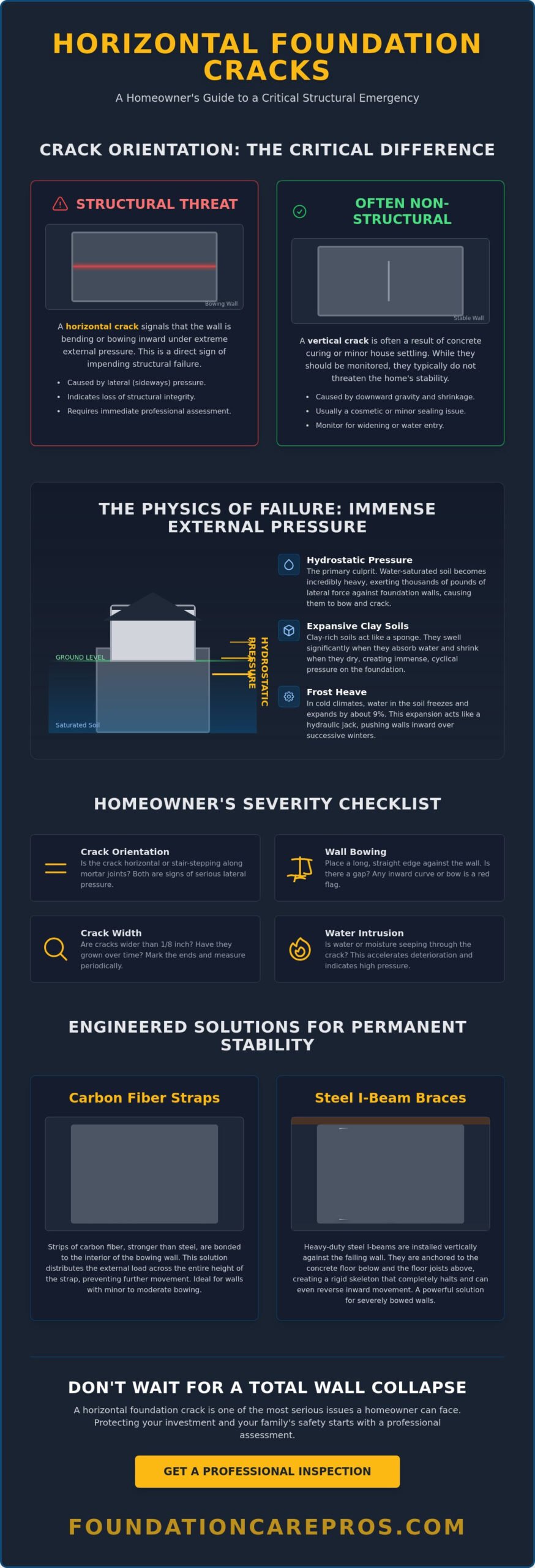
A horizontal foundation crack is a fracture that runs parallel to the basement floor or the concrete footing. Unlike small hairline cracks that might appear in a zigzag pattern through mortar joints, these long, level lines indicate that a wall is literally bending under pressure. Many homeowners find themselves asking, is a horizontal foundation crack serious? The answer is almost always yes. These cracks are almost exclusively structural in nature, meaning they directly impact the core stability of the entire building. They aren’t just cosmetic blemishes; they’re evidence of a wall in distress.
Vertical cracks often appear in new homes as concrete cures and shrinks. These are generally considered “shrinkage” cracks and rarely threaten the home’s safety if they remain thin. Horizontal cracks represent a different category of risk altogether. They signal that the foundation wall is bowing, tilting, or sliding inward. This movement is a direct indicator of a failing support system. When you see a horizontal line stretching across your foundation, it’s a sign that the wall’s ability to hold back the earth has been compromised.
Structural vs. Non-Structural Cracks
Distinguishing between different types of damage is the first step in protecting your property. Vertical cracks usually occur within the first few years of construction as the home finds its footprint. They are often narrow and don’t involve the wall moving out of its original plane. Horizontal cracks, however, indicate that the wall is no longer able to resist the weight of the earth behind it. For a complete breakdown of these differences, review our guide on types of foundation cracks and what they mean. A horizontal orientation is the primary red flag for external lateral pressure.
Why Orientation Matters in Foundation Diagnostics
The physics of a building determine where and how cracks form. Gravity pulls a house downward, which often creates vertical or diagonal fractures as the soil settles under the weight. Horizontal cracks are different because they result from force pushing against the side of the wall rather than from above. This is known as lateral earth pressure. Lateral earth pressure is the force exerted by soil and water against the exterior of a foundation wall.
When this force exceeds the wall’s design limits, the masonry or concrete begins to fail. This is a fundamental concept in structural integrity and failure, where materials snap or bend once they reach their breaking point. You’ll typically find these cracks at the mid-height of the wall or near the top. These specific locations are where the wall is most vulnerable to the weight of saturated soil pushing inward. Ignoring these signs leads to eventual wall collapse, making prompt professional diagnosis essential for the safety of your home.
The Physics of Failure: Why Horizontal Cracks Form
Horizontal cracks don’t appear by accident; they are the physical result of extreme external force. When the soil surrounding your home becomes saturated, it begins to act like a slow-motion hydraulic jack. This pressure is not a static weight. It’s a dynamic force that pushes against your foundation walls with relentless intensity. Determining if a horizontal foundation crack is serious requires understanding these physical forces, as they represent a direct threat to your home’s structural stability.
Clay-heavy soils, often called expansive soils, play a significant role in this process. These soils act like a sponge, swelling as they absorb water and exerting thousands of pounds of force against the concrete. In colder climates, frost heave adds another layer of stress. When water in the soil freezes, it expands by approximately 9 percent, creating a seasonal cycle of lateral displacement that can eventually snap a foundation wall. This combination of weight and expansion makes horizontal fractures a critical concern for any property owner.
Hydrostatic Pressure and Soil Expansion
Hydrostatic pressure is the primary culprit behind basement wall failure. As groundwater levels rise, the weight of the water-logged soil presses inward. This pressure often exceeds the load-bearing capacity of the concrete or masonry blocks. The freeze-thaw cycle compounds the issue, as the repeated expansion and contraction of frozen soil creates a “ratchet effect” that pushes the wall further inward each year. Relieving this stress often requires comprehensive basement waterproofing to manage water levels and protect the wall from structural compromise.
The Impact of Poor Grading and Drainage
The area immediately surrounding your foundation, known as the backfill zone, is particularly vulnerable to saturation. When gutters are clogged or downspouts dump water directly at the base of the home, this looser soil becomes over-saturated. Over time, the backfill soil often settles into a V-shaped depression, which directs even more surface water toward your foundation wall rather than away from it. Understanding what causes basement walls to bow begins with recognizing how these drainage failures translate directly into lateral pressure against your foundation.
- Check your gutters: Ensure they are clear of debris to prevent overflow near the foundation.
- Inspect downspouts: Verify that water is discharged at least five to ten feet away from the house.
- Monitor the perimeter: Look for pooling water or soil that slopes toward the basement walls during heavy rain.
Managing these external factors is the first step in preventing further movement. If you notice a fracture, a professional evaluation can help determine if the pressure has already caused permanent damage. Understanding that a horizontal foundation crack is serious allows you to take action before the lateral force leads to a total wall failure. Homes with crawl spaces face similar moisture-driven risks, and water in crawl space areas can accelerate the same hydrostatic pressure that compromises foundation walls.
Myth vs. Reality: Why “Normal Settling” Does Not Apply Here
A common misconception among homeowners is that all foundation cracks are a natural byproduct of a house “finding its seat.” While small vertical or diagonal lines might occur during initial settling, a horizontal fracture is never a normal part of aging. If you’re asking is a horizontal foundation crack serious, you need to recognize that these lines signify a failure in structural integrity. A house settles vertically due to gravity, but it bows horizontally due to lateral force. These two movements are entirely different engineering events that require different diagnostic approaches.
Ignoring these signs often leads to a “wait and see” approach that backfires. A dormant crack is not a safe crack. Even if the wall hasn’t moved in months, the broken bond remains a permanent weak point in your home’s defense. Delaying action only increases the risk of a sudden, catastrophic failure during a heavy rain event. Furthermore, failing to address these issues now can lead to a financial crisis later. You may eventually find yourself selling a house with foundation issues at a significant loss because the structural damage has progressed beyond simple stabilization.
Vertical vs. Horizontal: The Settling Distinction
Vertical cracks often follow mortar joints in a “stair-step” pattern. This usually happens as the soil beneath the footing shifts or compacts. While these require monitoring, they are often less urgent than a straight horizontal line. Horizontal cracks are the smoke before the fire of wall collapse. They indicate that the wall is no longer strong enough to resist the weight of the earth pushing against it. Unlike vertical settling, which may eventually reach an equilibrium, horizontal movement rarely self-stabilizes. Once the bond in the masonry is broken, the wall becomes progressively weaker with every seasonal cycle.
The Tipping Point: When Cracks Lead to Bowing Walls
Bowing often occurs long before a homeowner notices a visible curve in the wall. The horizontal crack is typically the first physical evidence of a “hinge” effect. In this scenario, the wall begins to pivot inward at the point of maximum pressure, usually near the middle or top third of the structure. This inward movement creates a structural vulnerability that compromises the entire foundation.
Stabilizing a wall that has moved less than two inches is a relatively efficient process. However, once a wall bows more than 2 inches, the repair complexity and technical requirements increase significantly. The bowing is often invisible to the naked eye until the crack appears, making the fracture itself your final warning. Addressing the issue at the first sign of a horizontal line is the most methodical way to protect your property and avoid more invasive, expensive repairs in the future.
Measuring Risk: A Homeowner’s Severity Checklist
Evaluating your basement walls requires a methodical eye and a few basic tools. When you’re trying to determine is a horizontal foundation crack serious, the level of immediate danger depends on the degree of movement. You can conduct a preliminary assessment using a simple plumb line. Hang a string with a weight attached from the top of the wall down to the floor. If the wall curves away from the string at any point, it is bowing. If the wall is sliding inward at the base, it is shearing. Both are indicators of advanced structural distress that require professional intervention.
While any horizontal fracture is a concern, the specific width of the gap helps categorize the urgency of the repair. Structural failure is often a progressive event. Catching the movement in its early stages allows for more efficient stabilization methods. If you ignore the signs, the lateral pressure will continue to push until the wall’s internal reinforcement snaps. Use the following criteria to gauge your current risk level.
The Quarter Test for Crack Width
A standard U.S. quarter is a helpful tool for a quick diagnostic check. Use the edge of the coin to measure the gap in your foundation wall.
- Hairline (Less than 1/16 inch): These are often early warning signs of pressure. While they don’t indicate immediate collapse, you should call for a professional inspection to address the underlying soil issues.
- Quarter-width (Greater than 1/8 inch): If you can fit the edge of a quarter into the crack, the wall is experiencing significant structural stress. Stabilization is required immediately to prevent the bowing from worsening.
- Wide gaps (Greater than 1/2 inch): Gaps of this size represent an emergency status. The structural integrity of the wall is severely compromised, and the risk of a total collapse is high.
Identifying Secondary Signs of Foundation Failure
Look beyond the crack itself to see how the rest of your home is reacting to the foundation movement. Structural failure rarely stays contained to a single area. Check for shearing at the bottom of the wall, which occurs when the wall slides inward over the concrete floor slab. This indicates the connection between the wall and the footing has failed completely.
You should also look for diagonal cracks at the corners of the basement. These often appear when the center of the wall bows inward, pulling the corners under extreme tension. Finally, observe the first floor of your home. If windows or doors directly above the damaged wall are suddenly difficult to operate or refuse to latch, the foundation movement is likely pulling the upper frame out of alignment. If your home shows any of these symptoms, you need a validated solution. Schedule a professional structural assessment to determine the exact degree of failure before the damage spreads further.
Engineered Solutions: How to Permanently Stabilize Your Foundation
Addressing a failing foundation wall requires more than a bucket of sealant or a weekend DIY project. Once you’ve identified the signs of lateral pressure, understanding why a horizontal foundation crack is serious helps you prioritize the right mechanical fix. These fractures represent a structural deficit that cosmetic repairs cannot overcome. Professional stabilization isn’t just about closing a gap; it’s about restoring the structural integrity of your home and protecting its long-term market value.
If you’re still asking is a horizontal foundation crack serious, consider the consequences of a surface-level patch. Many homeowners attempt to use epoxy or polyurethane injections to fill the fracture. While these materials are excellent for sealing out moisture in non-structural cracks, they offer zero resistance to soil pressure. The hydrostatic force that caused the initial break remains present. Without mechanical reinforcement, the wall will continue to move, eventually cracking the epoxy or causing a new fracture elsewhere. A permanent solution requires hardware that can counteract the thousands of pounds of force pushing against your basement.
I-Beam Braces and Carbon Fiber Reinforcement
The choice of stabilization hardware depends on the severity of the bowing. For walls that have moved significantly, I-Beam wall braces installation provides the necessary rigidity to stop further inward travel. These high-strength steel beams are anchored to the basement floor and the heavy timber floor joists above, creating a secondary skeleton for the wall. If the wall has minimal bowing but shows active cracking, carbon fiber straps offer a low-profile alternative. These straps are bonded directly to the concrete with high-strength epoxy. They are ten times stronger than steel in tension, preventing the wall from expanding or stretching further. Both solutions provide a permanent fix and often come with a lifetime warranty.
Foundation Piering and Wall Anchors
Other mechanical solutions utilize the stable soil deep in your yard to secure the home. Foundation wall anchors consist of an interior wall plate connected by a steel rod to an anchor plate buried in the yard. By tightening these anchors, professionals can often pull a bowing wall back toward its original position over time. If your horizontal crack is accompanied by vertical sinking, foundation pier systems, such as helical piers, may be necessary. These piers transfer the weight of the home to deeper, more stable soil strata. A professional diagnostic is the only way to determine which mechanical solution fits your home’s specific soil conditions and failure pattern. Once you choose a path, you can follow the foundation repair process to return your home to a state of unwavering stability.
Secure Your Home’s Future Stability
Identifying a structural fracture is the first step toward protecting your home’s long-term value. You now understand that the question of is a horizontal foundation crack serious carries significant weight. These fractures are physical proof that hydrostatic pressure has compromised your basement walls. Unlike minor vertical settling, these issues won’t stabilize on their own. They require professional mechanical intervention to prevent a total wall failure. Ignoring the problem only leads to higher repair costs and increased safety risks for your family.
You don’t have to face structural anxiety alone. Our team of certified structural specialists provides the methodical expertise needed to secure your property. As a Supportworks Network member, we offer validated solutions like I-beam wall braces and carbon fiber straps. These repairs are backed by lifetime transferable warranties, ensuring your foundation remains permanent and reliable. Taking action today preserves your equity and restores your peace of mind.
Schedule Your Professional Foundation Inspection Today
Frequently Asked Questions
Is a horizontal foundation crack always structural?
Yes, horizontal cracks are almost exclusively structural because they indicate the wall is yielding to lateral pressure. Unlike vertical cracks that often result from concrete shrinkage, a horizontal fracture shows that the wall is no longer able to resist the weight of the soil outside. Even a thin horizontal line is a sign that the foundation’s integrity is compromised and requires a professional diagnostic.
Can I patch a horizontal foundation crack myself with epoxy?
No, patching with epoxy is a cosmetic fix that fails to address the underlying mechanical failure. While epoxy can seal out moisture, it has no structural load-bearing capacity against lateral earth pressure. The soil will continue to push against the wall, eventually causing the patch to fail or a new crack to form. Permanent stabilization requires engineered solutions like carbon fiber straps or I-beam wall braces.
How much bowing is too much for a basement wall?
Any visible bowing is a sign of structural distress, but movement exceeding two inches typically marks a critical tipping point. If you are asking is a horizontal foundation crack serious, the presence of any inward curve confirms the wall is losing its battle against hydrostatic pressure. Early intervention is more efficient and cost-effective than waiting until the wall reaches a state of near-collapse.
Will insurance cover the repair of a horizontal foundation crack?
Standard homeowner’s insurance policies generally do not cover foundation repairs. Most providers view structural movement and soil-related issues as maintenance responsibilities rather than sudden accidents. Coverage is usually only available if the damage was caused by a specific, covered peril like a major plumbing failure. You should check your policy, but expect to pay for structural stabilization as an out-of-pocket home investment.
Do horizontal cracks only happen in cinder block foundations?
No, horizontal cracks occur in both concrete block and poured concrete foundations. In block walls, the fracture usually appears along a horizontal mortar joint near the mid-height of the wall. In poured concrete, the crack may be less uniform but indicates the same dangerous lateral displacement. Both wall types are vulnerable to the thousands of pounds of force exerted by saturated expansive soils.
What happens if I ignore a horizontal crack in my foundation?
Ignoring a horizontal fracture leads to progressive structural failure and eventual wall collapse. The pressure from the soil outside will not decrease; instead, it often intensifies during seasonal rain and freeze-thaw cycles. As the wall moves further inward, the damage will spread to the upper levels of your home, causing windows to stick and floors to slope. Prompt stabilization protects your equity and prevents catastrophic property damage.