What if the same technology used to build high-performance aircraft and spacecraft could be the very thing that secures your home against structural collapse? It’s natural to feel a sense of dread when you notice a horizontal crack or a slight inward bow in your basement wall. You’re likely concerned about the long-term stability of your foundation and the fear of losing valuable living space to bulky, invasive repair systems.
We understand that your home is your most significant investment. This guide explains how carbon fiber reinforcement offers a permanent, low-profile solution that stabilizes bowing foundation walls and stops structural cracks from advancing. We will examine the engineering that makes these aerospace-grade straps significantly stronger than steel. You’ll learn how this non-invasive method provides a lasting fix that can be painted over, restoring both your wall’s integrity and your peace of mind through a disciplined, engineered approach.
Key Takeaways
- Understand the engineering behind carbon fiber reinforcement and why its high strength-to-weight ratio makes it ideal for stabilizing residential foundations.
- Learn how to identify the specific signs of hydrostatic pressure, such as horizontal cracks, that indicate your home is a candidate for this technology.
- Compare modern carbon fiber straps against traditional I-Beam wall braces to determine which low-profile or heavy-duty solution fits your basement’s needs.
- Discover how to maintain your basement’s usable square footage and aesthetic appeal with repairs that can be easily concealed or painted.
- See why professional integration with your home’s framing is vital for ensuring the long-term success of an engineered stabilization system.
What is Carbon Fiber Reinforcement in Foundation Repair?
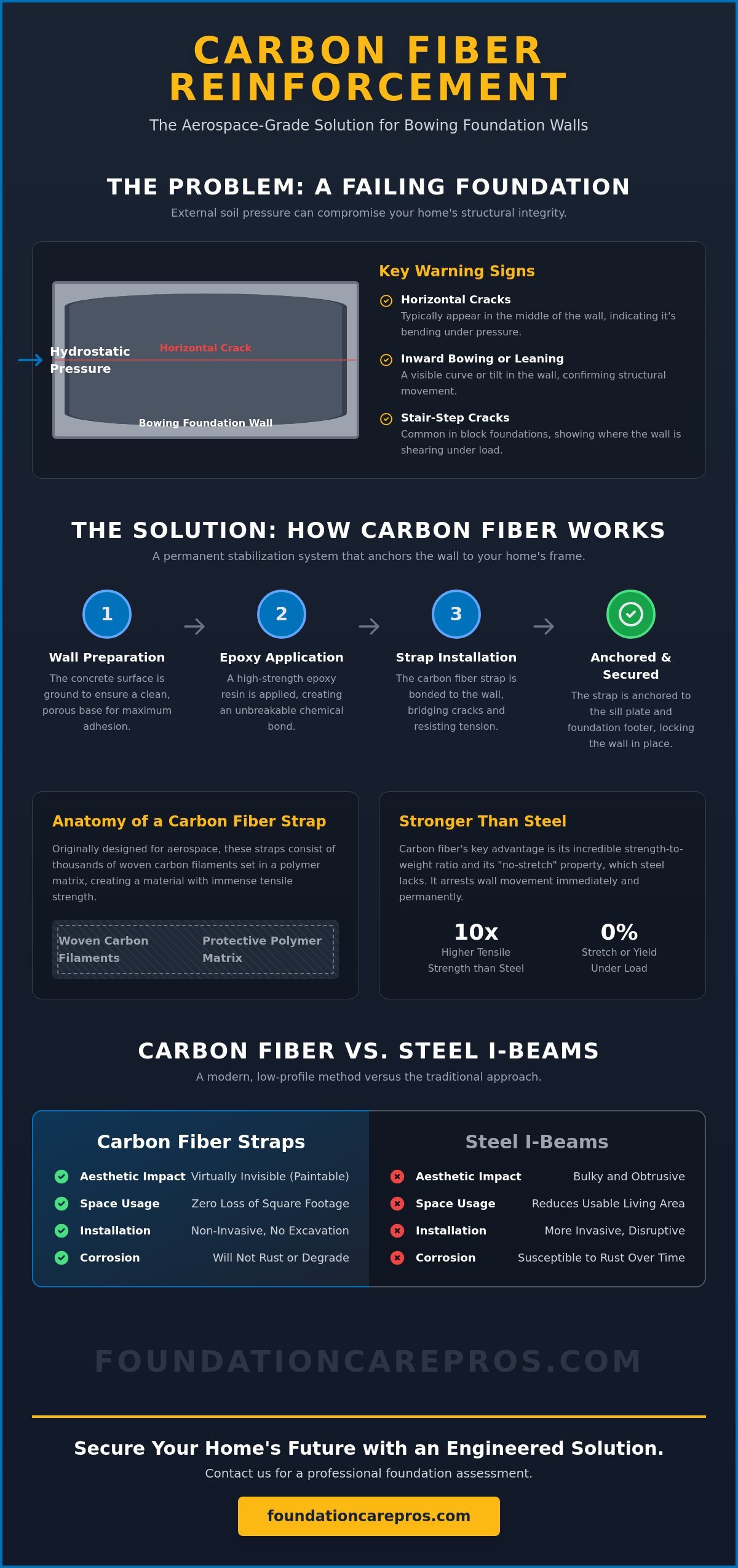
Carbon fiber reinforcement is a sophisticated composite material used to stabilize failing structures. It consists of thin, strong crystalline filaments woven into a fabric-like material. These fibers are exceptionally durable. Engineers originally developed Carbon-fiber reinforced polymer for the aerospace and military sectors. These industries required materials that were lightweight yet significantly stronger than steel. In a residential setting, we apply these fibers as reinforced straps or grids. We bond them directly to foundation walls using high-strength epoxy. This process adds immense tensile strength to masonry surfaces that are otherwise prone to cracking under external pressure.
The Anatomy of a Carbon Fiber Strap
The effectiveness of a strap depends on its specific weave pattern. This design ensures that structural loads distribute evenly across the entire surface of the wall rather than concentrating on a single point. A polymer matrix surrounds these fibers. This matrix acts as a protective shield and ensures the individual filaments work together as a single, cohesive unit. High-quality raw carbon filaments are essential for this process. If the filaments are low-grade, the entire system loses its structural integrity. We utilize materials that meet strict engineering standards to ensure the repair remains permanent.
Why Aerospace Technology is Used in Basements
Airplane wings must withstand massive uplift and turbulence without snapping or deforming. Your foundation walls face a similar challenge from the soil surrounding your home. Saturated earth exerts immense hydrostatic pressure. The application of carbon fiber reinforcement in a basement mirrors the structural logic used in modern aviation. Carbon fiber provides the necessary stiffness to arrest the bowing process immediately. It does not stretch or yield. This lack of elasticity is exactly what a failing wall needs to remain upright. Under standard residential soil pressures, these straps are virtually unbreakable. They provide a level of security and permanence that traditional materials often fail to match.
How Carbon Fiber Stabilizes Bowing Foundation Walls
Hydrostatic pressure is the primary force behind foundation failure. When soil becomes saturated with water, it expands and exerts immense lateral pressure against your basement walls. This force often exceeds the original design capacity of the masonry, causing the center of the wall to push inward. Carbon fiber reinforcement works by counteracting this pressure. We bond high-strength straps vertically to the wall, creating a permanent tension-resistant barrier. Because the material does not stretch, the wall is effectively locked in place. Once the installation is complete, the structural movement stops immediately.
The “no-stretch” property of carbon fiber is its most significant advantage over traditional materials. While steel can eventually bend under extreme loads, carbon fiber maintains its shape without yielding. This rigidity is backed by extensive research on strengthening concrete beams, which highlights how composite materials manage high-tension environments. For a repair to be successful, we must anchor the strap to the home’s structural framing. We secure the top of the strap to the rim joist and the bottom to the foundation footer. This creates a continuous load path that transfers external soil pressure into the strongest parts of the building’s structure.
The Role of High-Strength Epoxy Resin
Epoxy resin is the critical bridge between your concrete wall and the carbon fiber strap. It doesn’t just stick to the surface; it creates a deep chemical bond that integrates the two materials. Surface preparation is the most vital part of this process. We grind the wall to remove paint, dirt, and loose concrete to expose a clean, porous surface. Without this step, the epoxy cannot achieve the necessary adhesion. When the resin cures, the strap and the wall become a single, unified structural element. If you’ve noticed signs of movement, it’s wise to have an expert assess your bowing foundation walls to see if this bonding process is the right fit.
Arresting Horizontal Crack Movement
Horizontal cracks typically appear in the middle third of a foundation wall. These openings are clear indicators that the wall is bowing and losing its structural integrity. Carbon fiber reinforcement bridges these cracks, preventing them from widening during seasonal soil expansion. For smaller, localized cracks, we often use specialized carbon fiber stitches. These stitches provide a “stapling” effect that keeps the crack tightly closed. By addressing these fissures early, we prevent water infiltration and stop the structural damage from escalating into a total wall failure.
Carbon Fiber vs. Steel Beams: Evaluating Structural Options
Selecting the right structural fix involves balancing engineering requirements with the long-term use of your basement. Steel I-Beams have historically been the “brute force” standard for foundation stabilization. These systems use heavy-duty steel to physically block a wall from further movement. While powerful, they are bulky and protrude several inches into the room. Carbon fiber reinforcement represents a shift toward high-tech, low-profile engineering. It provides a permanent fix that preserves every square inch of your usable floor space. This choice often comes down to the current state of the wall and your future plans for the basement area.
When to Choose Carbon Fiber Over I-Beams
Professional diagnostics determine the best path forward. Carbon fiber is the ideal choice for walls showing early signs of failure, specifically those with less than 2 inches of inward deflection. Because it is a passive restraint system, it excels at locking a wall in its current position to prevent future deterioration. Homeowners who intend to finish their basement with drywall or paint find this method particularly attractive. According to American Concrete Institute guidelines, these fiber-reinforced polymers offer a high strength-to-weight ratio that steel cannot match in a thin profile. If your wall movement is minimal, you should explore the specific advantages of Carbon Fiber Straps vs. Steel Beams to ensure you aren’t over-engineering a solution at the cost of your living space.
Installation Speed and Home Disturbance
The experience of the repair process matters as much as the result. Carbon fiber installation is a quiet, methodical process. It doesn’t involve heavy machinery, massive steel components, or invasive floor jackhammering. Technicians focus on meticulous surface preparation and epoxy bonding. This contrasts sharply with the intensive labor required for I-Beam wall braces installation, which involves drilling into the concrete floor and bolting to overhead joists. A typical carbon fiber reinforcement project is completed in a fraction of the time, often within a single day. This efficiency minimizes the disruption to your daily life. The “clean” nature of the epoxy system also means there is less dust and debris to manage after the crew leaves, making it a preferred choice for occupied homes.
Identifying the Right Candidates for Carbon Fiber Reinforcement
Determining the suitability of your foundation for carbon fiber reinforcement requires a disciplined diagnostic approach. While this technology is incredibly powerful, it is not a universal fix for every structural failure. We look for specific patterns of distress to confirm if this is the correct engineered solution for your home. Horizontal cracks running across the middle third of the wall are the most common indicator of bowing caused by lateral pressure. Conversely, stair-step cracks near the corners often point toward foundation settlement, which typically requires a piering system instead. We also check for tipping at the top of the wall or sliding at the base. These conditions indicate shear failure and may require a combination of reinforcement methods to ensure long-term stability. For a broader look at how carbon fiber compares to other methods, our comprehensive guide to basement wall stabilization systems covers the full range of engineered solutions available to homeowners.
Measuring Wall Deflection
Professionals use a plumb line to accurately measure the degree of inward movement. This measurement is critical because it dictates the choice of repair. We generally follow the 2-inch rule. If the wall has deflected less than 2 inches, carbon fiber is the primary choice for stabilization. It arrests the movement efficiently without the need for invasive excavation. However, if the wall has moved beyond this threshold, the structural integrity is compromised to a degree where straps alone may not suffice. In these advanced cases, foundation wall anchors may be required to provide the necessary pulling force to stabilize the masonry. Understanding how do wall anchors work to use stable deep soil as a mechanical counterforce can help you evaluate whether this more aggressive intervention is the right next step for your home.
Soil and Environmental Considerations
Environmental factors play a significant role in the need for structural reinforcement. Expansive clay soils are a common culprit. These soils swell significantly when wet and shrink when dry, creating a repetitive cycle of pressure that weakens unreinforced walls over time. Frost heaving also poses a threat, as freezing ground exerts immense force against the foundation. Choosing an interior solution like carbon fiber is often more cost-effective than exterior excavation. It addresses the problem from the inside, avoiding the high costs and yard destruction associated with digging out the foundation. This method provides a clean, permanent result while shielding your home from the unpredictable nature of local soil conditions. If you see signs of wall movement, schedule a professional assessment of your foundation stabilization needs today.
Professional Installation and Long-Term Structural Benefits
Professional execution is the final step in securing your home’s structural integrity. While the materials are advanced, their success relies on precise integration into the home’s framing. We don’t just apply straps to the surface; we create a unified system that transfers load from the masonry to the foundation’s strongest points. This engineered approach ensures the carbon fiber reinforcement functions as a permanent shield against future movement. When the installation is handled by specialists, the system works as a single, cohesive unit to protect the entire building envelope.
The Supportworks Advantage
We utilize systems from the Supportworks network, which are designed and rigorously tested by structural engineers. This partnership provides access to validated solutions that exceed standard residential building codes. A critical component of this system is the specialized bracket attachment at the top and bottom of each strap. These brackets prevent the wall from “sliding” at the base or “tipping” at the top joists. When you choose a professional installation, you receive a long-term warranty that provides financial security and peace of mind. This level of validation is something a DIY kit or a general contractor simply cannot offer.
Carbon fiber is a non-reactive material. Unlike steel, it doesn’t rust, corrode, or degrade when exposed to moisture or common soil chemicals. This makes it a lifetime solution for basement environments where humidity is often present. Once the epoxy cures and the installation is complete, the straps are ready for a finishing touch. You can paint directly over the reinforced areas. This low-profile finish makes the repair nearly invisible to the naked eye, preserving the aesthetic quality of your basement without sacrificing strength.
Protecting Home Resale Value
Foundation issues are a major concern during real estate transactions. Sellers are legally required to disclose structural defects, which can derail a sale if they aren’t properly addressed. A certified repair provides documented proof of stabilization. Potential buyers often prefer this low-profile method over bulky steel beams because it doesn’t interfere with future remodeling or finishing plans. A stabilized foundation also prevents the progression of various types of foundation cracks that might otherwise signal ongoing structural neglect. Investing in a professional fix protects your equity and ensures a smoother transition when it’s time to sell. You’re not just fixing a wall; you’re protecting your home’s long-term marketability.
Secure Your Home’s Future with Aerospace-Grade Strength
Stabilizing your foundation doesn’t have to mean losing your basement space to bulky steel beams. Carbon fiber reinforcement provides a high-tech, permanent solution that arrests wall movement without the need for invasive excavation. This aerospace-grade material ensures your walls remain secure, non-corrosive, and ready for a finished look that maintains your home’s aesthetic and resale value. By choosing this low-profile method, you’re opting for a disciplined, engineered fix that addresses structural stress at its source.
Taking action early is the most effective way to prevent minor wall movement from escalating into a total structural failure. Our team brings over 20 years of structural repair expertise to every project we undertake. As a locally owned and operated specialist and a proud Supportworks Network Member, we provide the validated solutions your property deserves. Schedule a Professional Foundation Inspection with Foundation Care Pros today to verify your home’s integrity. You’ll regain your peace of mind knowing your most valuable investment is protected by a permanent, local authority who values long-term results over quick fixes.
Frequently Asked Questions
Is carbon fiber reinforcement stronger than steel?
Carbon fiber reinforcement possesses significantly higher tensile strength than steel. While steel is a ductile material that can bend under extreme pressure, carbon fiber is rigid and maintains its shape without yielding. This makes it an ideal choice for arresting the inward movement of foundation walls where maintaining structural stiffness is the priority.
How long does carbon fiber foundation repair last?
Carbon fiber repairs are designed to last for the lifetime of your home. Because the material is chemically inert, it doesn’t rust, rot, or degrade when exposed to the moisture often found in basement environments. Once the epoxy bond is fully cured, the reinforcement becomes a permanent part of the foundation’s structural framework.
Can I paint over carbon fiber straps once they are installed?
You can easily paint over the straps to match your basement walls once the installation is complete. The low-profile design sits nearly flush against the masonry, allowing for a seamless finish. This feature is particularly beneficial for homeowners who plan to finish their basement or maintain a clean, professional aesthetic in their storage areas.
How much does carbon fiber reinforcement cost for a basement?
The total investment for a project depends on the number of straps required and the length of the failing wall. Costs for carbon fiber reinforcement are generally lower than invasive methods like exterior excavation or installing heavy steel beams. A professional diagnostic assessment is the only way to determine the exact requirements for your home’s unique structural needs.
Will carbon fiber stop my basement wall from leaking?
Carbon fiber reinforcement is a structural stabilization tool, not a waterproofing solution. While it stops cracks from widening and prevents further bowing, it doesn’t seal out groundwater. If you have water infiltration issues, we typically recommend an interior basement drainage system or a sump pump installation in conjunction with the structural repair.
Can I install carbon fiber foundation straps myself?
Professional installation is required to ensure the system is correctly anchored and bonded to the wall. DIY applications often fail due to improper surface preparation or a lack of understanding of load-path engineering. Furthermore, systems like those in the Supportworks network require certified technicians to validate the warranty and ensure the repair meets local building codes.
What happens if I ignore a bowing basement wall?
Ignoring a bowing wall leads to progressive structural failure and significantly higher repair costs. Over time, hydrostatic pressure will cause the wall to deflect further, potentially leading to a total collapse of the foundation masonry. Addressing the issue early with carbon fiber reinforcement prevents catastrophic damage and protects the safety of the entire building.
Does carbon fiber reinforcement increase my home’s value?
A stabilized foundation protects your home’s equity and increases its marketability during a sale. Potential buyers are often wary of structural issues; however, a professionally installed and warrantied repair provides the necessary confidence to proceed with a transaction. Because the repair is low-profile and paintable, it doesn’t detract from the usable square footage of the basement.