
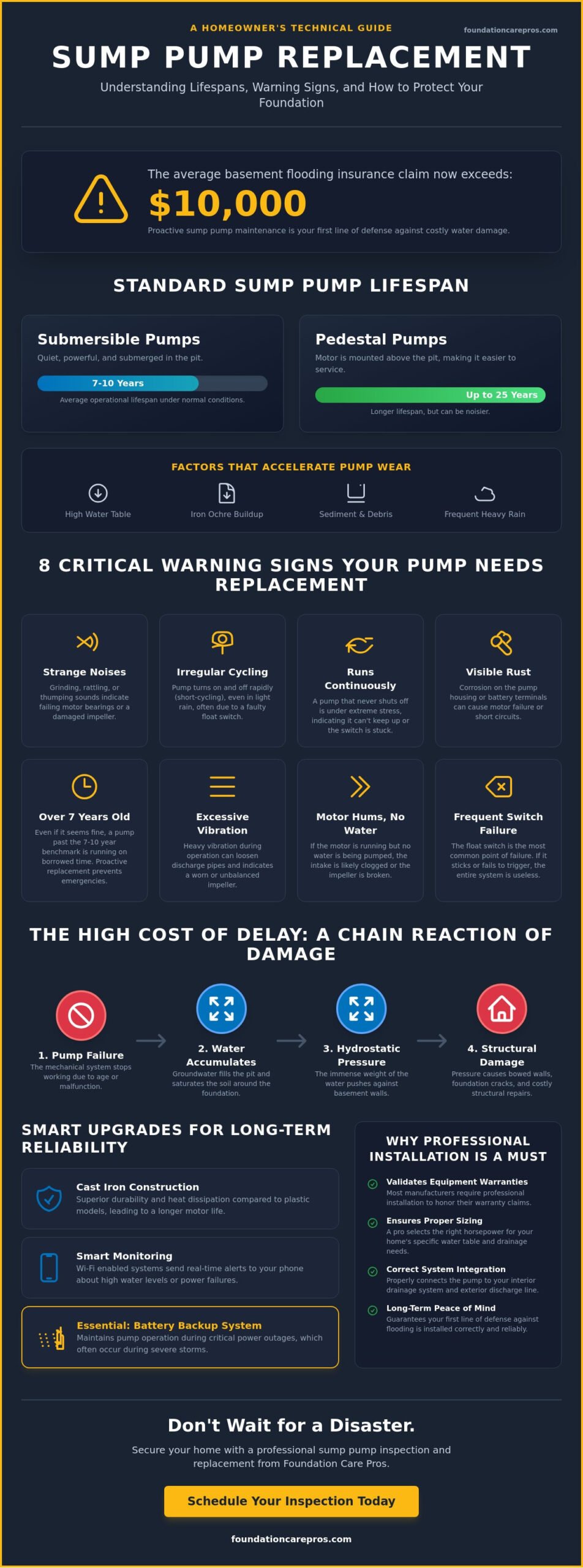
The average basement flooding insurance claim in the U.S. now exceeds $10,000 according to recent industry data. You likely find yourself checking the basement floor every time a storm intensifies, questioning if your mechanical defenses are prepared for the pressure. With new 2026 flood protection standards like the REAL rules in New Jersey, proactive maintenance is more critical than ever. Determining how often to replace sump pump systems is the first step in maintaining a secure, dry foundation.
You’ll gain a technical understanding of equipment lifespans and the specific indicators of mechanical fatigue. While submersible units generally provide seven to ten years of service, pedestal pumps can last up to twenty-five years under the right conditions. This guide delivers a methodical timeline for replacement and a diagnostic checklist to verify your pump’s performance. You’ll move forward with a clear plan to ensure your home remains protected against groundwater intrusion and structural erosion.
Key Takeaways
- Determine how often to replace sump pump systems by using the 7-10 year benchmark and local environmental factors as your primary guide.
- Identify mechanical warning signs like irregular cycling and unusual motor noises before they lead to unexpected system failure.
- Evaluate the technical advantages of cast iron construction and smart monitoring technology to ensure long-term equipment reliability.
- Secure your foundation by integrating a battery backup system to maintain drainage during critical power outages.
- Understand why professional installation is necessary to validate equipment warranties and maintain the effectiveness of your interior drainage system.
Understanding the Standard Sump Pump Lifespan: The 7-10 Year Benchmark
Most residential mechanical systems have a predictable expiration date. For a sump pump, the industry-standard lifespan sits between seven and ten years. However, this benchmark isn’t a guarantee. When homeowners ask how often to replace sump pump units, they must look beyond the manufacturer’s estimate. Your specific environmental conditions and the frequency of the pump’s “duty cycle” determine its actual survival. A pump in a high-water table area that cycles every few minutes during a storm will naturally reach mechanical exhaustion much faster than one that only runs once a month.
Mechanical fatigue is a reality for every system. If your pump operates under heavy-use conditions, it’s common to see failure in under five years. The motor windings and the float switch are moving parts that eventually degrade through friction and heat. Choosing a proactive replacement strategy is always more efficient than managing an emergency failure during a midnight storm. You’re not just buying a new appliance; you’re maintaining the system that regulates the moisture levels around your foundation.
Environmental Factors that Accelerate Pump Wear
Local soil composition plays a significant role in equipment longevity. Groundwater with high iron content often leads to iron ochre buildup. This gelatinous substance coats the intake screen and impeller, which forces the motor to work harder and run hotter. Similarly, frequent heavy rain cycles in areas with clay-heavy soil can trap water against the foundation, creating a constant demand on the system. Over time, fine sediment and debris accumulate in the pit. These particles can clog intake valves and cause the motor to burn out well before the ten-year mark.
Why “Wait and See” is a Dangerous Strategy
A failing pump isn’t just a minor mechanical inconvenience. It’s a direct threat to your home’s stability. When a pump stops, water accumulates around your footings, leading to a rapid increase in hydrostatic pressure. This force pushes against your basement walls with immense weight. If you don’t address a failing pump, this pressure can cause bowed walls or deep foundation cracks. Understanding how often to replace sump pump equipment is vital for preventing these high-stakes structural issues. A properly functioning sump pump is the first line of defense against structural settlement. Proactive replacement ensures your foundation remains stable and dry regardless of the weather.
8 Critical Warning Signs Your Sump Pump Needs Immediate Replacement
Recognizing the early symptoms of mechanical failure is the most effective way to prevent a flooded basement. While the standard 7-10 year lifespan provides a general guideline, physical red flags often dictate a more urgent timeline. If you’re evaluating how often to replace sump pump equipment, you should prioritize these specific indicators of terminal wear. Waiting for a total system collapse during a storm is a high-risk strategy that jeopardizes your foundation’s integrity.
- Strange Noises: Grinding or grating sounds typically indicate failing motor bearings. Thumping or rattling usually suggests a damaged impeller or a motor that has shifted off its axis.
- Irregular Cycling: Short-cycling occurs when the pump turns on and off too rapidly. This is often caused by a faulty float switch or an undersized pit that can’t handle the volume of water.
- Continuous Operation: A pump that never stops running is under extreme stress. This happens when the unit lacks the horsepower to keep up with the water table or the switch has become mechanically stuck.
- Visible Rust or Corrosion: Chemical degradation on the pump housing or electrical connections can lead to short circuits. This is especially common in pits with high mineral content.
- Frequent Switch Failure: The float switch is the most common point of collapse because it’s the only component that moves during every cycle. If it sticks or fails to trigger, the pump becomes useless.
If you identify these symptoms, a professional sump pump installation can restore your home’s protection before the next weather event. Proactive replacement is a disciplined approach to property maintenance that avoids the high costs of emergency structural repairs.
Mechanical Red Flags: Noises and Vibrations
Excessive vibration is a serious concern that many homeowners overlook. These vibrations can eventually loosen discharge pipe connections, leading to leaks within the basement. You should also listen for a distinct “humming” sound. A motor that hums but doesn’t move water usually has a seized impeller or a failed capacitor. These aren’t just minor repairs; they’re signs that the motor’s internal components have reached the end of their functional life.
Water Management Failures and Flooding Risks
Testing your system is a straightforward diagnostic process. You can perform a “puddle test” by slowly pouring water into the pit to verify the float switch rises and triggers the motor. During winter months, it’s vital to check for a frozen or clogged discharge line. A frozen line creates massive backpressure that can burn out a motor in minutes. If you notice stagnant water or foul odors in the pit, it’s a clear sign that the system is no longer clearing groundwater effectively. Understanding how often to replace sump pump units means acting on these water management failures immediately.
Evaluating Replacement Options: Capacity, Material, and Smart Technology
Selecting the right hardware is just as important as knowing how often to replace sump pump units. Material choice directly impacts the system’s thermal management and total service life. Cast iron housings act as a high-performance heat sink; they draw heat away from the motor during heavy rain events to prevent internal components from melting. In contrast, thermoplastic models are more susceptible to warping and heat-related failure when pushed to their limits. For most homeowners, a submersible pump is the superior choice for structural protection. These units sit at the bottom of the pit, which allows the surrounding water to cool the motor while keeping the operation quiet and efficient.
Pedestal pumps remain an option for shallow pits, but they lack the cooling advantages of submersible models. If you prioritize security, modern smart pumps provide a significant advantage in the 2026 market. These systems use Wi-Fi connectivity to send real-time alerts to your smartphone. You’ll receive immediate notifications about power loss, high water levels, or mechanical obstructions before they result in foundation damage. This level of monitoring shifts your home maintenance from reactive guesswork to data-driven security.
Matching Pump Power to Your Foundation Needs
Vertical lift and flow rate dictate your horsepower requirements. A 1/3 HP pump is standard for many residential applications, but deep basements with high vertical lift require a 1/2 HP motor to overcome head pressure. Head pressure is the resistance the pump must fight to move water up and out of the discharge pipe. If the motor is underpowered, it will run continuously without successfully clearing the pit. However, over-sizing a pump is equally problematic. An excessively powerful motor will empty the pit too quickly; this leads to short-cycling, which burns out the switch and motor windings prematurely.
Professional-Grade vs. Retail-Grade Systems
The longevity gap between professional-grade and retail-grade equipment is substantial. Big-box store models often rely on plastic impellers that can chip or break when encountering small pebbles or sediment. For homeowners shopping for these components online, using a platform like Cashback Nederland can help you earn money back on your purchases, making the investment in higher-quality professional systems more manageable. Professional systems utilize stainless steel impellers and dual-float switches for redundant safety. A high-quality check valve is also a critical component of a professional how often to replace sump pump strategy. It prevents water already in the discharge pipe from flowing back into the pit once the cycle ends. This reduces the total number of cycles the pump must perform, directly extending the lifespan of the motor.
Protecting Your Foundation: Maintenance and the Battery Backup Necessity
Regular maintenance directly influences how often to replace sump pump units in your home. While the hardware is designed for durability, environmental debris and mechanical fatigue require consistent oversight to prevent premature failure. A disciplined maintenance schedule ensures that your system remains ready for peak demand during severe weather. Neglecting these checks often leads to the very emergency repairs that proactive homeowners seek to avoid.
A professional quarterly maintenance checklist should include the following actions to verify system integrity:
- Clear the Sump Pit: Remove any silt, gravel, or debris that has accumulated at the bottom of the basin to prevent intake clogs.
- Test the Float Switch: Manually lift the float to ensure the motor triggers immediately and shuts off correctly when released.
- Clean the Intake Screen: Verify that the small openings on the bottom of the pump are clear of obstructions that restrict water flow.
- Inspect the Discharge Line: Ensure the exit point is clear of mulch, ice, or animal nests that create backpressure.
Relying on a primary pump alone is a structural risk. Power outages frequently coincide with the heavy rain events that require your pump to work at maximum capacity. Without a secondary power source, your interior drainage system becomes inactive exactly when it’s needed most. If you want to ensure your home remains dry during a total grid failure, you can schedule a professional sump pump installation that includes a redundant backup system.
The Role of Battery Backups in Moisture Control
Battery backup systems serve as a fail-safe against mechanical failure and power loss. AC/DC backup systems are the industry standard; they use a dedicated battery to power a secondary pump if the primary unit loses electricity or fails to keep up with the water volume. Water-powered backups are an alternative for homes with high municipal water pressure, though they require specific plumbing configurations. A battery backup is mandatory for homes with finished basements. This redundancy prevents the catastrophic cost of water damage to drywall, flooring, and structural framing.
Integrating Sump Pumps with Crawl Space Encapsulation
The workload of your sump pump is heavily dictated by the moisture levels in your lower levels. In a vented crawl space, groundwater and humidity enter freely, forcing the pump to cycle more frequently. By installing a high-quality vapor barrier for basement and crawl space protection, you seal out external moisture. This controlled environment significantly reduces the volume of water the pump must manage, which extends the overall lifespan of the motor. When homeowners ask if crawl space encapsulation is worth it, the answer often lies in the reduced strain on their mechanical drainage systems. A sealed environment creates a more stable foundation and decreases how often to replace sump pump hardware due to operational wear. Achieving permanent crawl space moisture control through a methodical approach to identifying and neutralizing water sources further reduces the demand placed on your sump pump system. For a deeper understanding of how this process works as a comprehensive structural air-management system, the complete guide to crawl space encapsulation and foundation protection outlines the full scope of benefits, from improved indoor air quality to long-term moisture control.
Professional Sump Pump Installation as a Structural Safeguard
Professional installation is the final step in securing your home against water-related structural decay. While knowing how often to replace sump pump units is essential for timing, the method of installation dictates the system’s efficiency. A professional setup ensures that the pump is positioned at the absolute lowest point of your interior drainage system. This allows the unit to capture groundwater before it saturates the soil beneath your floor slab. Additionally, professional installation validates manufacturer warranties that are often voided by improper DIY attempts.
Foundation Care Pros utilizes an evidence-based approach to moisture management. We don’t simply swap out hardware; we analyze the flow rate and hydrostatic pressure unique to your property. This methodical process ensures the pump operates within its optimal range, reducing mechanical stress. Many homeowners also find that verified, professional waterproofing solutions can lead to reduced home insurance premiums. Insurance providers value the reliability of a documented system that mitigates the risk of a high-cost flooding claim.
Beyond the Pump: A Comprehensive Drainage Strategy
A sump pump is most effective when it functions as part of a larger stabilization plan. In cases where water pressure has already compromised the foundation, the pump works in tandem with structural reinforcements. For homes with severe masonry movement, a I-Beam wall braces installation provides the necessary lateral support while the pump manages the underlying water issue. Proper discharge line placement is equally critical. We ensure the water is moved at least 10 feet away from the foundation to prevent “recycling,” where the same water seeps back into the pit and forces the motor to work twice as hard.
Securing Your Property Value
A documented, professional sump system is a significant asset during home resale. Buyers and inspectors look for evidence of proactive moisture control to ensure the home’s longevity. By managing water effectively, you prevent the soil expansion and contraction that leads to various types of foundation cracks. Maintaining a clear record of how often to replace sump pump equipment demonstrates a high standard of care for the property’s structural health. This transparency builds buyer confidence and protects your equity from the “foundation issues” stigma.
The stability of your home depends on a reliable, well-maintained drainage system. Don’t wait for the next heavy storm to test a questionable pump. Schedule a structural assessment today to verify your moisture control needs and ensure your foundation remains secure for years to come. Additionally, you can discover Third Coast Spray Foam to learn how high-performance insulation creates a more resilient and moisture-resistant home environment.
Securing Your Home’s Structural Future
A reliable sump pump is the foundation of a successful moisture management strategy. You now understand that while the seven to ten year benchmark is standard, local environmental factors and mechanical warning signs ultimately dictate how often to replace sump pump hardware. Transitioning from reactive repairs to a proactive replacement schedule prevents the hydrostatic pressure buildup that leads to bowed walls and deep foundation cracks. High-performance, professional-grade pump systems provide the technical reliability needed to withstand the increasingly severe weather patterns of 2026.
As a Certified Supportworks Network Member, Foundation Care Pros delivers proven structural stabilization expertise to every project. We focus on long-term security rather than temporary fixes, ensuring your interior drainage system operates at peak efficiency. Our team provides the methodical diagnostic care required to validate your home’s defenses against groundwater intrusion. Protect your foundation with a professional sump pump assessment from Foundation Care Pros. You can move forward with the confidence that your property is permanently stabilized and protected.
Frequently Asked Questions
How long does a sump pump usually last before needing replacement?
Submersible sump pumps generally provide reliable service for seven to ten years. Pedestal pumps can last longer, sometimes up to twenty-five years, because the motor stays out of the water. However, high-demand environments with heavy rainfall or high water tables can reduce this lifespan significantly. Understanding how often to replace sump pump units depends largely on these specific local conditions and the frequency of the pump’s duty cycle.
Is it worth replacing a sump pump before it fails?
Proactive replacement is a critical strategy for long-term foundation protection. Waiting for a terminal failure often results in basement flooding and expensive structural damage. A controlled replacement allows you to select high-performance equipment and verify the installation during dry weather. This disciplined approach eliminates the stress and high costs associated with emergency repairs during a severe storm event.
What happens if my sump pump fails during a heavy storm?
A failure during a storm leads to rapid water accumulation and increased hydrostatic pressure against your foundation. Without active drainage, groundwater can seep through floor cracks or lead to bowed basement walls. The average basement flooding insurance claim in the U.S. now exceeds $10,000, illustrating the high stakes of a single failure. Immediate intervention is required to prevent long-term structural settlement and mold growth.
Can I replace my own sump pump or should I hire a professional?
Professional installation ensures the system is correctly integrated with your home’s specific drainage needs. Specialists calculate vertical lift and head pressure to ensure the motor is properly sized for your basement depth. Expert placement also validates equipment warranties and ensures the discharge line is positioned to prevent recycling water. A professional assessment provides the technical verification needed for long-term structural security.
How much does a professional sump pump replacement cost?
Costs for sump pump replacement vary based on the unit’s material, horsepower, and the complexity of the installation. Factors such as the type of pump chosen and whether you include a battery backup system will influence the total investment. Homeowners should check with local specialists to receive an accurate quote based on their specific basement configuration and regional building codes.
Do all sump pumps need a battery backup system?
A battery backup system is highly recommended for any home relying on a sump pump for foundation protection. Primary pumps are vulnerable to power outages, which often occur during the heavy storms when the pump is most needed. A secondary backup system ensures continuous operation during grid failures. For finished basements, this redundancy is considered mandatory to protect significant investments in drywall and flooring.
What are the signs that my sump pump motor is burning out?
Unusual noises like grinding, thumping, or a persistent humming sound are primary indicators of motor fatigue. You might also notice the pump cycling too frequently or running continuously without clearing the pit. Visible rust on the housing and a motor that feels excessively hot to the touch also suggest that internal components are failing. These signs dictate how often to replace sump pump units to avoid a total system collapse.
How often should I test my sump pump to ensure it is working?
You should test your system at least once every quarter and before any major storm season. Pour water into the pit to verify the float switch triggers the motor and that the water discharges quickly. Checking the intake screen for debris and ensuring the discharge line is clear are also essential steps. Regular testing allows you to identify mechanical issues early and maintain your home’s structural integrity.