
What if you could render the unstable soil around your home completely irrelevant to its structural safety? Seeing stair-step cracks in your brickwork or doors that won’t latch feels like watching your biggest investment slowly sink. It’s natural to feel overwhelmed by technical jargon like underpinning when you’re worried about the long-term stability of your property. You need a direct answer to one main question: what are foundation piers and can they actually fix this problem for good?
We understand that structural movement is a high-stakes issue that requires a methodical, evidence-based response. You’ll gain a clear understanding of how these systems bypass weak surface soil to provide a permanent structural anchor deep in the earth. This guide covers the engineering mechanics of professional piering and the specific differences between helical and push piers. We’ll help you move from the stress of identifying damage to the confidence of a validated resolution. You’ll see exactly why piering is the gold standard for restoring total structural integrity to your home.
Key Takeaways
- Understand what are foundation piers and how the underpinning process creates a permanent anchor for your home.
- Learn how hydraulic pressure drives steel sections deep into the earth to bypass unstable surface soil.
- Discover the engineering differences between push piers and helical systems to determine the best fit for your property.
- Identify the structural warning signs, such as stair-step brick cracks or sticking doors, that indicate a need for professional intervention.
- Gain insight into the methodical installation process that restores structural integrity and prevents future settlement.
What Are Foundation Piers? Defining the Underpinning Process
Foundation piers are heavy-duty structural columns engineered to stop a building from sinking. These systems act as deep-reaching vertical supports that anchor your home to stable earth far below the surface. Most homeowners only encounter this term after discovering cracks in their walls or uneven floors. Understanding what are foundation piers is the first step toward securing a permanent fix for structural settlement.
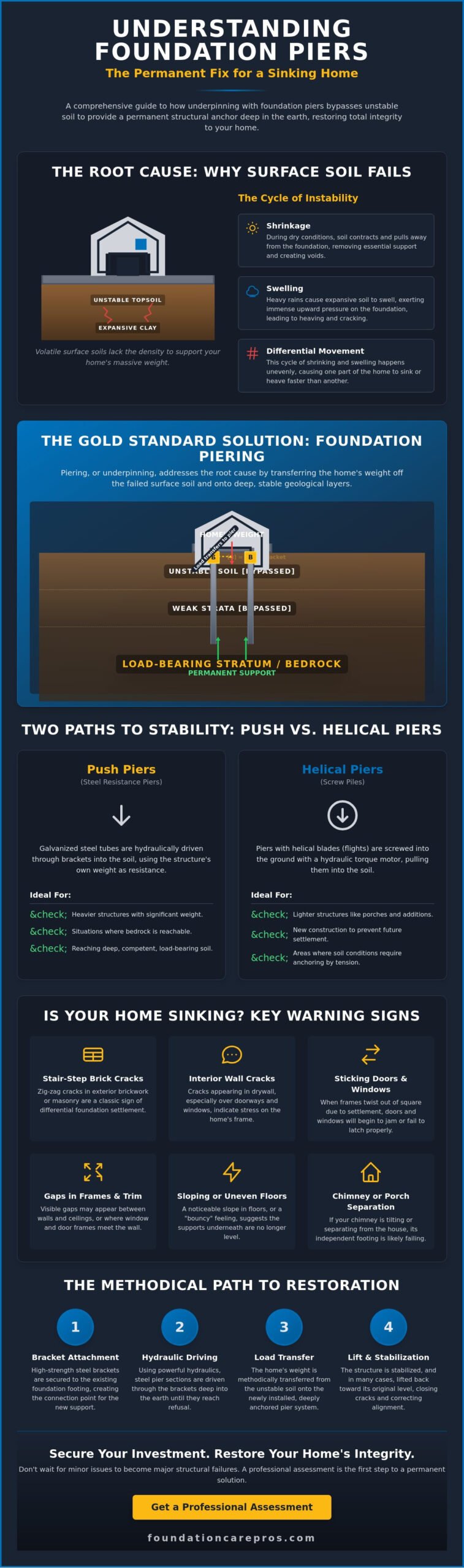
Unlike cosmetic repairs that only hide symptoms, piering addresses the root cause of movement. The technical process of installing these supports is known as underpinning, a method used to strengthen or stabilize an existing foundation. This process bypasses the unstable soil near the surface. It transfers the massive weight of your home onto deeper, more competent soil layers or solid bedrock. By shifting the load-bearing responsibility away from the topsoil, piering provides a level of structural security that is impossible to achieve with surface-level patches.
The Role of Underpinning in Modern Construction
Underpinning reinforces a foundation that has been compromised by environmental factors or poor initial construction. It remains the gold standard for correcting differential settlement. This occurs when one part of a home sinks faster than another, creating internal stress on the frame. Professional installation of a pier system ensures the structure stays level. It provides a consistent base that remains unaffected by seasonal changes or local weather patterns. This methodical approach transforms a failing foundation into a stable, verified structure.
Why Surface Soil Fails Your Foundation
The soil directly beneath your footing is often the weakest link in your home’s structural chain. Expansive clays and loose fill dirt lack the density required to support thousands of pounds of concrete and wood. These materials are highly sensitive to moisture levels, creating a cycle of instability:
- Shrinkage: Dry conditions cause the soil to contract and pull away from the foundation footing.
- Swelling: Heavy rains cause the soil to expand and exert upward pressure on the concrete.
- Differential Movement: Inconsistent moisture leads to the shifting and cracking seen in many residential properties.
Foundation Pier Systems solve this by reaching depths where moisture levels are constant. By extending the foundation’s reach to stable strata, the house no longer relies on volatile topsoil for support. This mechanical bypass renders the movements of the upper soil layers irrelevant to the home’s safety. It’s a disciplined solution that prioritizes long-term results over superficial fixes.
The Engineering Mechanics: How Foundation Piers Restore Stability
Installation begins by attaching high-strength steel brackets to the existing foundation footing. These brackets serve as the critical connection point between your home and the new support system. Once the brackets are secure, steel pier sections are driven through them and into the earth using powerful hydraulic pressure. This mechanical force continues until the system reaches a point of refusal. At this stage, the soil resistance is greater than the force required to support the home, indicating the pier has found a permanent anchor. Understanding what are foundation piers means recognizing they aren’t just buried pipes; they are calibrated engineering tools designed to halt settlement instantly.
The final step in the mechanical process involves shifting the home’s weight. Once the piers reach the necessary depth, the load of the house is transferred from the footing to the piers. This transfer effectively lifts the burden off the unstable surface soil. If you’re noticing signs of failure, a professional inspection of your Foundation Pier Systems can determine where these mechanical supports are most needed. This transition from soil-based support to pier-based support provides the immediate stabilization required to protect your investment.
Understanding Load Transfer and Distribution
Piers function like structural stilts for your home. They provide a direct path for the building’s weight to reach deep, stable earth. Specialists calculate the exact number of piers needed based on the home’s total tonnage and the soil’s capacity. This precise distribution is vital to prevent point loading. Point loading occurs when weight is unevenly concentrated, which can lead to new structural cracking or localized foundation failure. Adhering to the structural requirements for underpinning ensures that the load is spread safely across the entire support network. This methodical approach guarantees that what are foundation piers in theory becomes a reliable, long-term reality for your property.
Material Durability: Why Steel is the Standard
Modern underpinning systems utilize galvanized steel to resist the harsh conditions found underground. Unlike older concrete methods, steel won’t crumble or shift when the earth moves. It provides the high tensile and compressive strength required to hold up a residential structure for decades. Galvanization adds a protective layer that stops corrosion from moisture and soil chemicals. Load-bearing strata is defined as the deep earth layer capable of supporting the specific weight of a structure without further compression. By reaching this layer, steel piers provide a level of validation that surface-level repairs simply cannot match.
Helical Piers vs. Push Piers: Choosing the Right Support
Selecting the correct underpinning system depends on two primary variables: the weight of your home and the specific geological profile of your property. While both systems offer permanent stabilization, they achieve it through different mechanical methods. When homeowners ask what are foundation piers, they’re often surprised to learn that the “best” pier is determined by the house itself. A solution that works for a heavy brick estate might not be appropriate for a light frame house or a detached porch.
Push piers and helical piers represent the two industry standards for structural restoration. Both utilize high-strength steel and hydraulic equipment, yet their installation physics differ significantly. One relies on the building’s own mass to find deep support, while the other uses mechanical torque to screw into the earth. Understanding these nuances ensures you choose a Foundation Pier System that provides a validated, long-term anchor for your specific structure.
When to Use Steel Push Piers
Push piers are the preferred choice for heavy residential structures, such as those with full masonry or thick brick-veneer exteriors. These systems use the massive weight of the home as a counter-force. Hydraulic rams drive the steel sections through the bracket and into the ground until they reach bedrock or load-bearing strata. Because the house provides the resistance, every push pier is essentially load-tested during the installation process. This provides immediate verification that the pier can handle the structural demand. They excel in environments with deep bedrock or very dense soil where lighter systems might struggle to penetrate.
The Versatility of Helical Piles
Helical piers feature screw-like plates, known as helices, welded to the steel shaft. Unlike push piers, they don’t require the building’s weight for installation. Instead, a high-torque hydraulic motor bores them into the ground like a giant wood screw. This makes them exceptionally versatile for lighter structures like porches, decks, or chimneys. They’re also the superior option for homes built on sandy or loose soil where bedrock is too deep to reach. In some cases, specialists use the mechanical leverage of helical piers to pull a foundation back into its original alignment. This capability makes them a powerful tool for both stabilization and structural correction.
Identifying Settlement: When Foundation Piers Become Necessary
Identifying the early warning signs of settlement is critical for long-term property preservation. When you research what are foundation piers, you discover they are the engineered remedy for a sinking structure. These signs are often subtle at first but progress as the soil beneath your home continues to shift. Recognizing these symptoms early allows for a targeted intervention before the damage spreads to the rest of the building’s systems.
Stair-step cracks in exterior brickwork are a primary indicator of foundation settlement. These cracks follow the mortar lines in a jagged pattern, showing exactly where the wall is losing support as the footing drops. Similarly, doors and windows that stick or refuse to latch signal that the home’s frame has shifted out of its square alignment. If you notice a gap forming between your chimney and the rest of the house, this suggests significant soil movement that requires immediate attention. Inside the home, keep an eye out for interior drywall cracks that extend diagonally from the corners of door frames. These red flags aren’t just cosmetic; they are the house’s way of signaling structural distress. For a comprehensive overview of how professionals address these issues, our guide on foundation settlement repair explains the full scope of structural stabilization options available to homeowners.
Structural Red Flags vs. Cosmetic Issues
Distinguishing between different types of damage is essential for choosing the right repair. Horizontal cracks often indicate bowing walls rather than settlement. These are caused by hydrostatic pressure pushing against the side of the foundation. In contrast, tapered cracks, which are wider at the top than the bottom, strongly suggest the foundation is sinking. This distinction is vital because it determines whether you need wall reinforcement or underpinning. For a comprehensive breakdown, refer to our guide on types of foundation cracks for a detailed visual comparison.
The Dangers of Delayed Stabilization
Postponing a structural fix only increases the total repair bill over time. Ignoring settlement leads to severe secondary damage, including ruptured plumbing lines and misaligned roof rafters. Addressing the problem early with a Foundation Pier System is significantly more cost-effective than waiting for a total foundation failure. Beyond the physical structure, permanent stabilization protects the resale value and marketability of your property. Buyers and lenders look for a verified, stable foundation before proceeding with a sale. If you’ve identified these red flags, it’s time to secure your home’s future with a professional foundation pier installation.
Restoring Structural Integrity: The Professional Installation Process
Execution of a structural repair follows a disciplined diagnostic phase. Site preparation begins by excavating small areas around the foundation. These access holes are strategically placed to expose the footings without compromising the structure’s safety. Once the area is cleared, high-strength steel brackets are secured directly to the concrete footing. This creates the platform for the hydraulic equipment to drive the pier sections into the earth. Understanding what are foundation piers involves seeing them as more than steel rods; they are part of a synchronized mechanical system designed to reclaim your home’s stability.
Once all piers are anchored, a synchronized hydraulic lifting system is engaged. This equipment allows the team to stabilize the foundation or, in many cases, raise it back toward its original level. This controlled movement is the most visible part of the restoration. The pressure is distributed across the entire Foundation Pier System to ensure the lift is gradual and safe. This methodical approach ensures that the structure is not just supported, but correctly aligned to prevent future stress on the home’s frame.
Diagnostic Assessment and Engineering
Every project starts with a detailed evaluation of the building’s weight and the underlying soil conditions. Engineers use this data to calculate the precise placement of each pier for uniform support. This prevents the uneven pressure and point loading that could lead to further damage. During the drive process, hydraulic gauges monitor the pressure in real-time to confirm that the pier has reached the necessary load-bearing strata or solid bedrock. This verification ensures that the system is not just deep, but structurally sound and capable of supporting the specific tonnage of your home.
The Final Lift and Property Restoration
Lifting the foundation often yields immediate results. This process can close stair-step cracks in brickwork and interior drywall gaps that were caused by the initial settlement. It restores the frame’s alignment, allowing doors and windows to function properly again. After the lift is verified and the brackets are locked into place, the excavated soil is replaced and compacted. This restoration phase leaves the structural supports completely hidden beneath the surface. You’re left with a home that looks identical to its pre-settlement state but possesses the invisible, permanent support of a professional underpinning system. This provides the long-term security every homeowner needs to protect their property’s value.
Protect Your Investment with Validated Structural Support
Foundation settlement is a progressive issue that requires a disciplined, engineering-based solution. By understanding what are foundation piers, you can move past the stress of cosmetic symptoms and focus on a permanent resolution. These systems work by transferring your home’s weight to stable, load-bearing strata, effectively rendering volatile surface soil irrelevant to your safety. Whether your property requires helical piles for a shifting chimney or push piers for a sinking masonry wall, the goal remains the same: unwavering stability.
We take a methodical approach to every project as an A+ Rated specialist and a member of the Supportworks Network. Our Foundation Pier Systems come with permanent, transferrable warranties to ensure your peace of mind lasts as long as the repair itself. Choosing a verified solution today prevents the high costs of secondary damage and protects your property’s market value. Secure your home’s future with a professional foundation assessment from Foundation Care Pros. You deserve the confidence that comes with a house built on a solid, verified anchor.
Frequently Asked Questions
Is a foundation pier a permanent fix for my home?
Yes, foundation piers are considered a permanent solution for structural settlement. They function by bypassing the unstable topsoil that caused the initial movement and anchoring the structure to competent load-bearing strata. Because these supports reach depths unaffected by seasonal moisture changes, the stabilization is designed to last for the life of the structure.
How much do foundation piers cost to install?
Total costs depend on the number of piers required and the depth of the stable soil layer. Every property presents unique geological challenges that influence the final investment. A professional diagnostic assessment is the only way to determine the specific scope of work and the materials needed for a permanent fix. Readers should consult with a specialist to receive a project-specific estimate.
Can foundation piers lift my house back to its original level?
Lifting is often possible and is a primary goal of the underpinning process. Hydraulic systems allow specialists to carefully raise the foundation toward its original position. This process frequently closes exterior cracks and helps re-align sticking doors. While the primary focus remains on stopping further settlement, achieving a level structure is a common outcome of professional piering.
How long does it take to install a foundation pier system?
Most residential piering projects are completed within three to five days. The exact timeline depends on the number of piers and the accessibility of the site. Because the process involves localized excavation rather than a total foundation replacement, it causes minimal disruption to your daily routine. Most homeowners can remain in their house throughout the entire installation process.
Will foundation piering damage my landscaping or basement?
Modern installation techniques minimize the impact on your property. Excavation is limited to small areas around the foundation footing where the brackets are attached. While some landscaping directly against the house may need to be moved, the structural supports are completely hidden underground once the soil is replaced. Interior basement work is rarely required unless the settlement is occurring under an interior load-bearing wall.
What is the difference between a push pier and a helical pier?
Push piers use the weight of the building to drive steel sections into the earth until they reach bedrock. Helical piers feature screw-like plates and are mechanically bored into the ground using high-torque motors. When asking what are foundation piers best suited for your home, the answer depends on your structure’s weight and the local soil profile found during the initial inspection.
Do foundation piers increase my home’s resale value?
Structural stabilization protects and often increases a home’s resale value by removing the liability of a failing foundation. A house with active settlement is difficult to sell and often ineligible for traditional financing. Providing documentation of a professional Foundation Pier System installation with a transferrable warranty gives potential buyers the confidence they need to move forward with a purchase.
Can I install foundation piers myself or do I need a professional?
Structural underpinning requires specialized hydraulic equipment and precise engineering calculations. Professional installation ensures that the load is distributed correctly to avoid damaging the home’s frame. Attempting a DIY repair on a foundation is dangerous and fails to meet the building code requirements necessary for property safety and future real estate transactions.