
Up to 40% of the air on the first floor of your home can come directly from the crawl space. This reality explains why musty smells, cupping hardwood floors, and rising energy bills often persist even when the rest of your house is well-maintained. Achieving permanent crawl space moisture control requires more than a temporary fix. It demands a methodical approach to identifying and neutralizing water sources. You likely feel the weight of this responsibility every time a heavy rain occurs or a new odor appears in the living room.
We recognize the stress that hidden structural threats cause for homeowners. This guide delivers the professional sequence for diagnosing, managing, and permanently eliminating moisture to protect your home’s structural integrity. You’ll learn how to move from initial assessment to professional execution, ensuring your foundation remains secure and your air stays clean. We will walk you through the essential steps of bulk water management, vapor barrier standards, and the benefits of full encapsulation systems. By following this expert path, you can secure a dry, odor-free home and lower your monthly utility costs.
Key Takeaways
- Identify critical indicators like musty smells and joist condensation to stop moisture damage before it spreads to your living areas.
- Implement a professional crawl space moisture control strategy by addressing groundwater seepage and high humidity at the source.
- Follow a methodical remediation sequence, beginning with site inspections and the installation of internal drainage and sump pump systems.
- Learn why full encapsulation offers a more reliable, permanent solution for structural protection than standard thin-plastic vapor barriers.
- Understand how a professional diagnostic assessment leads to a customized plan that secures your home’s foundation and lowers energy costs.
Identifying the Indicators of Crawl Space Moisture
Most homeowners rarely venture into their foundation’s lowest point. However, the symptoms of high humidity and water intrusion often migrate into the living areas. Recognizing these early warning signs is the first step toward effective crawl space moisture control. Before you can implement a solution, you must identify the diagnostic markers that indicate a failing environment. Ignoring these signals often leads to expensive structural remediation and degraded air quality.
To understand these signs, it helps to first answer the question: What is a Crawl Space? At its core, this area serves as a buffer between the ground and your home, but it often becomes a reservoir for moisture. Musty odors are the most common indicator. These smells are the byproduct of microbial volatile organic compounds released during the growth of mold or mildew. If you notice a persistent, earthy scent in your hallway or bedrooms, the source is likely beneath your feet.
Visible condensation on metal ductwork or wooden floor joists signals that the air has reached its dew point. When warm, humid air contacts these cooler surfaces, it transforms into liquid water. This process accelerates wood rot and attracts wood-destroying organisms like termites. You may also notice soft or sagging spots in your subflooring. This happens when the wood absorbs excessive moisture, compromising its structural density and causing the floor above to feel “spongy” underfoot.
The Physics of the Stack Effect
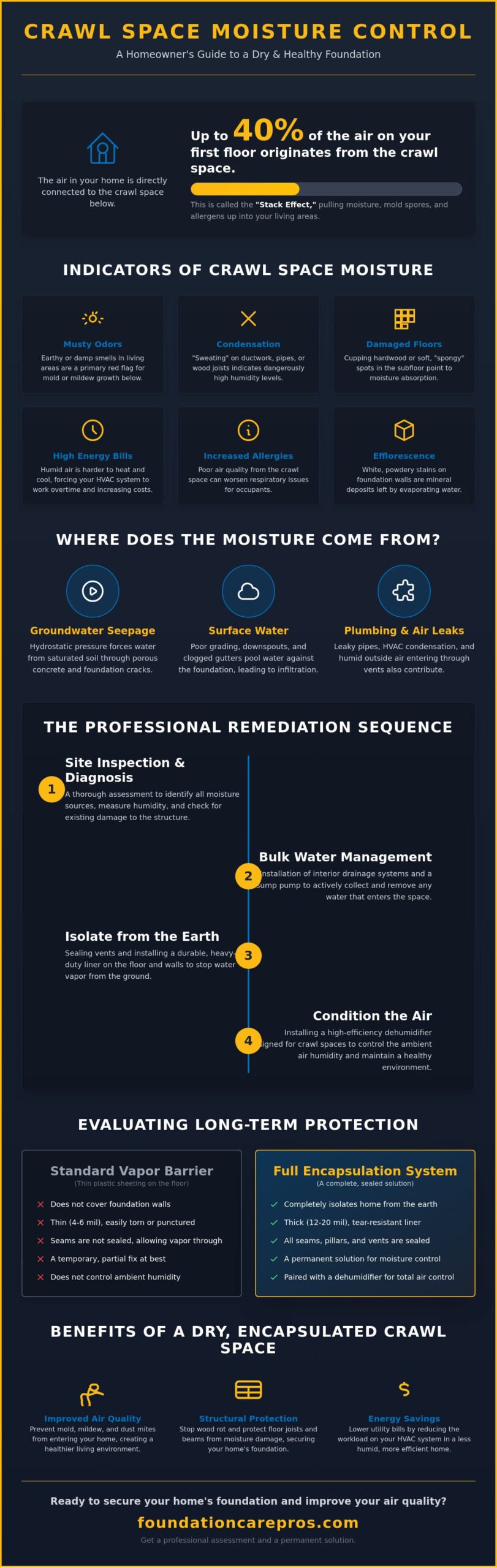
Air movement in a home follows a predictable pattern known as the stack effect. As warm air rises and escapes through the attic, it creates a vacuum that pulls air from the crawl space upward. Research indicates that up to 40% of the air you breathe on the first floor originates in this lower area. This connection makes crawl space moisture control a matter of health as much as structural maintenance. High humidity levels downstairs directly degrade the indoor air quality of your entire home by carrying spores and allergens into your breathing zone.
Secondary Signs of Foundation Distress
When moisture causes floor joists to swell or shift, you’ll often experience sticking doors and windows throughout the house. These alignment issues stem from the structural movement of the framing above the foundation. Occupants might also notice increased allergy symptoms or unexplained respiratory issues. Efflorescence on the foundation walls serves as a clear indicator of hydrostatic pressure forcing groundwater through the masonry. These white, powdery mineral deposits prove that water is actively migrating through your foundation walls. Addressing these signs early prevents the need for more invasive structural repairs later.
Sources of Crawl Space Infiltration: Where Moisture Begins
Effective crawl space moisture control starts with a precise diagnostic of where the water originates. Moisture isn’t a single issue; it enters your home through three distinct pathways. Groundwater seepage is often the most destructive force. Hydrostatic pressure in the soil pushes water through porous concrete or cinder block walls, especially during heavy rain cycles. This pressure can force liquid through microscopic cracks, creating a constant supply of moisture against your home’s wood framing.
Surface water also contributes to foundation saturation. If your gutters are clogged or the soil grading slopes toward your home, water pools against the foundation. This saturation eventually migrates into the crawl space. Additionally, internal plumbing leaks from kitchens or bathrooms above can go unnoticed for months. These leaks drip directly onto the floor joists, providing a localized source of rot. Identifying these specific entry points is essential before you can select a permanent remediation strategy.
Bulk Water vs. Water Vapor
You must differentiate between bulk water and water vapor to fix the problem correctly. Bulk water refers to liquid standing on the ground or streaming through walls. Addressing this standing water is the non-negotiable first step. Air sealing or adding a dehumidifier won’t work if the ground remains saturated. High air humidity, or water vapor, is a separate challenge. Even if your crawl space looks dry, moisture can rise through the soil via capillary action. This process turns the ground into a constant source of humidity that feeds the stack effect mentioned earlier. If you suspect groundwater issues, a professional site assessment can help determine if your home requires specialized drainage solutions.
The Myth of Traditional Ventilation
For decades, building codes required foundation vents to “air out” crawl spaces. We now know this practice is counterproductive in most climates. When you open vents during a humid summer day, you’re inviting warm, moisture-laden air into a cool environment. As this air cools, it reaches its dew point and releases moisture as liquid condensation on your ductwork and joists. This creates the exact environment that mold needs to thrive. Modern crawl space moisture control focuses on a “sealed” mindset. By closing vents and installing a comprehensive system, you eliminate the entry of outdoor humidity. This shift from venting to sealing is the only way to maintain a stable, dry environment year-round.
- Groundwater: Seepage through masonry walls due to hydrostatic pressure.
- Surface Water: Runoff from poor grading or failing gutter systems.
- Plumbing Leaks: Hidden drips from supply or waste lines in the subfloor.
- Outdoor Humidity: Moist air entering through traditional foundation vents.
A Step-by-Step Strategy for Crawl Space Moisture Control
Executing a successful remediation plan requires a specific order of operations. Many homeowners attempt to solve humidity issues by simply laying down plastic or buying a retail dehumidifier, but these efforts often fail without proper sequence. A professional crawl space moisture control strategy begins with addressing bulk water before moving to air quality management. This methodical approach ensures that each layer of protection builds upon the last, creating a permanent solution for your home’s foundation.
The process starts with a comprehensive site inspection. You must verify that the exterior of the home isn’t contributing to the problem. Check that gutters are clear and downspouts extend at least six feet away from the foundation walls. Once the exterior is secure, the internal work begins. We prioritize the removal of liquid water, the sealing of the building envelope, and finally, the conditioning of the air to prevent microbial growth.
Water Management and Drainage
Manage bulk water first. If your crawl space has a high water table or frequent seepage, you need an interior drainage system. This typically involves a perforated pipe embedded in a trench along the interior perimeter of the foundation. This pipe directs water to a central collection point. You must then install a sump pump with battery backup installation to move that water out of the space and away from the home. A battery backup is critical; most moisture events occur during heavy storms when power outages are most likely. Without this fail-safe, your crawl space remains vulnerable to flooding.
Sealing and Isolation Techniques
Once the ground is dry, you must isolate the home from the earth’s natural moisture. Installing a high-grade vapor barrier basement crawl space is the standard for professional protection. According to the 2021 International Residential Code (IRC), you should use a Class 1 vapor barrier. Ensure all joints overlap by at least 6 inches and are sealed with specialized tape. The barrier must also extend at least 6 inches up the foundation walls and be fastened securely.
- Seal Foundation Vents: Use airtight covers or spray foam to eliminate the entry of humid outdoor air.
- Rim Joist Insulation: Apply spray foam to the rim joist area where the house frame meets the foundation. This prevents air bypass and improves energy efficiency.
- Mechanical Dehumidification: Install a dedicated, high-capacity dehumidifier to maintain relative humidity between 30% and 50%, as recommended by the EPA.
This sequence creates a controlled environment. By removing the variables of groundwater and outdoor humidity, you protect the wood framing from rot and ensure the air entering your home is clean and dry.
Encapsulation vs. Vapor Barriers: Evaluating Long-Term Protection
Vapor barriers and full encapsulation systems are not interchangeable terms. A standard vapor barrier is simply a thin plastic sheet laid over the dirt floor. This approach provides minimal crawl space moisture control because it leaves the foundation walls and vents exposed. Full encapsulation creates a sealed building envelope. It utilizes a heavy-duty, reinforced liner that is mechanically fastened to the walls. This system isolates your home from both ground moisture and outdoor humidity.
Thin 6-mil poly sheets are prone to tearing and often emit a pungent odor as they degrade. Professional-grade liners are antimicrobial and puncture-resistant. These materials prevent soil gases and moisture from entering the home’s structure. Dry wood is also less attractive to wood-boring insects like termites and carpenter ants. These pests require moisture to thrive and navigate through your foundation. By removing the water source, you create a natural deterrent that protects your home’s framing from infestation and decay.
Is Crawl Space Encapsulation Worth It?
The benefits of crawl space encapsulation extend beyond simple moisture reduction. When you analyze the is crawl space encapsulation worth it debate, the data supports the long-term investment. Verified statistics from 2026 show that a properly installed system can recoup 70% to 90% of its cost at resale. Homeowners also see immediate energy savings of 15% to 20% on heating and cooling bills. This occurs because your HVAC system no longer has to compete with the extreme humidity levels pulled from the earth. Encapsulation also prevents the warping of expensive hardwood floors. Cupping occurs when the underside of the wood absorbs more moisture than the top; maintaining a stable environment preserves these high-value finishes.
Mechanical Dehumidification Requirements
A sealed space requires active air management to remain effective. Household dehumidifiers will fail in this environment. They aren’t designed for the cooler temperatures or the continuous operation required in a crawl space. Maintaining consistent crawl space moisture control requires an industrial-grade, self-draining unit. These machines are built to maintain relative humidity between 30% and 50% as recommended by the EPA. This level prevents mold growth and ensures your floor joists remain dry and stable. To protect your home’s structural integrity, schedule a professional crawl space encapsulation today.
Professional Crawl Space Solutions from Foundation Care Pros
Foundation Care Pros approaches crawl space moisture control with the technical discipline of an engineering firm and the dedication of a local advocate. We recognize that your home’s structural integrity depends on a dry, stable foundation. Our process begins with a methodical diagnostic assessment. We don’t rely on superficial observations. Instead, we verify wood moisture content, identify specific hydrostatic pressure points, and map out water infiltration routes. This data-driven approach allows us to design a customized system that addresses the unique environmental stresses on your property.
Every home requires a tailored solution rather than a one-size-fits-all application. Our team evaluates the specific soil conditions and drainage patterns surrounding your foundation. We then implement a comprehensive plan that may include interior drainage, high-capacity sump pumps, and reinforced liners. This commitment to accuracy ensures that our moisture management systems provide permanent protection rather than temporary relief. We prioritize long-term results over quick fixes to give you unwavering confidence in your home’s safety.
Comprehensive Structural Protection
Moisture often acts as the primary catalyst for foundation failure. When saturated soil exerts excessive pressure against your foundation walls, it can lead to bowing, cracking, or total displacement. Our crawl space encapsulation systems are engineered to integrate seamlessly with our stabilization services. For homes where moisture has already compromised wall stability, an i-beam wall braces installation provides the necessary reinforcement to stop further movement. By combining advanced moisture barriers with high-strength steel supports, we create a unified defense system. This integrated approach ensures your home remains level, dry, and structurally sound regardless of external weather conditions.
Taking the Next Step for Your Home
Securing your property starts with a clear, professional assessment of its current condition. During a consultation, our specialists conduct a thorough walkthrough and explain their findings with total transparency. You will receive a detailed, written plan for remediation that outlines the specific sequence of repairs needed. This plan eliminates the stress of the unknown by providing a logical path from identification to resolution. We focus on providing you with the facts necessary to make an informed decision about your home’s welfare. Secure your foundation’s structural integrity with a professional diagnostic assessment from our local experts.
- Diagnostic Accuracy: We use precise tools to measure and verify moisture levels.
- Customized Design: Every encapsulation system is built for your specific foundation layout.
- Structural Integration: We address both water management and foundation stabilization simultaneously.
- Verified Results: Our goal is a dry, odor-free environment that stands the test of time.
Securing Your Home’s Long-Term Structural Integrity
Effective crawl space moisture control is a technical necessity that protects your family’s health and your property’s value. You now understand that moisture management requires a specific sequence. It must start with bulk water drainage and move toward a sealed, conditioned environment. Simple plastic sheets can’t provide the permanence of a professional encapsulation system. By addressing the root causes of infiltration and humidity, you eliminate the risk of wood rot, pests, and poor indoor air quality.
As a Supportworks Network Member, Foundation Care Pros specializes in structural stabilization and moisture control. We utilize a methodical, engineering-based approach to every diagnostic and repair. This ensures that your foundation remains dry and stable for the long term. Our team focuses on providing validated results that lower your energy costs and protect your home’s structural framing. Don’t let hidden moisture compromise your safety or comfort. Protect your home with a professional crawl space assessment from Foundation Care Pros. Taking this proactive step today provides the peace of mind that comes from a permanently secured foundation.
Frequently Asked Questions
What is the most effective way to control crawl space moisture?
Full encapsulation combined with mechanical dehumidification is the most reliable method for crawl space moisture control. This process involves sealing the earth with a heavy-duty, reinforced liner, closing all exterior vents, and conditioning the air. It creates a managed environment that isolates your home from ground-sourced humidity and outdoor weather patterns. This comprehensive approach addresses both liquid water and water vapor simultaneously.
How much humidity should be in a crawl space?
You should maintain your crawl space relative humidity between 30% and 50%. The U.S. Environmental Protection Agency (EPA) recommends this specific range to prevent mold growth and wood rot. Levels that consistently rise above 60% create an environment where microbial activity accelerates. This can eventually compromise your home’s structural integrity and degrade the air quality on the floors above.
Do I really need a dehumidifier if my crawl space is encapsulated?
You still need a dehumidifier in an encapsulated space to manage residual moisture and air diffusion. Even with a high-quality seal, humidity can enter through the access door or through microscopic gaps in the building envelope. A dedicated, industrial-grade unit ensures the environment stays within the safe range regardless of external weather shifts. It acts as the final layer of protection for your floor joists.
Can I use a regular vapor barrier instead of full encapsulation?
A regular vapor barrier is insufficient for long-term protection because it only covers the dirt floor. Full encapsulation extends the barrier up the foundation walls and seals all vents to create a complete building envelope. Thin plastic sheets used in basic barriers are also prone to tearing and don’t address the humid air that causes wood decay. Encapsulation provides a permanent, reinforced solution that a simple ground cover cannot match.
How does moisture in the crawl space affect my electric bill?
High humidity in the crawl space forces your HVAC system to work significantly harder to cool your living areas. Damp air holds more heat than dry air, meaning your air conditioner must run longer cycles to achieve your thermostat’s setting. Professional encapsulation can lead to energy savings of 15% to 20% on your monthly heating and cooling bills by reducing this latent heat load. Beyond moisture control, ensuring you have efficient equipment from Crome Mechanical, such as a professional furnace installation Cedar Springs MI, can further maximize your home’s overall utility savings.
Should I close my crawl space vents in the summer?
You should keep your foundation vents closed and sealed throughout the summer. Opening them allows warm, moist air to enter the cool crawl space, where it reaches its dew point and condenses on your ductwork and joists. This liquid condensation provides the exact moisture source that mold and wood-destroying insects need to thrive. Transitioning to a sealed system is essential for modern moisture management.
How long does crawl space encapsulation typically last?
Professional crawl space encapsulation systems are designed to last 20 to 25 years when maintained correctly. The reinforced, antimicrobial liners used in these systems are far more durable than standard 6-mil plastic. Regular inspections of your sump pump installation and dehumidifier will ensure the system continues to protect your foundation and structural framing for decades to come.
Is mold in the crawl space always a structural emergency?
Mold isn’t always an immediate structural emergency, but it serves as a definitive warning of an ongoing moisture crisis. While mold grows on the surface, the high humidity levels that support it will eventually lead to wood rot and joist failure. Addressing mold early through proper moisture control prevents the need for invasive structural repairs or the installation of I-Beam wall braces in the future.