Hydrostatic pressure is responsible for 41% of all basement wall cracks, yet many homeowners wait until a visible bow appears before seeking a professional assessment. You might be observing a curve in your foundation right now and feeling the stress of structural uncertainty. It’s common to feel overwhelmed by the technical differences between carbon fiber and steel or the fear of a sudden wall failure. Choosing the correct basement wall stabilization method is the only way to ensure your home remains safe and your property value stays intact.
You can secure your foundation permanently with a solution that requires zero future maintenance. This guide provides the technical clarity you need to evaluate and select the most effective stabilization system for your specific soil conditions. We’ll examine the engineering behind I-beam wall braces, carbon fiber straps, and wall anchors to help you make an informed decision. You’ll gain a clear understanding of how to stop wall movement and protect your investment with professional precision.
Key Takeaways
- Identify how hydrostatic pressure causes structural failure and why arresting inward movement is critical for home safety.
- Compare industry-standard solutions like I-Beam braces and carbon fiber straps to determine the most effective basement wall stabilization for your foundation.
- Evaluate your specific repair needs by matching stabilization technology to your wall type, whether it’s poured concrete or masonry block.
- Prepare for the installation process by understanding the diagnostic phase, including laser leveling and wall deflection mapping.
- Restore the structural integrity and market value of your property with a permanent, maintenance-free foundation repair.
Understanding Basement Wall Stabilization and Why It Cannot Wait
Basement wall stabilization is the engineering process of arresting inward movement and restoring the structural integrity of a foundation. It’s a proactive response to external forces that threaten the safety of your home. When a wall begins to bow or lean, the structural load of the entire house is compromised. This is not a project that allows for delay. Ignoring the early signs of movement leads to total wall collapse and exponentially higher repair costs.
Stabilization serves as the essential foundation for any other basement improvement. You cannot effectively finish a basement or install an interior drainage system if the walls are structurally unsound. Any cosmetic work performed on a moving wall will eventually fail as the foundation continues to shift. Securing the walls ensures that your investment in waterproofing or living space remains protected for the life of the home.
The Physics of Hydrostatic Pressure and Soil Expansion
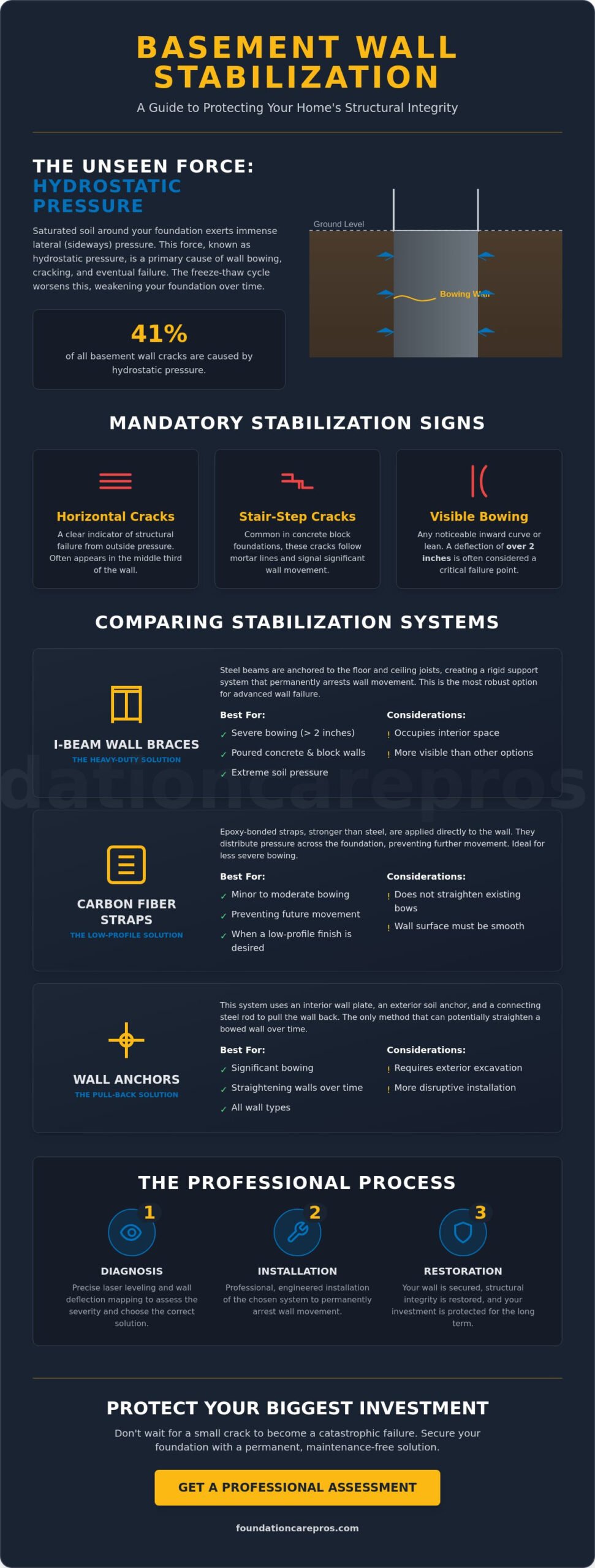
Soil surrounding your home acts as a massive reservoir. When heavy rains or snowmelt saturate the ground, expansive clay soils absorb the moisture and swell. This expansion creates significant lateral force directed toward your foundation. The weight of water-logged soil is substantially higher than dry earth, placing a burden on walls they weren’t designed to carry. Hydrostatic pressure is the force exerted by standing water against a structure.
The freeze-thaw cycle compounds this issue by causing structural fatigue. As wet soil freezes, it expands even further, pushing against the concrete. When it thaws, the soil contracts, leaving a gap that often fills with more water or sediment. This cycle repeats annually, gradually weakening the wall until visible bowing occurs. A thorough understanding of basement construction reveals that while walls are strong under vertical loads, they are vulnerable to these persistent lateral pressures.
Diagnostic Signs: When Stabilization Becomes Mandatory
Recognizing the difference between cosmetic cracks and structural threats is vital for every homeowner. Vertical cracks often result from natural settlement, but horizontal cracks are a clear signal of structural failure. These horizontal fissures usually appear in the middle third of the wall, where the bowing is most pronounced. In block foundations, stair-step cracking following the mortar lines is a primary indicator of lateral pressure and requires immediate basement wall stabilization.
Structural engineers and foundation specialists look for specific deflection measurements to determine the severity of the issue. A wall that has bowed more than 2 or 3 inches is often considered to be at the “point of no return.” At this stage, the wall’s center of gravity has shifted so far that it can no longer support the weight of the house safely. For a detailed visual breakdown of these indicators, consult our guide on Types of Foundation Cracks and What They Mean. Identifying these signs early allows for less invasive and more cost-effective stabilization methods.
Comparing the Top Basement Wall Stabilization Systems
Selecting the correct basement wall stabilization system requires a diagnostic match between the degree of wall deflection and the specific soil conditions surrounding the home. Engineering standards in 2026 recognize three primary technologies for securing foundation walls. Each method offers distinct advantages in terms of structural load management, installation footprint, and the ability to restore the wall to its original position. A methodical comparison ensures the chosen solution provides permanent security without unnecessary costs.
Most stabilization technologies focus on longevity and require zero maintenance after the initial installation. However, the physical presence of these systems varies significantly. Some solutions are nearly invisible, while others provide heavy-duty rigid support that occupies a small portion of the interior perimeter. Understanding the trade-offs between tensile strength and rigid bracing is the first step in a successful structural repair.
I-Beam Wall Braces: The Heavy-Duty Solution
I-Beam wall braces represent the most robust option for advanced structural failure. These systems utilize zinc-plated steel beams to provide maximum resistance against extreme lateral soil pressure. The installation involves anchoring the beams to the basement floor and the floor joists above, creating a floor-to-ceiling support structure. This configuration effectively distributes the lateral load across the entire house frame, halting further inward movement immediately. For detailed technical specifications, you can review our guide on Professional I-Beam Wall Braces Installation.
Carbon Fiber Straps: Low-Profile Reinforcement
Carbon fiber straps offer a high-tech, non-invasive alternative for walls with minor to moderate bowing. This aerospace-grade technology relies on incredible tensile strength to stop wall movement with minimal aesthetic impact. The process involves bonding the straps to the wall surface using a specialized high-strength epoxy. This creates a permanent structural marriage that prevents the wall from stretching or bowing further. Unlike steel, carbon fiber is incredibly thin; it can be painted over or concealed behind drywall easily. You can see how these materials stack up in our analysis of Carbon Fiber Straps vs. Steel Beams.
Foundation Wall Anchors: Utilizing Exterior Soil
Foundation wall anchors are unique because they utilize the stable soil outside the foundation to provide leverage. The system consists of an interior wall plate connected by a high-strength steel rod to an anchor plate buried in the yard. This clamping mechanism is particularly effective because it allows for the potential straightening of the wall over time. By periodically tightening the anchor rods during dry seasons, the wall can often be pulled back toward its original vertical position. To fully understand how do wall anchors work to counteract thousands of pounds of hydrostatic pressure using stable exterior soil as a mechanical lever, our detailed engineering guide explains the complete physics behind this system. Anchors are the ideal choice when interior space must be completely preserved for finishing. If you’re concerned about visible movement, a professional foundation assessment can determine if anchors are a viable path for your property.
Selecting the Right Stabilization Method for Your Home’s Needs
Choosing the right basement wall stabilization system is a diagnostic process based on the unique physical variables of your property. You must weigh the structural material of your foundation against the severity of the damage and your long-term goals for the space. A solution that works for a poured concrete wall with minor cracking might fail on a block wall showing significant deflection. Professional precision in this phase prevents costly re-repairs and ensures the permanence of the fix.
Block Walls vs. Poured Concrete Considerations
Concrete Masonry Units (CMU), or block walls, present different challenges than poured concrete. Block walls are more susceptible to shear failure at the bottom joint because the mortar is the weakest point of the assembly. When lateral pressure increases, the blocks can slide inward along these joints, creating a dangerous shift. I-Beam wall braces provide the necessary vertical support that carbon fiber straps might lack on weak block joints. Block walls require reinforcement that addresses both bowing and shifting. Poured concrete walls generally bow in a single curve, making them excellent candidates for tensile solutions like carbon fiber when caught in the early stages.
The Deflection Threshold: 2 Inches and Beyond
The degree of wall movement is the most critical factor in your selection framework. Engineering standards typically utilize a 2-inch rule to differentiate between reinforcement methods. Carbon fiber straps are highly effective for walls with less than 2 inches of deflection. They stop movement without adding bulk to the interior. However, once a wall bows beyond the 2-inch mark, the structural load requires the rigid, mechanical support of steel I-beams or wall anchors. Using under-powered solutions on severely compromised walls is a safety risk. You should always secure a professional engineering diagnostic before purchasing a system to ensure the load-bearing capacity matches the calculated soil pressure.
Your property layout and future goals also dictate which basement wall stabilization method is feasible. Foundation wall anchors require approximately 10 to 15 feet of clear yard space for installation. If you have a deck, a paved driveway, or expensive landscaping in that zone, anchors may not be an option. In these cases, interior systems like I-beams or carbon fiber are the standard. You should also consider your future plans for the basement. Carbon fiber straps are nearly flush with the wall, allowing for direct application of paint or drywall. I-beam braces protrude several inches into the room, which requires a deeper stud wall if you intend to finish the space later. Identifying these constraints early ensures a solution that fits both your home’s structure and your lifestyle.
The Professional Installation Process: What Homeowners Should Expect
Methodical execution is the hallmark of successful basement wall stabilization. A professional installation follows a disciplined sequence to ensure the structural fix is both permanent and safe. Technicians begin by clearing the workspace and mapping out the structural framework of the home. This preparation allows for the precise placement of hardware and ensures that all lateral forces are safely transferred to the surrounding structure. Every step is designed to verify that the foundation can withstand future soil pressure without further movement.
Phase 1: Diagnostic and Structural Mapping
Technicians utilize high-precision laser leveling tools to measure the exact degree of wall deflection. This diagnostic phase is critical for identifying the apex of the bow. The apex is the point of maximum pressure where the stabilization system will provide the most benefit. Technicians also evaluate the floor joists above the foundation. These joists must be structurally sound to handle the transferred lateral load once the system is tensioned or bonded. Professional installation ensures the load is balanced across the foundation, which prevents secondary structural issues from developing after the repair.
Phase 2: Securement and Permanent Bonding
The securement process depends on the specific technology chosen for your foundation. For I-Beam wall braces, technicians bolt the zinc-plated steel beams directly to the concrete basement floor. An adjustable bracket is then secured to the floor joists overhead. This bracket allows for precise tensioning, which applies constant pressure to the bowing wall. This mechanical force halts inward movement immediately. You can request a professional inspection to determine if your home requires this heavy-duty steel reinforcement.
For carbon fiber straps, the process focuses on surface preparation and chemical bonding. Technicians grind the wall surface to remove paint, dirt, and loose concrete. This step is essential to ensure a permanent thermal bond with the high-strength epoxy. The straps are then applied and saturated with the bonding agent, creating a structural marriage that is stronger than the concrete itself. You can find more technical details on this process in our comprehensive guide to Carbon Fiber Reinforcement. Once the bonding or tensioning is complete, the system provides immediate stabilization that requires no future maintenance.
Investing in Structural Integrity with Foundation Care Pros
Foundation Care Pros applies a disciplined, methodical approach to structural repair. We recognize that structural integrity is the cornerstone of your home’s safety and long-term value. Our team prioritizes accurate diagnostics to ensure that every repair is a permanent resolution rather than a temporary patch. As a Supportworks Network Member, we utilize engineered products that are developed and tested by a national team of structural engineers. This membership provides us with exclusive access to the most advanced basement wall stabilization technologies in the industry. You benefit from a combination of localized expertise and nationally recognized engineering standards.
Our commitment to excellence extends beyond the installation phase. We provide warrantied solutions designed to offer homeowners total peace of mind. When we stabilize a wall, we’re not just stopping movement; we’re restoring the confidence you have in your home’s foundation. This evidence-based approach ensures that the forces of hydrostatic pressure are permanently countered by systems that are built to last a lifetime.
The Value of Engineered Solutions
Investing in premium materials like zinc-plated steel and aerospace carbon fiber ensures your foundation remains secure for decades. These components are specifically designed to withstand the immense lateral forces of saturated soil without corroding or stretching. Beyond immediate safety, a stabilized foundation is a critical asset for home resale. Most buyers will not consider a property with visible structural defects or active wall movement. By addressing these issues now, you protect your equity and restore full market value to your property. You can find more information on budgeting for these essential repairs in our Foundation Stabilization Cost Guide.
Next Steps: Securing Your Home’s Future
Structural problems are progressive and never resolve themselves. A wall that is bowing slightly today will eventually reach a point of total failure if the underlying soil pressure isn’t neutralized. Acting early allows for less invasive repairs and prevents the extreme costs associated with total wall replacement. Our diagnostic process is designed to give you technical clarity without the stress of high-pressure sales tactics. We’ll walk you through the laser-level measurements, explain the physics of the movement, and recommend the most efficient engineering fix for your specific foundation type.
Our goal is to provide a permanent, maintenance-free solution that secures your home’s future. The consultation process is straightforward and focuses on providing you with the data needed to make an informed decision. Don’t wait for a manageable bow to become a structural emergency. Schedule your professional foundation inspection with Foundation Care Pros today.
Secure Your Foundation with Engineered Precision
Stabilizing a bowing wall is an essential engineering requirement that protects the structural integrity of your entire property. You now understand that the choice between carbon fiber and steel depends on precise diagnostic measurements and soil pressure analysis. Acting before a wall reaches the point of no return ensures your home remains safe and its market value is preserved.
Foundation Care Pros has specialized in I-Beam wall braces and carbon fiber reinforcement since 2004. As a Supportworks Network Member, we provide engineered structural products that offer permanent, warrantied solutions for bowing and cracked foundation walls. Our methodical approach to basement wall stabilization prioritizes accuracy and long-term performance over temporary fixes. We’re here to help you navigate the repair process with transparency and technical expertise.
Secure your home’s structural future: request a professional diagnostic from Foundation Care Pros.
You can restore the safety of your foundation and eliminate the stress of structural failure with a single, expert decision today.
Frequently Asked Questions
Is basement wall stabilization a permanent fix?
Yes, basement wall stabilization is a permanent solution designed to halt structural movement for the life of the home. Systems like I-Beam braces and carbon fiber straps are engineered to counter lateral soil pressure indefinitely. These methods provide a warrantied fix that requires no ongoing maintenance once the initial installation and tensioning are complete.
How much does basement wall stabilization typically cost?
The total investment for stabilization depends on the degree of wall deflection, the length of the affected area, and the specific technology required. While minor reinforcement is less resource-intensive, severe bowing that requires heavy-duty steel bracing involves higher material and labor requirements. A professional diagnostic assessment is the only way to determine the exact scope of work for your unique foundation.
Can I finish my basement after installing wall braces or carbon fiber?
Yes, you can finish your basement after the stabilization is complete. Carbon fiber straps are nearly flush with the wall and can be painted or covered with drywall easily. I-Beam braces protrude slightly from the wall; you’ll need to build a stud wall deep enough to clear the steel beams if you want a completely hidden installation.
What happens if I ignore a bowing basement wall?
Ignoring a bowing wall leads to progressive structural failure and, eventually, total wall collapse. As the center of gravity shifts and the bow exceeds two or three inches, the wall’s ability to support the vertical load of your home is compromised. This results in shifting floors, stuck doors, and exponentially higher repair costs compared to early-stage basement wall stabilization.
Will wall stabilization straighten my foundation wall completely?
Stabilization is primarily designed to stop further movement rather than restore the wall to its original vertical position. However, foundation wall anchors can often straighten a wall over time through periodic tightening during dry seasons. If you want to understand the mechanical science behind this process, our guide on how do wall anchors work to gradually restore vertical alignment provides a complete engineering breakdown. I-Beam braces and carbon fiber straps are permanent reinforcement methods that lock the wall in its current position to prevent future failure.
How long does the installation of a stabilization system take?
Most basement wall stabilization systems are installed in one to two days. The process is efficient and doesn’t require major excavation or heavy machinery inside your home. Technicians can typically complete the diagnostic mapping and final securement with minimal disruption to your daily routine, allowing you to return to a safe and stable environment quickly.
Does a stabilized foundation affect my home’s resale value?
A stabilized foundation protects and restores your home’s resale value by providing proof of structural integrity to potential buyers. Unaddressed foundation issues are a major deterrent during real estate transactions and often lead to failed inspections. Providing a transferable warranty for a professional stabilization system gives buyers the confidence that the home is a safe and secure investment.
Can I install basement wall stabilization systems myself?
No, structural stabilization is not a DIY project. It requires specialized engineering knowledge, precise diagnostic tools, and high-strength materials that aren’t available at retail hardware stores. Improper installation can lead to unbalanced loads and further structural damage. Professional technicians ensure that every anchor and strap is correctly bonded or tensioned to meet safety standards.