
A bowing basement wall is more than a cosmetic flaw; it’s a structural warning that your home’s safety is currently under negotiation with the soil outside. You’ve likely watched the cracks widen and felt the growing fear of a total foundation failure. It’s natural to feel overwhelmed by technical jargon and the potential foundation wall anchor cost when you’re just looking for a permanent solution.
We agree that protecting your largest investment shouldn’t feel like a gamble against hidden excavation fees or confusing repair methods. This guide provides a clear roadmap to understanding the variables that dictate structural repair pricing and the long-term security these systems provide. We’ll examine how anchors compare to alternatives like I-beam wall braces or carbon fiber straps, the impact of soil conditions on your project, and how to ensure your foundation passes its next inspection with confidence.
Key Takeaways
- Learn how the three-part anchor system uses stable exterior soil to actively pull bowing walls back toward their original position over time.
- Identify the specific variables that influence your total foundation wall anchor cost, including the standard 5-foot spacing requirements and exterior soil composition.
- Evaluate the trade-offs between wall anchors and alternative methods like I-beam wall braces or carbon fiber straps to determine the most effective solution for your basement.
- Understand the financial risk of delaying structural repairs, as unaddressed bowing can lead to total wall replacement costs that are often triple the price of stabilization.
- Discover why professional installation using galvanized steel and precise torque monitoring is essential for a permanent, corrosion-resistant structural fix.
What Is a Foundation Wall Anchor System?
Foundation wall anchors are a sophisticated engineering solution designed to stabilize basement walls that have begun to bow or lean inward. This system addresses the root cause of structural movement by reaching into the stable soil surrounding your home. While homeowners often focus on the initial foundation wall anchor cost, the long-term value lies in the system’s ability to potentially straighten a wall over time. This is a corrective capability that interior-only methods cannot match.
The Components of a Professional Anchor System
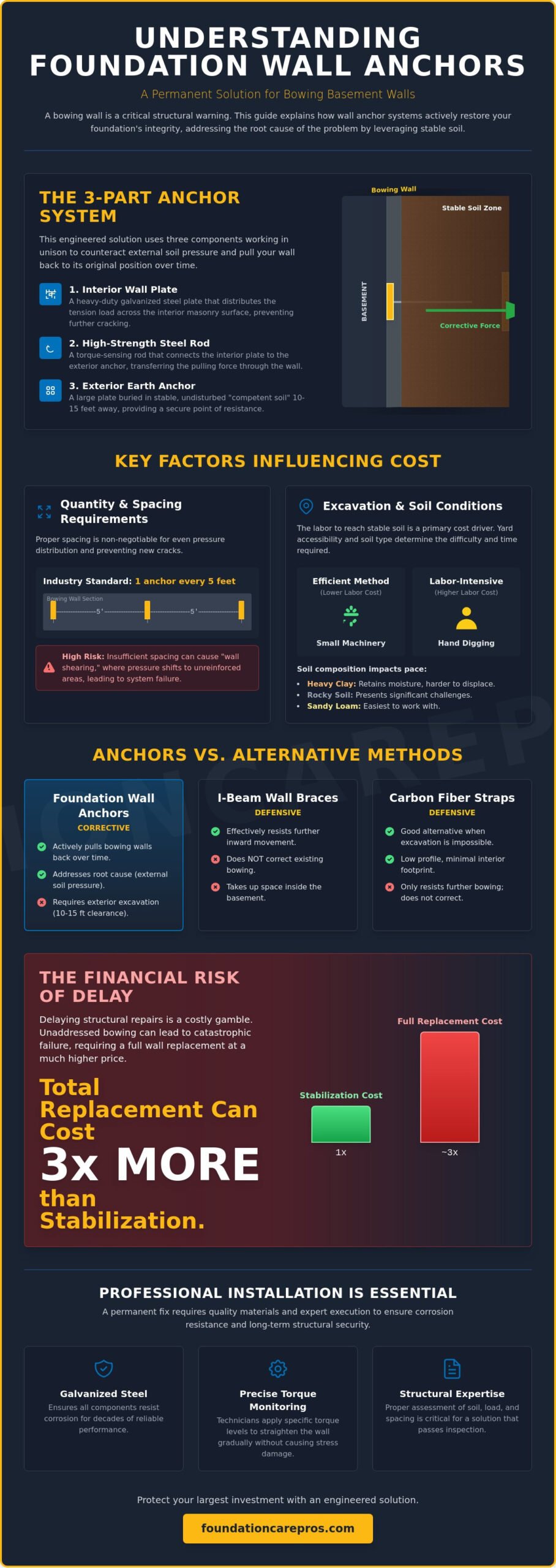
A high-performance anchor system relies on three interconnected parts working in unison to secure your foundation. These components follow proven Earth anchor principles to ensure the system remains secure for decades. The primary parts include:
- Interior wall plates: Heavy-duty galvanized steel plates that distribute tension across the masonry surface to prevent further cracking.
- High-strength rods: Steel torque-sensing rods that bridge the gap between the interior wall and the exterior soil.
- Exterior earth anchors: Large plates buried in “competent soil” beyond the foundation’s expansion zone to provide a stable point of resistance.
This method differs significantly from standard bracing techniques. While interior braces like I-Beam Wall Braces effectively resist further movement from the inside, they don’t address the external forces pushing against the wall. Anchors neutralize those forces by pulling the wall outward toward the stable soil. This mechanical advantage allows for a corrective approach rather than just a defensive one.
How Anchors Restore Structural Integrity
The restoration process begins with the installation of the exterior plates, which are positioned to leverage the weight of undisturbed earth. Once the system is connected, technicians use a process of incremental tightening. By applying specific levels of torque to the interior nuts, the wall is slowly drawn back toward its original vertical position. This gradual adjustment helps close horizontal cracks and relieves the stress on the masonry. Lateral earth pressure is the primary force wall anchors are designed to counteract. By anchoring into soil that isn’t saturated or shifting, the system effectively bypasses the hydrostatic pressure that causes basement walls to fail. Understanding this mechanical process helps clarify why the foundation wall anchor cost reflects a specialized engineering intervention rather than a simple cosmetic patch.
Ideal candidates for this system are walls with less than 2 to 3 inches of bowing. Because the installation requires burying plates in the yard, your property must have sufficient exterior clearance, typically about 10 to 15 feet from the foundation. If landscaping or property lines prevent excavation, alternative methods like carbon fiber reinforcement may be the recommended path forward.
Typical Foundation Wall Anchor Cost Factors
Calculating the foundation wall anchor cost requires a detailed look at the physical environment of your home. It isn’t a one-size-fits-all calculation. Professional installers must account for the lateral pressure exerted by the soil and the specific resistance needed to stabilize the masonry. Factors like soil density, yard accessibility, and wall dimensions play a critical role in determining the final project scope.
Quantity and Spacing Requirements
A structural assessment defines the load-bearing requirements for your specific foundation. Industry standards typically dictate anchor placement every 5 feet along the affected wall. For a standard 20-foot bowing section, you can expect a configuration of four to five anchors to ensure even pressure distribution. Attempting to reduce the number of anchors to save on the foundation wall anchor cost is a high-risk decision. Insufficient spacing leads to localized wall shearing. This occurs when the pressure simply shifts to the unreinforced sections of the masonry, causing new cracks and eventual system failure.
Exterior Labor and Excavation Costs
The physical labor involved in reaching “competent soil” is a primary driver of the total investment. Excavation methods vary based on yard accessibility. If a site allows for small machinery, the process is efficient and keeps labor hours predictable. However, tight spaces near property lines, existing decks, or dense landscaping often require hand-digging. This manual labor significantly increases the time required to set the exterior earth plates.
Soil composition also dictates the pace of work. Heavy clay retains significant moisture and is harder to displace than sandy loam. Rocky soil presents even greater challenges, often requiring specialized equipment to clear the path for the steel rods. Beyond the dig itself, homeowners should budget for site restoration. A professional installation includes soil tamping to prevent future settling and careful backfilling to return the yard to a functional state. Taller or thicker concrete walls may also require specialized, longer rods or larger plates to achieve the necessary leverage.
Navigating underground utilities adds another layer of complexity. If gas lines, water pipes, or electrical conduits cross the installation path, the crew must proceed with extreme caution. This diagnostic precision ensures the safety of your home’s infrastructure during the repair. Because structural integrity is at stake, a professional engineer’s sign-off is a standard part of the process. This verification confirms that the anchor placement matches the specific needs of your home’s geometry. If you’re unsure how these variables apply to your basement, requesting a professional evaluation of your Foundation Wall Anchors is the most reliable next step.
Anchors vs. Alternative Methods: A Cost-Benefit Analysis
Selecting the right stabilization method requires balancing your budget with the physical reality of your property. While the foundation wall anchor cost is often higher than interior-only fixes due to excavation labor, it offers a unique “straightening” premium. Unlike other methods, anchors can actively restore a wall’s verticality over time. This mechanical advantage makes them a preferred choice for homeowners who want to regain structural value rather than just stopping the damage.
I-Beam Wall Braces rely on the basement floor and ceiling joists to resist pressure. They are highly effective but take up usable floor space and don’t offer the potential for wall straightening. In contrast, Carbon Fiber Straps are nearly flush with the wall. They’re the least invasive option available but lack the mechanical leverage to pull a wall back into place. You should also consider long-term maintenance. Beams and straps are generally “set and forget” solutions. Anchors require a commitment to periodic tightening during dry seasons to take advantage of soil shrinkage and encourage the wall to move back.
When to Choose I-Beams Over Anchors
Property line restrictions are the most common reason to pivot away from anchors. If you don’t own the 10 to 15 feet of land outside your foundation, exterior excavation isn’t possible. Accessibility is the deciding factor here. Additionally, if you have a finished basement, the cost of removing drywall to install anchors might outweigh the benefits. In cases of severe bowing, engineers sometimes recommend pairing beams with anchors. This dual approach provides maximum safety and resistance against extreme lateral pressure when a single system isn’t enough to guarantee stability.
Carbon Fiber as a Budget-Friendly Alternative
Carbon fiber is an ideal choice for early-stage foundation cracks where no significant bowing has occurred. Since this method requires no digging, you save significantly on both labor and landscaping restoration. However, technical limitations exist. Carbon fiber cannot safely stabilize walls with more than 2 inches of deflection. If your wall has passed this threshold, the foundation wall anchor cost becomes a necessary investment in your home’s structural survival. Choosing a cheaper method for a severely bowed wall often leads to system failure and more expensive repairs later. Homeowners evaluating this option can learn more about how carbon fiber reinforcement works as a permanent, low-profile stabilization solution before making a final decision.
The Financial Risk of Delaying Wall Stabilization
Delaying structural repairs is a costly gamble that often results in exponential price increases. A foundation wall that bows one inch rarely stays in that position. Hydrostatic pressure remains constant, and once the masonry is compromised, the rate of movement typically accelerates. What begins as a minor deflection can quickly reach a 4-inch bow. This is a critical threshold where the wall’s structural integrity is effectively lost. At this stage, simple stabilization is no longer a viable option. You are then forced into total wall replacement, which typically costs 3 to 5 times more than the initial foundation wall anchor cost.
Structural shifts don’t remain confined to the basement. As the wall moves inward, it pulls on the entire framing of the house. This movement manifests as stuck doors on the upper floors, plumbing leaks from shifted pipes, and visible gaps in window frames. Moisture also enters through the widening cracks, creating a persistent environment for mold growth. Addressing the issue early prevents these secondary damages from compounding your repair bill.
The “Foundation Discount” in Real Estate
Unaddressed foundation issues are a primary reason home sales fail during the inspection phase. Mortgage lenders often deny financing for homes with unaddressed structural bowing because the asset is considered unstable. This forces sellers to accept a “foundation discount” that far exceeds the cost of the actual repair. Professional stabilization is often viewed as a “home improvement” rather than a “repair” by savvy buyers. A transferable warranty on wall anchors protects your home’s resale value by providing documented proof of a permanent, engineered fix. This transparency instills buyer confidence and keeps your home equity intact.
Safety and Liability Concerns
Extreme weather events pose a direct threat to compromised foundations. Heavy rain or rapid snowmelt cycles significantly increase the risk of a sudden wall collapse. Most homeowners’ policies do not cover “gradual” foundation failure; they typically only cover sudden collapse, but the resulting damage is often catastrophic and involves the loss of personal property. Beyond the financial math, there is a significant emotional cost to structural anxiety. Every heavy rainstorm becomes a source of stress rather than just weather. Investing in foundation wall anchors provides the peace of mind that comes from a verified, permanent solution. Proactive stabilization ensures your home remains a safe, predictable asset for your family.
Professional Installation: Why Quality Hardware and Expertise Matter
Precision engineering separates a permanent structural fix from a temporary patch. While homeowners often prioritize the immediate foundation wall anchor cost, the quality of the hardware used determines the lifespan of the repair. We utilize the Supportworks system, which features high-strength, galvanized steel components. This zinc coating is critical because it resists corrosion in the wet, acidic soil often found surrounding basement foundations. Using substandard, non-galvanized steel leads to hardware degradation, which eventually compromises the entire stabilization system.
Precision torque monitoring is the only way to verify that each anchor has reached the exact foot-pound required for long-term stability. Installers don’t simply tighten the rods by feel. They use calibrated equipment to ensure every anchor provides the specific resistance needed to counteract lateral earth pressure. This data-driven approach removes the guesswork from the installation process. It also ensures the pressure is distributed evenly across the masonry, preventing the localized shearing mentioned in previous sections.
DIY installation is not a viable option for structural wall stabilization. The process requires specialized heavy-duty hydraulic equipment to drive rods through several feet of dense soil. Beyond the physical requirements, the structural liability is immense. An incorrectly installed anchor can cause more damage than it fixes by putting uneven stress on a compromised wall. Professional installers also provide diagnostic accuracy, ensuring that wall anchors are the correct engineering choice for your specific soil type and wall deflection level.
What to Look for in a Structural Specialist
Certified installers bring a methodical understanding of soil mechanics and masonry behavior to your project. You should look for a specialist who provides a transparent diagnostic process. This must include a thorough crawl space or basement inspection to identify all signs of movement, including stair-step cracks and shearing. Choosing a specialist who utilizes precision monitoring ensures that your foundation wall anchor cost provides a verified return on investment through structural permanence. Reliable contractors also offer comprehensive warranties that cover both the galvanized hardware and the labor involved in the installation.
The Foundation Care Pros Approach
Our team focuses on delivering a methodical assessment of wall deflection and soil conditions before any soil is moved. We don’t believe in “band-aid” fixes that only address the symptoms of foundation failure. Every project begins with a disciplined problem-solving approach to identify the most effective stabilization method for your home’s unique geometry. Whether your home requires anchors, I-beam wall braces, or carbon fiber straps, our goal is to restore safety and permanence to your property. Schedule a professional structural evaluation to receive a customized stabilization plan and take the first step toward a secure foundation.
Secure Your Home’s Structural Future
Stabilization is a critical investment in your property’s long-term equity. While the initial foundation wall anchor cost is a primary consideration, it serves as a defensive measure against the catastrophic expense of total wall replacement. These systems provide a mechanical advantage that other methods cannot match. They offer the unique potential to restore your basement walls to their original vertical position over time. By addressing hydrostatic pressure now, you protect your home from compounding damage like plumbing leaks and shifted window frames.
Our team brings over 20 years of structural repair expertise to every project. As a Supportworks Certified Dealer, we utilize high-strength, galvanized steel hardware and precision torque monitoring to deliver permanent, warrantied stabilization solutions. We prioritize diagnostic accuracy to ensure your home receives the exact intervention it needs for lasting safety. Taking a proactive approach today eliminates structural anxiety during heavy weather cycles.
Professional guidance is the first step toward a stable foundation. Request Your Free Structural Evaluation and Quote to receive a detailed assessment of your home’s unique needs. You deserve the confidence that comes with a professionally secured property.
Frequently Asked Questions
How many wall anchors are typically needed for a 20-foot wall?
Technicians typically install anchors every 5 feet along the affected masonry section. For a standard 20-foot wall, you should expect a configuration of 4 or 5 anchors to ensure even pressure distribution. This specific spacing prevents localized shearing and ensures the structural load is managed safely across the entire wall surface.
Can foundation wall anchors really straighten a bowed wall?
Wall anchors are the only stabilization method capable of pulling a wall back toward its original vertical position. This restoration occurs through a process of incremental tightening over several dry weather cycles. By leveraging the stable, undisturbed soil outside your home, the system gradually draws the masonry outward as soil pressure fluctuates.
How long does the installation of foundation wall anchors take?
Professional crews typically complete a standard installation in a single day. The process involves drilling small access points in the foundation, driving steel rods into the yard, and securing the exterior earth plates. While complex soil conditions or high anchor counts can extend the timeline, most homeowners experience minimal disruption to their daily routine.
Will installing wall anchors damage my landscaping or yard?
Installation requires digging localized holes approximately 10 to 15 feet away from the foundation to set the earth plates. While some sod removal is necessary, installers prioritize site restoration by carefully replacing the soil and tamping the area. This approach results in significantly less yard disturbance than a total wall replacement or exterior waterproofing project.
What happens if I don’t have enough room in my yard for wall anchors?
If property lines, decks, or utility locations prevent exterior excavation, interior-only solutions are the recommended path forward. In these cases, we utilize I-Beam Wall Braces or Carbon fiber straps to provide the necessary structural reinforcement. These methods stabilize the wall from the inside without requiring any yard access or soil displacement.
Do wall anchors come with a lifetime warranty?
High-quality anchor systems generally include a long-term structural warranty that covers both the galvanized hardware and the labor. These warranties are often transferable to new homeowners, which helps protect your home’s resale value. Choosing a warrantied solution ensures that the repair is viewed as a permanent, professional improvement rather than a temporary fix.
Are wall anchors more expensive than I-beam braces?
The total foundation wall anchor cost is usually higher than I-beam installation due to the added labor of exterior excavation. Anchors require more specialized equipment and man-hours to bridge the gap between the basement and the stable soil in your yard. Many homeowners find this investment worthwhile for the ability to straighten the wall and preserve basement floor space.
How often do wall anchors need to be tightened after installation?
Anchors require periodic tightening during dry seasons when the soil shrinks and pulls away from the foundation. These adjustments take advantage of reduced lateral pressure to encourage the wall to move back toward its original position. Your structural specialist will provide a specific maintenance schedule and demonstrate the proper technique for safe, incremental tightening.