A basement wall that leans inward is never just a sign of an aging home; it is a structural failure in progress. While many homeowners assume that small cracks or slight shifts are part of a house settling, the reality is that over 80% of structural defects originate from soil movement. Understanding what causes basement walls to bow is the first step in protecting your property from a total wall collapse. You might feel uncertain about whether your foundation is in a critical state or if the repair costs will be manageable, but ignoring the signs only allows the external forces to grow stronger.
We understand the stress that comes with seeing a horizontal crack or a visible curve in your foundation. This article will help you identify the hidden forces behind bowing walls and teach you how to diagnose structural instability before it threatens your home. You will learn about the physics of lateral pressure, the specific role of expansive clay soils, and the difference between standard settlement and dangerous bowing. We also provide a clear overview of professional solutions like carbon fiber straps and I-Beam wall braces. This guide ensures you can move forward with a methodical plan for permanent stability.
Key Takeaways
- Differentiate between vertical settlement and lateral deflection to accurately assess your home’s structural health.
- Identify what causes basement walls to bow by examining the relationship between hydrostatic pressure and saturated, expansive soils.
- Recognize how external factors like frost heave and surcharge loads from heavy patios or vehicles accelerate foundation failure.
- Understand why upper-floor symptoms like sticking doors or drywall cracks often indicate a deeper issue with basement wall stability.
- Explore engineered stabilization options, including I-Beam wall braces and carbon fiber straps, designed to provide permanent reinforcement.
Defining the Bow: What is Foundation Wall Deflection?
Foundation wall deflection is a specific engineering failure. It occurs when external forces push against the wall with more power than the wall’s design can resist. This lateral movement is exactly what causes basement walls to bow inward over time. While homeowners often worry about any crack they see, a bowing wall specifically indicates that the masonry is failing to support the horizontal load of the surrounding earth. It’s a sign that the structural equilibrium of your home is currently under siege.
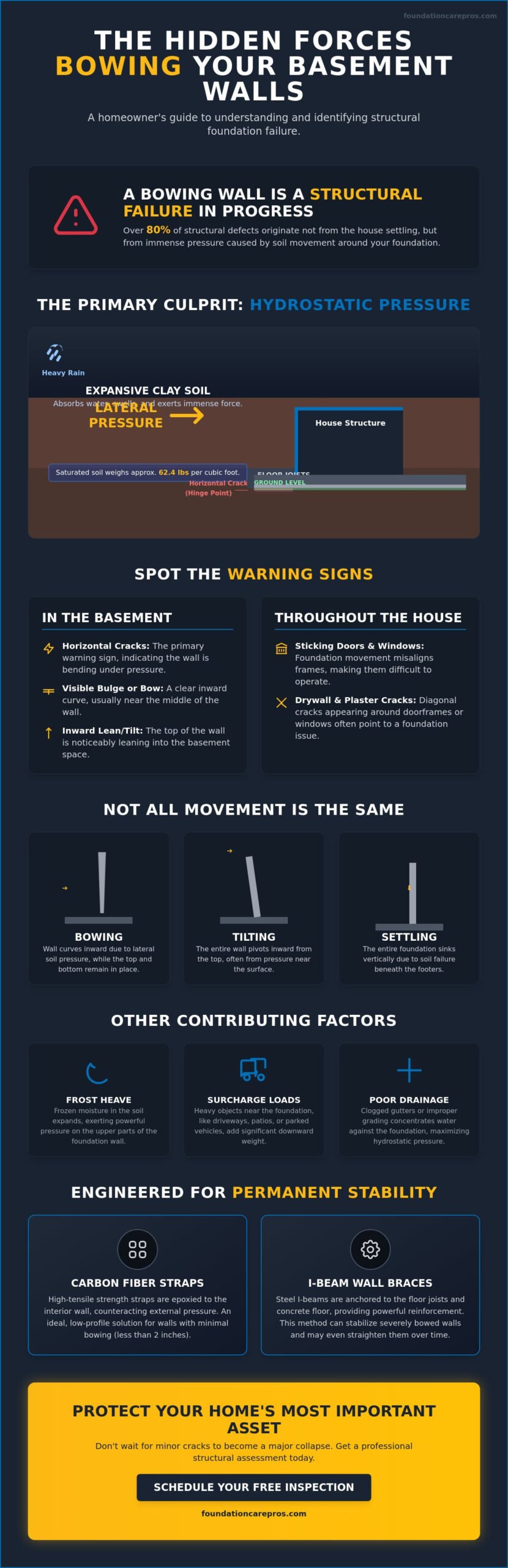
Identifying this issue early is vital for long-term stability. A bowing wall typically manifests as a visible bulge near the center or a distinct lean at the top. Horizontal cracks along the mortar joints serve as the primary warning sign. These cracks demonstrate that the wall has reached its yield point. This is the stage where the pressure from the outside is physically tearing the wall apart, compromising its ability to hold up the rest of the structure.
Bowing vs. Tilting vs. Settling
Structural movement follows different patterns based on the source of the stress. Vertical settlement occurs when the soil beneath the footer can no longer support the weight of the house, causing the foundation to sink. Bowing happens when the wall remains on its footer but curves inward due to external force. Tilting is a variation where the entire wall pivots inward from the top. This often happens because of a poor connection between the wall and the floor joists or extreme pressure near the surface. Understanding the mechanics of what causes basement walls to bow helps you differentiate between a minor cosmetic crack and a structural emergency.
The Anatomy of a Failing Foundation Wall
The stability of a foundation wall depends on its center of gravity remaining aligned with the footer. As the wall moves inward, this center of gravity shifts, reducing the wall’s ability to support the vertical weight of the house above. Concrete block walls are particularly susceptible to this movement. Unlike poured concrete, these walls rely on mortar joints, which act as weak points under stress. The hinge point is the specific area where the wall experiences the most deflection. In block walls, this usually occurs between the third and fifth courses of block from the floor. Because Hydrostatic pressure accumulates against these joints, the blocks eventually shift and create the characteristic bow. This process creates a cycle of instability that won’t stop without professional intervention.
The Primary Culprit: Hydrostatic Pressure and Expansive Soil
Hydrostatic pressure is the leading answer to what causes basement walls to bow. This physical force occurs when water accumulates in the soil surrounding your foundation. Water is heavy; it weighs approximately 62.4 pounds per cubic foot. When the earth becomes saturated after a heavy storm, it gains massive amounts of weight. This saturated soil presses directly against your basement walls with immense force. According to the International Building Code, foundation walls are designed to resist specific lateral soil loads, but persistent saturation often exceeds these engineering thresholds.
The specific composition of your soil dictates how much pressure your walls face. Expansive clay soils, like bentonite, act much like a sponge. These soils swell significantly when they absorb moisture, creating a “wedge” effect. As the clay expands, it physically shoves the masonry inward. It isn’t just the weight of the water causing the issue; it’s the physical expansion of the earth itself. Over time, this repetitive pushing creates the structural fatigue that leads to visible bowing.
The Physics of Soil Expansion
Clay molecules have a unique structure that allows them to trap water between their layers. As they hydrate, they increase in volume and expand in all directions. During periods of heavy rainfall, this expansion happens rapidly. When a drought follows, the soil shrinks and pulls away from the foundation, leaving large gaps. The next rain event fills these gaps with loose soil and even more water. This creates a cycle of increasing pressure that gradually overcomes the wall’s resistance. This constant back-and-forth movement is a primary reason why foundations in clay-heavy regions fail more frequently.
The Role of Poor Drainage
Poor water management is the primary driver of localized soil saturation. If your home’s drainage system fails, you’re essentially feeding the hydrostatic pressure against your walls. Common issues include:
- Surface Grading: Ground that slopes toward the house directs all yard runoff directly into the foundation backfill.
- Gutter Overflow: Clogged gutters cause sheets of water to fall from the roof, saturating the soil at the base of the wall in minutes.
- Downspout Extensions: Short extensions discharge water into the “active zone” instead of moving it safely away from the structure.
Implementing comprehensive basement waterproofing is essential for managing these external forces. If you notice water pooling near your foundation, a diagnostic check from foundationcarepros.com can identify which drainage failures are putting your walls at risk.
Secondary Triggers: Frost Heave, Surcharge Loads, and Vegetation
While hydrostatic pressure is the primary driver, several secondary factors contribute to what causes basement walls to bow. These external stressors often work in tandem with soil saturation to accelerate structural decline. Large tree root systems, for example, can physically exert pressure against the masonry as they grow. Alternatively, these roots drink massive amounts of water from the soil during a drought. This causes the earth to shrink unevenly, creating voids that lead to unstable lateral support once the next rain event occurs.
Construction errors also play a significant role in foundation failure. Walls built without sufficient reinforcement or those backfilled with improper materials lack the internal strength to resist normal soil movement. If a wall wasn’t engineered for the specific load-bearing requirements of the local soil type, it will eventually yield to the weight of the earth. Identifying these secondary triggers is a critical part of a professional diagnostic process.
The Impact of Surcharge Loads
A surcharge load is any additional weight placed on the soil surface near your foundation. This includes heavy objects like parked vehicles, newly poured concrete patios, or large retaining walls. Physics dictates that downward pressure doesn’t just travel straight down; it radiates outward in a “pressure bulb” pattern. When these weights are placed too close to the basement wall, that downward force translates into intense lateral pressure. The proximity of the load matters more than its total weight. A medium-sized car parked right next to the foundation can exert more destructive force on the wall than a much heavier structure located ten feet away.
You can perform a preliminary diagnostic check by looking for specific patterns of distress. Examine the exterior for new heavy additions or large trees within five feet of the wall. If you find horizontal cracks or a localized bulge directly behind a parked vehicle or a concrete driveway, you’re likely dealing with a surcharge load issue. This methodical approach helps narrow down the specific forces at play before you consult a structural specialist.
Frost Heave and Cold-Climate Risks
In regions with freezing winters, frost heave represents a severe structural threat. When water in the soil freezes, it expands by approximately 9% in volume. This expansion generates enough force to shift even the most solid concrete. A phenomenon known as the “adfreeze” effect occurs when the freezing soil literally bonds to the exterior of your foundation wall. As the ground heaves upward and outward, it pulls the wall with it, causing it to tilt or bow inward.
Unheated basements and crawl spaces are at the highest risk because the lack of internal warmth allows the frost line to penetrate deeper into the soil. Implementing crawl space encapsulation can help manage these temperature fluctuations and protect your foundation from seasonal climate stress. Understanding these cold-weather mechanics is vital for homeowners in northern climates who are investigating what causes basement walls to bow during the spring thaw.
The Long-Term Effects of Foundation Problems
Neglecting a foundation issue leads to a predictable sequence of structural deterioration. A bowing wall is not a stable condition; it’s a progressive failure that gains momentum over time. As the wall moves inward, its capacity to support the vertical weight of your home decreases. This instability eventually forces the entire structure to settle and shift in ways it was never designed to handle. Understanding what causes basement walls to bow is important, but recognizing the downstream consequences is vital for protecting your investment and your family’s safety. Ignoring these signs leads to more than just cosmetic issues; it threatens the very permanence of your property.
Cascading Structural Failure
The house functions as an interconnected system. When a basement wall bows, it pulls the sill plate inward, potentially causing floor joists to disconnect from their supports. This shifts the home’s weight onto interior partitions not engineered for these heavy loads. Consult our guide on types of foundation cracks and what they mean to see how these forces manifest. Sticking doors on upper floors are often the first sign of this systemic migration.
Identifying what causes basement walls to bow also helps you understand why stress cracks are forming and how they allow ground moisture to seep into your home. These openings compromise the building envelope, leading to persistent dampness, wood rot in the floor joists, and degraded indoor air quality from mold growth. The structural integrity of the home depends on a dry foundation. Once the wall’s geometry is compromised, the interior environment becomes as unstable as the masonry itself. Progressive bowing creates a cycle where water widens cracks, which then allows more water to enter, accelerating the decay of the entire foundation system.
Real Estate Value and Liability
Foundation issues are a primary hurdle in home sales. Most mortgage lenders won’t approve loans on properties with active bowing walls, forcing sellers to accept lower cash offers or complete expensive repairs before listing. Structural damage is a mandatory disclosure in real estate transactions that can devalue a home by up to 30%. Early intervention prevents the exponential increase in repair costs. To protect your equity, schedule a diagnostic inspection the moment you notice a shift in your basement walls.
Professional Stabilization: Engineering a Permanent Solution
Once you understand what causes basement walls to bow, the focus must shift from diagnosis to professional stabilization. This isn’t about cosmetic repairs or temporary patches. It’s about restoring structural equilibrium to your home. Engineering a permanent solution requires counteracting the lateral forces identified in previous sections with systems designed for long-term resistance. The goal is to stop further movement immediately and, in many cases, begin the process of restoring the wall to its original plumb position.
Professional stabilization provides a sense of permanence that DIY fixes cannot offer. By utilizing high-grade materials like industrial steel and aerospace-grade carbon fiber, specialists can reinforce a foundation so it’s stronger than the day it was built. The choice of system depends on the severity of the deflection, the wall type, and the specific soil conditions surrounding the property. Every installation is a methodical process aimed at securing the home’s vertical load and protecting its overall market value.
I-Beam Wall Braces vs. Carbon Fiber
Carbon fiber straps are the preferred choice for early-stage stabilization. These straps are made of a high-tensile material that is virtually unbreakable. They are ideal for walls with less than 2 inches of bowing. Because they are incredibly thin, they maintain a low profile on the basement wall. You can easily paint over them, which makes them a favorite for homeowners with finished basements. They bond directly to the masonry and use the wall’s own mass to prevent any further inward movement.
For more severe structural failure, I-Beam wall braces installation provides the high-torque support necessary to manage significant deflection. These heavy-duty steel beams are anchored to the concrete floor and the floor joists above. They create a rigid vertical skeleton that resists even the most intense hydrostatic pressure. Both systems offer a “no-dig” advantage. They are installed from the interior of the basement, which means your landscaping, porches, and driveways remain undisturbed during the repair process.
The Role of Foundation Wall Anchors
Foundation wall anchors are a unique solution because they leverage the stable soil deep in your yard to pull the wall back into place. This system involves an earth anchor buried in the yard, a steel plate on the interior basement wall, and a high-strength threaded rod connecting the two. By reaching beyond the “active zone” of expansive soil, these anchors use passive soil pressure to counteract what causes basement walls to bow in the first place.
One of the primary benefits of wall anchors is their adjustability. A technician can tighten the anchors during dry seasons when the soil shrinks away from the foundation. Over time, this repetitive tightening can potentially straighten a bowed wall and close horizontal cracks. This active restoration is a powerful tool for recovering lost structural integrity. For a detailed comparison of these methods, check out the comprehensive guide to basement wall stabilization systems in 2026 to determine which engineering approach fits your specific foundation needs.
Protect Your Home’s Structural Integrity Today
Bowing basement walls represent a serious structural failure, but they don’t have to result in a total wall collapse. Identifying what causes basement walls to bow, specifically hydrostatic pressure and expansive clay, is the first step toward reclaiming your home’s stability. Early intervention prevents cascading damage to your upper floors and protects your property’s market value from significant devaluation. Professional stabilization stops the cycle of structural fatigue and provides a permanent, engineered fix.
As a Supportworks Network Member, Foundation Care Pros delivers expert diagnostic reports and validated stabilization methods. Our team specializes in I-Beam wall braces and carbon fiber straps to ensure your foundation remains secure for decades to come. We focus on methodical, evidence-based results that lower your stress and restore your home’s safety. Secure your home’s future with a professional foundation assessment from Foundation Care Pros. You can resolve these structural threats today and enjoy the lasting confidence that a stable foundation provides.
Frequently Asked Questions
Is a bowed basement wall a deal-breaker when buying a house?
A bowed wall isn’t necessarily a deal-breaker, but it does require a professional structural assessment before closing. Most mortgage lenders won’t approve a loan on a property with unaddressed foundation failure. If you’re interested in a home with this issue, you should negotiate for the cost of engineered stabilization like I-Beam wall braces to ensure the structure is secure.
Can I fix a bowing basement wall from the inside only?
Yes, interior stabilization is the standard professional approach for most residential properties. Systems like carbon fiber straps and I-Beam wall braces are installed from the inside to provide high-torque resistance against external soil loads. These “no-dig” solutions are highly effective and allow you to fix the problem without destroying your landscaping or exterior concrete.
How much bowing in a foundation wall is considered ‘safe’?
No amount of active inward movement is considered safe because it indicates the wall has exceeded its load-bearing capacity. Generally, bowing less than 2 inches can be reinforced with carbon fiber straps. Once deflection exceeds 2 inches, more robust systems like I-Beam wall braces are required to support the vertical load of the home. Any visible curve should be evaluated by a specialist immediately.
Will homeowners insurance cover the cost of repairing a bowing wall?
Standard homeowners insurance policies typically don’t cover foundation repairs caused by soil movement or hydrostatic pressure. These issues are usually classified as long-term maintenance or “earth movement” exclusions. Coverage is generally only available if the damage resulted from a sudden, accidental event like a major plumbing burst or a specific covered peril.
How do I know if my basement wall is bowing or just settling?
Bowing is characterized by inward, side-to-side movement and horizontal cracks along the mid-point of the wall. Settling is a vertical sinking of the foundation that often creates stair-step cracks in block walls or vertical cracks in poured concrete. Understanding what causes basement walls to bow—specifically lateral pressure from saturated soil—helps you identify the inward “bulge” that defines a bowing failure.
What is the most permanent way to fix a bowed basement wall?
The most permanent fix involves engineered systems tailored to the specific degree of wall deflection. Carbon fiber straps provide a permanent, low-profile solution for minor bowing by bonding directly to the masonry. For severe cases, I-Beam wall braces or foundation wall anchors offer a lifetime of structural support by leveraging the house’s own frame or the stable soil deep in your yard.
Can tree roots really cause a concrete foundation to bow?
Tree roots contribute to what causes basement walls to bow by physically pressing against the masonry or by dehydrating the soil. Large root systems drink massive amounts of water, causing the soil to shrink and pull away from the wall. When the next rain event occurs, the soil expands rapidly against the weakened wall, creating intense lateral pressure that leads to bowing.
How long does it take to install I-Beam wall braces?
Most professional I-Beam wall brace installations are completed within one to two days. The process is efficient because it doesn’t require exterior excavation or heavy machinery in your yard. Technicians anchor the steel beams to the concrete floor and the floor joists above, providing immediate stabilization for the wall without a lengthy construction timeline.