
A bowing basement wall is rarely just a sign of aging masonry; it is a symptom of a soil management failure happening right outside your home. When you first notice a curve or a lean in your foundation, it’s natural to feel a sense of dread. You might worry about the long-term stability of your property or feel overwhelmed by technical jargon and the uncertainty of repair timelines. Dealing with structural issues is stressful, but understanding the mechanics of the problem is the first step toward a permanent fix.
This guide explains exactly what causes basement walls to bow by uncovering the hidden forces pushing against your home. You’ll learn how to identify structural threats before they become emergencies and how to differentiate between minor settling and serious instability. We will walk through the role of hydrostatic pressure and soil expansion, helping you move from confusion to a clear, engineered plan. By the end, you’ll know how to protect your investment with proven solutions like I-beam wall braces, carbon fiber straps, or foundation anchors.
Key Takeaways
- Understand that bowing is a progressive structural deflection caused by external forces and will never self-correct without professional intervention.
- Identify what causes basement walls to bow by examining how hydrostatic pressure from saturated soil exerts immense force on your foundation.
- Learn to spot critical warning signs like horizontal cracks and inward movement before they result in a structural emergency.
- Discover engineered methods to restore stability, such as I-beam wall braces and carbon fiber straps, designed for long-term security.
Understanding Bowing Basement Walls: More Than Just a Cosmetic Curve
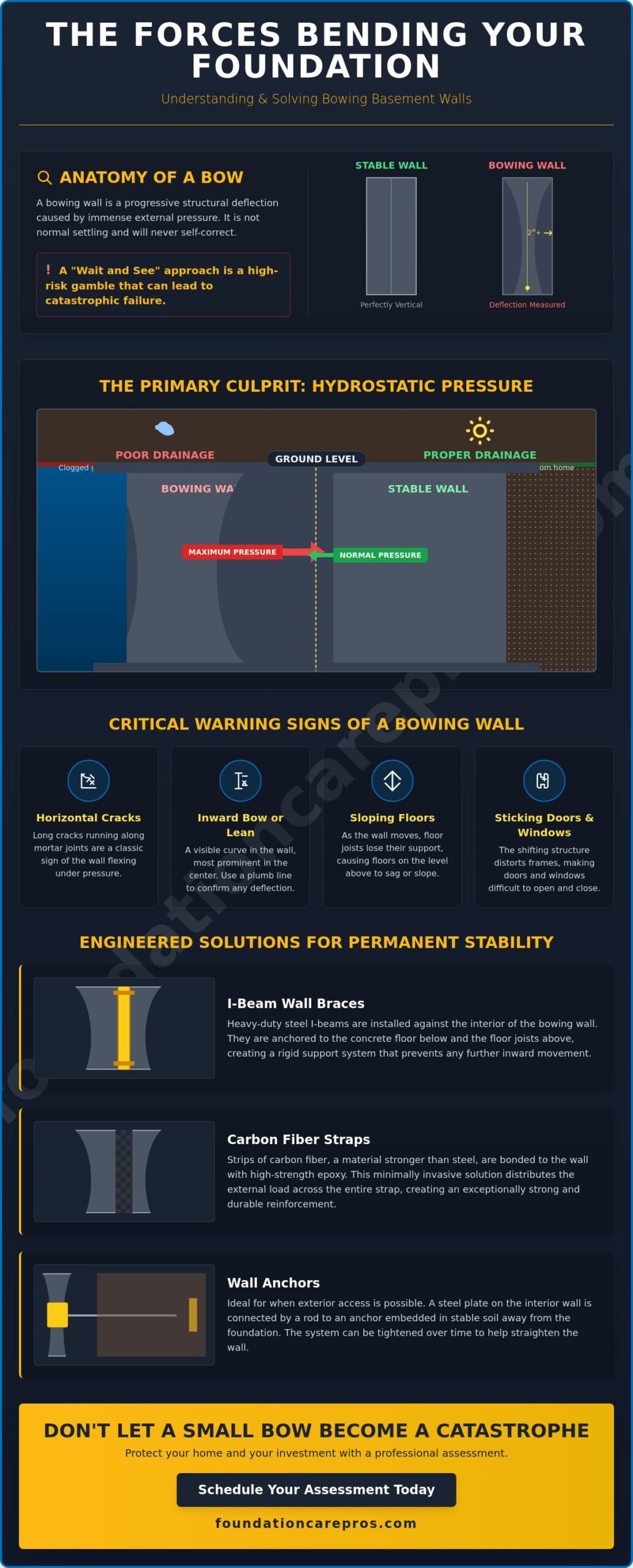
A bowing basement wall is a specific type of structural deflection where the vertical surface of your foundation curves or leans inward. This movement typically occurs in the center of the wall, creating an arc that compromises the home’s ability to support the weight above it. While homeowners often encounter minor cracks during routine maintenance, a visible bow indicates a significant shift in the relationship between your home and the surrounding soil. It’s a sign that the external environment is winning the battle against your foundation’s design.
You might hear that some movement is normal for older homes. This is a common misconception. While homes do settle vertically over time, bowing is a progressive issue that never self-corrects. It’s driven by lateral earth pressure, which is the force exerted by the soil and water against the exterior of your foundation. Once the wall begins to deflect, the structural integrity of the material is compromised. This makes it easier for that pressure to cause further damage, turning a small curve into a major structural threat.
The Anatomy of a Bowing Foundation Wall
Understanding what causes basement walls to bow requires looking at how the wall reacts to external stress. As the center of the wall moves inward, it creates an arc. This displacement disrupts the home’s center of gravity, shifting the load-bearing weight away from the vertical axis. You can visualize this by using a plumb line test. Simply hang a weighted string from the top of the wall to the floor. Any gap between the string and the wall’s surface confirms a deflection. This movement is often preceded or accompanied by specific types of foundation cracks and what they mean, such as long horizontal fractures running along the mortar joints.
Why ‘Wait and See’ is a Dangerous Strategy
Ignoring a bowing wall is a high-risk gamble. Even small deflections of less than two inches weaken the entire floor joist support system. These joists rely on a perfectly vertical wall to transfer the weight of the house to the footing. When the wall curves, the joists can lose their seat or begin to pull away from the sill plate. This misalignment causes floors to slope and doors to stick on the levels above.
This instability increases the risk of a sudden wall collapse, especially during extreme weather events where soil pressure spikes rapidly. Beyond the immediate safety concerns, waiting to address the issue complicates the process of selling a house with foundation issues. Buyers and inspectors prioritize structural stability. An unrepaired bow is a red flag that can halt a sale or drastically reduce your property value. Addressing the root cause early ensures a permanent, engineered solution that protects both your family and your equity.
The Primary Culprit: How Hydrostatic Pressure and Soil Mechanics Force Walls Inward
Hydrostatic pressure is the most common answer to what causes basement walls to bow. This engineering term describes the immense weight of water-saturated soil pressing against your foundation. When the ground surrounding your home cannot drain effectively, water pools against the exterior masonry. Because water is heavy, a yard saturated by a heavy storm exerts thousands of pounds of force. This pressure is not static; it fluctuates based on weather patterns and the efficiency of your home’s water management systems.
Poor yard drainage and gutter failure are the primary drivers of this accumulation. If downspouts discharge too close to the foundation or gutters overflow, the soil becomes a reservoir. This creates a destructive cycle of expansion. During heavy rain, the soil swells with water. During dry periods, it shrinks. This constant oscillation eventually fatigues the masonry, forcing the wall to yield to the external weight. Identifying these external pressures early allows you to implement a permanent stabilization strategy before the damage requires total wall replacement.
Soil composition also dictates the severity of this force. Sandy soils are porous, allowing water to pass through to deeper layers or drainage systems relatively quickly. In contrast, heavy, non-porous soils like silt trap moisture and maintain high pressure for longer durations. This difference in drainage capacity is why two identical homes on the same street can experience vastly different levels of foundation stress. The same moisture that saturates the soil around your foundation walls can also migrate beneath your home’s floor system, making water in crawl space areas a related concern that compounds the overall structural risk.
Expansive Clay Soils and the ‘Sponge’ Effect
Clay soils act like a massive underground sponge. At a molecular level, clay particles absorb water and physically expand in volume. This expansion generates significantly more lateral force than the weight of the water alone. Clay also exhibits an adhesion effect. As it swells, it grips the foundation wall and pushes it with immense strength. Because clay retains moisture so effectively, the pressure often remains constant long after the rain stops, making it a leading factor in what causes basement walls to bow.
The Role of Surcharge Loads Near the Foundation
Surcharge loads are external weights that intensify the existing soil pressure. Parking a heavy vehicle, like an RV or a large truck, near the foundation increases the downward and outward force on the soil. This extra weight is transferred directly to your basement walls. Similarly, large tree roots can act as physical levers. As roots grow and thicken, they displace soil and masonry, physically shoving foundation blocks out of alignment and creating localized points of failure that compromise the entire wall.
Beyond Water: Secondary Factors and Material Vulnerabilities
While water is the most aggressive force, environmental temperature swings and construction choices also influence what causes basement walls to bow. In regions with freezing winters, frost heave becomes a dominant factor. As moisture in the soil freezes, it expands by approximately 9% in volume. This expansion creates a multi-directional force that pushes upward against the footings and inward against the foundation surface. This repetitive cycle of freezing and thawing over several seasons can eventually overcome the wall’s structural resistance.
Thermal expansion and contraction cycles also play a role over long periods. Concrete and mortar are not static materials; they expand in the heat and contract in the cold. Over decades, these subtle movements create micro-fractures in the masonry. These small weaknesses eventually become the path of least resistance for lateral pressure. Additionally, extreme dry periods are just as problematic as heavy rain. When soil dries out, it shrinks and pulls away from the foundation. This creates a void where loose sediment or debris can fall. When the next rain arrives, the soil expands again, but it now has more material packed into the space, ratcheting the wall further inward with each cycle.
Block Walls vs. Poured Concrete: Different Failure Patterns
Failure patterns differ based on the construction material. Block walls are modular, meaning they are only as strong as the mortar holding them together. They typically bow along the horizontal mortar joints near the center of the wall, creating a “stair-step” or long horizontal fracture. If you notice this, you must ask, is a horizontal foundation crack serious? In block foundations, the answer is always yes. It indicates a loss of the structural bond between the units. Poured concrete walls are monolithic. Instead of cracking at a joint, they often “tip” inward from the top or develop a localized bulge where the concrete is thinnest or where the lateral pressure is most concentrated.
The Impact of Improper Backfilling
The quality of the soil used during the initial construction phase is a hidden factor in what causes basement walls to bow. Builders often use “native” soil excavated from the site to fill the gap around the finished foundation. If that soil is heavy in clay, it creates a permanent pressure trap for the life of the home. Modern engineered standards prefer gravel backfill. Gravel doesn’t expand and allows water to flow freely to the footing drains, relieving pressure before it builds. If the backfill contains construction debris like wood or broken bricks, it creates localized “point loads” that can punch through or crack the wall when the surrounding soil expands.
Assessing the Damage: Signs Your Foundation Wall is Nearing Structural Failure
A common mistake is assuming that a dry basement is a structurally sound one. Many homeowners believe that if they don’t see water intrusion, their foundation is safe. In reality, structural failure often begins long before a single drop of water enters the home. Understanding what causes basement walls to bow helps you interpret early warnings that occur while the masonry is still dry. These signs indicate that the lateral pressure from the surrounding soil has reached a tipping point, and the wall is no longer able to resist the load without assistance.
You can perform a basic DIY check using a standard four foot level or a plumb line. Place the level vertically against the wall in several locations. If you see a gap between the level and the wall’s surface, or if the bubble indicates the wall is not perfectly vertical, movement has occurred. In block foundations, look closely at the horizontal mortar joints. A “stair-step” crack pattern that follows the mortar lines is a classic precursor to significant bowing. This pattern shows that the pressure is successfully breaking the bond between the individual blocks, allowing the wall to flex inward.
The Warning Signs Checklist
- Horizontal Cracking: Fractures running along the mid-section of the wall indicate that the center is being pushed inward by external soil weight.
- Inward Tilting (Shearing): The top of the foundation wall may begin to lean inward, a sign that the connection to the sill plate is failing.
- Upper Corner Cracks: Cracking where the basement wall meets the ceiling suggests that the stress of the bow is transferring into the home’s wooden frame.
- First-Floor Disruptions: Windows or doors on the level above the basement that suddenly stick or won’t close often signal that the foundation below has shifted.
When is it an Emergency?
While any bowing requires professional attention, certain conditions qualify as a structural emergency. A deflection of more than two inches from a plumb position is considered critical. At this stage, the wall’s center of gravity has shifted far enough that a collapse becomes a mathematical probability during the next heavy saturation event. You should also watch for “sudden shifts,” which are cracks that grow significantly in width or length after a single storm. If you can see visible light through a crack or notice soil intruding into the basement, the wall’s structural integrity has been fully breached. If you identify any of these critical signs, it is time to consult a specialist for a professional foundation assessment to prevent further damage.
Permanent Stabilization: Engineered Solutions for Bowed Foundation Walls
Stabilizing a foundation requires a methodical approach that addresses both the visible damage and the underlying physics of the soil. Once you understand what causes basement walls to bow, it’s clear that a simple patch won’t suffice. The foundation repair process focuses on halting inward movement and, in many cases, applying the necessary force to restore the wall to its original vertical position. This is an engineered solution designed to return structural equilibrium to your home.
Professional installation is the only reliable way to ensure long-term safety. Attempting a DIY fix on a load-bearing wall can lead to uneven weight distribution or sudden structural failure. A specialist identifies the specific failure pattern of your masonry and selects a system that counteracts the exact lateral pressure your property faces. This process must also include a strategy to manage the water and soil mechanics outside the wall. Addressing the wall without managing the external environment is only half of the solution.
I-Beam Wall Braces and Carbon Fiber Straps
For many homeowners, i-beam wall braces installation is the most effective way to provide rigid, permanent support. These high-strength steel beams are anchored to the basement floor and attached to the floor joists above. They provide a physical barrier that the wall cannot move past. This system is particularly effective for walls with significant bowing because the braces can be tightened over time to potentially push the wall back toward plumb.
Carbon fiber straps offer a lower-profile alternative for walls with minor bowing, typically less than two inches. These straps are made of a high-tensile strength material that is virtually unbreakable once bonded to the foundation. While they don’t have the “straightening” power of steel beams, they are nearly invisible once painted. They act as a permanent reinforcement that prevents further deflection without taking up any floor space in your basement.
Wall Anchors and Drainage Management
Foundation wall anchors are a heavy-duty solution that utilizes the stable soil deep in your yard. This system involves placing an anchor plate in the yard and connecting it to a plate on the interior basement wall with a high-strength steel rod. By tightening the nut on the interior plate, the system pulls the wall outward. This is often the preferred method when significant wall straightening is required, as it uses the earth’s own stability to counteract what causes basement walls to bow.
No structural repair is complete without addressing moisture. Implementing comprehensive basement waterproofing is essential to relieve the hydrostatic pressure that caused the failure in the first place. This may include interior drainage systems or sump pump installations to keep the soil around your foundation dry. Professional diagnostics are required to determine which combination of stabilization and drainage is right for your home’s unique soil composition and structural needs.
Restore Stability and Security to Your Foundation
Understanding what causes basement walls to bow is the first step toward reclaiming your home’s structural integrity. We have identified that hydrostatic pressure and expansive clay soils are the primary forces driving these structural deflections. Whether you have noticed horizontal cracks or an inward lean, these symptoms indicate that the external lateral pressure has exceeded your wall’s design capacity. Ignoring these signs leads to progressive damage, but early intervention with engineered solutions ensures a permanent resolution.
Since 2004, our team has specialized in precision diagnostics and structural maintenance. As a proud Supportworks Network Member, we utilize industry leading technology to stabilize failing foundations. We focus on providing long term security through specialized I-beam wall braces and carbon fiber stabilization systems. Don’t let structural uncertainty lower your property value or compromise your safety. Protect your home’s structural integrity with a professional foundation inspection from Foundation Care Pros today. We are ready to help you secure your investment with a solution built to last.
Frequently Asked Questions
Can a bowing basement wall be fixed from the inside?
Yes, most modern stabilization methods are performed from the interior of the home. Systems such as I-beam wall braces and carbon fiber straps provide a permanent solution without the need for extensive yard excavation. These internal reinforcements effectively halt inward movement and restore structural stability. Choosing an interior solution often reduces the overall project timeline and prevents disruption to your landscaping or outdoor structures.
Is a bowing wall always caused by water?
Water is the most frequent culprit, but it is not the only factor. Soil mechanics, such as the expansion of clay particles and frost heave in cold climates, contribute significantly to lateral pressure. Additionally, surcharge loads from heavy vehicles or nearby construction can push walls inward. Understanding what causes basement walls to bow requires a comprehensive look at both environmental moisture and the physical weight of the surrounding earth.
How much bowing in a basement wall is acceptable?
Structural engineers generally consider any deflection beyond a fraction of an inch to be a failure of the wall’s vertical integrity. While small curves might seem minor, they indicate that the masonry has already yielded to external pressure. Once a wall bows more than 2 inches from plumb, it enters a critical stage. At this point, the risk of sudden failure increases, and the repair methods required become more complex and invasive.
Does homeowners insurance cover bowing basement walls?
Most standard homeowners insurance policies do not provide coverage for foundation repairs. Insurance typically covers sudden, accidental damage rather than gradual issues like hydrostatic pressure or soil expansion. Because bowing is considered a maintenance or long-term earth movement issue, the cost of stabilization usually falls to the homeowner. You should review your specific policy or consult your agent to determine if a rider covers structural shifts.
Can I sell my house if the basement walls are bowing?
Selling a home with structural issues is possible, but it requires full transparency. You must disclose the bowing wall to potential buyers and inspectors. Most mortgage lenders will not approve a loan for a property with an active structural threat. Completing an engineered repair with a transferable warranty before listing the property is the most effective way to protect your equity and ensure a smooth closing process.
How long does it take to repair a bowed foundation wall?
Most professional stabilization projects are completed within one to three days. Carbon fiber strap installation is often the fastest method, frequently finishing in a single work shift. I-beam wall braces may take slightly longer depending on the number of beams required and the basement’s configuration. More intensive solutions, such as wall anchors that require exterior work, typically extend the timeline but rarely exceed a standard work week.
Will my house collapse if the basement wall is bowing?
Total collapse is the final stage of structural failure and usually follows years of neglect. While your house likely won’t collapse overnight, a bowing wall is a warning that the foundation is losing its capacity to support the home’s weight. The risk of a catastrophic breach is highest during periods of extreme saturation or rapid freeze-thaw cycles. Addressing the issue early eliminates this risk and provides permanent peace of mind.
What is the difference between settling and bowing?
Settling refers to the vertical sinking of a foundation into the ground, which often leads to uneven floors or cracked drywall. In contrast, what causes basement walls to bow is lateral pressure pushing the wall inward horizontally. While both issues are serious, they require different engineering solutions. Settling often necessitates pier systems to reach stable soil, while bowing requires bracing or anchors to resist the horizontal force of the earth.