Is your home’s foundation a ticking financial clock? Waiting for a hairline crack to become a structural crisis often triples the eventual foundation stabilization cost. It’s unsettling to watch your family’s largest asset shift, especially when you’re faced with complex engineering terms and the fear of being overcharged. You deserve a permanent fix, not a temporary patch that fails when the soil shifts again. We recognize that structural integrity is non-negotiable for your family’s safety and your property’s long-term value.
This guide provides the technical clarity you need to evaluate different stabilization methods and protect your investment. You’ll learn how variables like soil depth and structural load dictate the necessary engineering response. We’ll compare systems like I-Beam wall braces, carbon fiber straps, and foundation pier systems to help you identify the most effective solution for your basement or crawl space. You’ll gain a professional framework to analyze quotes with confidence and ensure your home remains on solid ground for decades to come.
Key Takeaways
- Distinguish between permanent structural stabilization and temporary cosmetic fixes to ensure your home’s long-term safety.
- Identify the specific engineering variables, such as soil depth and pier count, that determine your foundation stabilization cost.
- Compare the technical applications of I-Beam wall braces, wall anchors, and pier systems for different structural failures.
- Establish a clear framework for evaluating professional quotes based on diagnostic precision and structural verification.
- Understand why Foundation Care Pros relies on lab-tested, engineered hardware to deliver permanent solutions for your property.
Table of Contents
- Defining Foundation Stabilization: More Than Just a Repair
- Comparing Stabilization Methods: Piers, Braces, and Anchors
- Variables That Drive Foundation Stabilization Cost in 2026
- A Homeowner’s Framework for Evaluating Stabilization Quotes
- The Supportworks Advantage: Why Foundation Care Pros is the Solution
Defining Foundation Stabilization: More Than Just a Repair
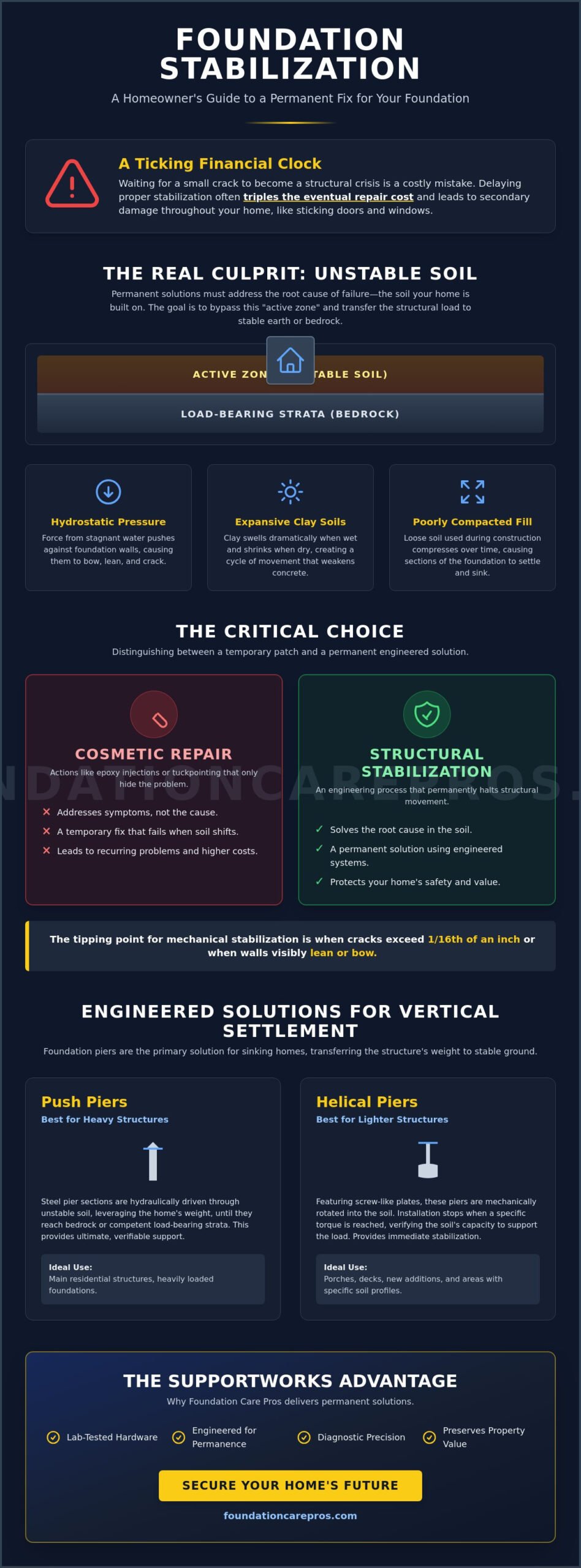
Foundation stabilization is a precision engineering process designed to halt structural movement permanently. It differs fundamentally from standard repairs that only address the visible symptoms of a settling home. While a repair might involve patching a crack, stabilization involves installing engineered systems to secure the home against future shifts. Understanding your total foundation stabilization cost requires looking past the surface of the concrete and focusing on the underlying soil mechanics. Proper stabilization ensures that the weight of your home is no longer supported by unstable, shifting earth but is instead transferred to competent, load-bearing strata.
Structural loads must be managed with mathematical certainty. When a foundation begins to fail, the weight of the structure creates stress points that the original footing can no longer support. Stabilization systems, such as foundation piers or wall anchors, intercept these loads. They redirect the pressure away from the failing sections of the foundation and into deeper, more stable soil layers. This process provides a sense of permanence that simple masonry work cannot achieve.
Stabilization vs. Cosmetic Repair
Filling a basement crack with epoxy or performing tuckpointing on exterior brickwork are cosmetic measures. These actions don’t address the reason the crack formed in the first place. If the soil continues to move, the new patch will simply fail, often within a single season. The tipping point for mechanical stabilization occurs when cracks exceed one-sixteenth of an inch or when walls begin to lean or bow. At this stage, underpinning becomes the gold standard. Underpinning involves installing mechanical supports like push piers or helical piers to provide the structural validation your home requires.
The Role of Soil Mechanics in Stabilization
Most structural failures stem from the soil surrounding the home. Expansive clay soils swell when wet and shrink when dry, creating a cycle of movement that weakens concrete over time. Poorly compacted fill dirt can also lead to sudden settlement as the house’s weight compresses the ground. Hydrostatic pressure is the force exerted by stagnant water against your foundation walls, acting as the primary driver for mechanical stabilization needs. To solve these issues, stabilization systems must reach deep enough to bypass the “active zone” of surface soil and anchor into bedrock or dense, stable earth.
Delaying these interventions almost always guarantees a higher foundation stabilization cost in the future. As a foundation continues to shift, it creates secondary damage throughout the house. You’ll notice doors that no longer latch, windows that stick, and even roofline separations. These issues require additional, expensive interior restoration that can be avoided by securing the structure immediately. Investing in a permanent engineered solution protects your family’s safety and preserves the equity in your property.
Comparing Stabilization Methods: Piers, Braces, and Anchors
Different structural failures require specific engineered systems to restore safety. Your total foundation stabilization cost is determined by which mechanical solution best addresses your home’s unique symptoms. We utilize Supportworks systems, which are lab-tested to provide a permanent fix for settlement and bowing walls. These systems range from heavy-duty steel piers that reach bedrock to low-profile carbon fiber straps designed for early-stage reinforcement. Selecting the wrong method leads to recurring repairs, so matching the technology to the soil condition is vital.
Piering Systems: Push Piers vs. Helical Piers
Homeowners often ask what are foundation piers and why they are necessary. These systems are the primary solution for vertical settlement, where sections of the home are sinking into the earth. Push piers are the most common choice for heavy residential structures. They use a hydraulic installation process that leverages the weight of the house to drive steel pier sections deep into the ground. These piers continue until they reach bedrock or a load-bearing soil layer that can support the structure’s weight indefinitely.
Helical piers function differently. They feature screw-like plates on the lead section and are mechanically “screwed” into the soil. This method is ideal for lighter structures like porches, decks, or new additions where the building’s weight isn’t sufficient to drive push piers. Helical pier foundation systems provide immediate stabilization and are often used in areas with specific soil profiles that require a high degree of torque-verified capacity. Both systems effectively bypass unstable topsoil to provide a permanent foundation for your home. For a deeper understanding of how these systems address sinking structures, our guide to foundation settlement repair explains the complete underpinning process in detail.
Wall Reinforcement: I-Beams and Wall Anchors
Lateral movement requires a different engineering approach than vertical settlement. When hydrostatic pressure from saturated soil pushes against your basement walls, they begin to bow or lean inward. A i-beam wall braces installation stops this movement by providing a rigid, vertical support system. These zinc-plated steel beams are anchored to the floor and the floor joists above, creating a tension-based barrier that prevents further inward shifting. They are highly effective for severe bowing in unfinished basements.
Wall anchors provide a unique advantage by using a “clamping” force. They consist of an interior wall plate connected by a steel rod to an anchor plate buried in the yard. Over time, these anchors can be tightened to pull the wall back toward its original position. For homeowners with finished basements or minor bowing, carbon fiber straps offer a low-profile alternative. These straps are bonded directly to the wall with high-strength epoxy. They are nearly invisible once painted, making them the preferred choice for maintaining aesthetic value while securing the structure. To understand the full range of engineered options available for lateral wall movement, our comprehensive guide to basement wall stabilization systems provides an in-depth comparison of every method. If you notice signs of movement, obtaining a professional evaluation is the first step in choosing the right system.
Variables That Drive Foundation Stabilization Cost in 2026
Every structural project is unique. Your foundation stabilization cost isn’t a random figure; it’s a direct reflection of the physical requirements of your property. Specialists use specific metrics to calculate the force needed to stop movement. These metrics translate into a per-unit pricing model that ensures you only pay for the materials and labor required for your specific soil conditions. This precision prevents the overcharging often associated with flat-rate quotes that lack technical backing.
The ‘Per Pier’ and ‘Per Brace’ Pricing Model
Pricing by the number of stabilization points is the industry standard for professional engineering. This model provides transparency and allows for adjustments based on the severity of the damage. For example, a typical corner settlement project often requires between 5 and 7 push piers to properly distribute the structural load. If you’re dealing with bowing walls, the count is determined by linear footage. We typically install I-Beam wall braces or wall anchors every 4 to 5 feet. This spacing is essential to ensure that lateral pressure is evenly countered across the entire span of the masonry.
Hidden Variables: Depth and Obstructions
Depth is the most significant variable in any piering project. Specialists don’t know the exact depth of load-bearing strata or bedrock until the installation begins. A pier that reaches capacity at 20 feet requires less material and labor than one that must go to 40 feet. While soil testing and borings help provide a data-driven estimate, the final depth is verified during the hydraulic installation process. This real-time verification ensures the system is anchored in soil capable of supporting your home’s weight.
Physical accessibility also dictates labor intensity. If a crew must hand-dig around buried utilities or work underneath a low-clearance deck, the project timeframe expands. Obstructions like HVAC units, established landscaping, or interior finished walls also play a role. Removing and replacing these items adds to the logistical complexity of the site. Finally, structural validation requires professional oversight. Permitting fees and structural engineer inspections ensure that the plan meets local building codes. These steps are necessary to validate the permanent nature of the solution and provide the documentation needed for future property value.
A Homeowner’s Framework for Evaluating Stabilization Quotes
Selecting a contractor based solely on the lowest foundation stabilization cost often leads to substandard materials and incomplete engineering. A professional structural evaluation must be methodical and data-driven. It should involve precise measurements of floor elevations and wall plumbness rather than a simple visual walkthrough. You need a partner who views your home as a complex structural system, not just a series of cracks to be patched. This diagnostic precision is the only way to ensure the proposed solution will actually stop the movement of your foundation.
Red flags are common in the foundation industry. Beware of “one-size-fits-all” solutions where a contractor suggests the same repair for every home regardless of the soil type or damage severity. High-pressure sales tactics that demand an immediate signature are another sign of a non-specialist. A principled specialist provides the facts and allows the engineering data to speak for itself. Always ask about the specific hardware and steel grade being proposed; the materials used underground are just as important as the expertise of the crew installing them.
Verifying System Quality and Warranty
Hardware quality is a primary driver of long-term reliability. Galvanized steel provides superior corrosion resistance compared to painted or untreated steel. Because stabilization systems reside in damp, underground environments for decades, untreated steel will eventually weaken. Choosing a Supportworks dealer ensures your home is protected by lab-tested, proprietary hardware designed by structural engineers. This membership indicates a higher standard of training and a commitment to verified results.
Warranty terms also require close inspection. You must distinguish between a simple workmanship warranty and a structural performance guarantee. A workmanship warranty only covers the labor of the installation. A structural performance guarantee ensures the system will actually hold the home in place. Look for transferable warranties that stay with the property. These “life of the structure” guarantees provide immense value during a home sale, as they offer the next buyer verified proof of stability.
Comparing Quotes: Apples to Apples
Ensure you are comparing identical scopes of work when reviewing multiple estimates. Verify that both contractors are addressing the same number of stabilization points. If one quote includes five piers and another includes eight, the higher count often reflects a more accurate load distribution plan. A lower foundation stabilization cost might simply mean the contractor is cutting corners on the number of supports required to secure the structure safely.
Confirm that the quote is comprehensive. It should include permit fees, soil restoration, and site cleanup. Some contractors leave these as hidden costs for the homeowner to handle later. Consult our guide on types of foundation cracks to ensure the proposed repair matches the symptoms your home is exhibiting. If you’re ready for a precise, engineering-based assessment of your property, schedule a professional structural evaluation to get a clear path forward.
The Supportworks Advantage: Why Foundation Care Pros is the Solution
Foundation Care Pros operates as a specialized Supportworks dealer. This partnership grants us exclusive access to engineered hardware that is unavailable to general contractors. We focus on providing a permanent resolution to structural failure through a methodical, evidence-based approach. Our team understands that your foundation stabilization cost represents a significant commitment to your home’s future. We honor that commitment by utilizing lab-tested components designed for maximum durability in volatile soil conditions. Our role is to act as your technical expert and protective advocate, ensuring your property remains secure.
Proprietary Stabilization Technology
Our I-Beam wall braces and foundation pier systems represent the pinnacle of structural engineering. These components are manufactured with high-strength, galvanized steel to resist corrosion and maintain integrity for the life of the structure. A unique benefit of our mechanical systems is the ability for future adjustment. If extreme weather causes further soil shifts, these systems can be professionally tightened to maintain support. Our solutions are designed to be permanent, providing a level of validation that superficial repairs simply cannot match.
The Diagnostic Experience
We eliminate guesswork through a comprehensive inspection process. Our specialists use precision tools to map floor elevations and measure wall deflection with mathematical accuracy. This data allows us to create a clear, written plan that explains the technical necessity behind every proposed stabilization point. You will understand exactly why specific hardware is required and how it will interact with your home’s unique load requirements. This transparency ensures you know exactly what drives your foundation stabilization cost before any work begins.
Professional stabilization does more than just keep your walls straight. It protects your property’s resale value by providing documented proof of structural integrity to future buyers. When you choose a principled specialist, you are securing the long-term health of your family’s largest asset. We provide the technical clarity and reliable execution needed to restore your peace of mind. Take the first step toward a stable home and schedule your professional foundation evaluation today.
Securing Your Home’s Structural Future
Stabilization is a commitment to the permanence of your property. By choosing engineered systems over surface-level patches, you protect your home from the unpredictable cycles of soil movement. You now have the technical framework to evaluate professional quotes based on engineering merit and material quality. Understanding the variables that influence foundation stabilization cost ensures you’re investing in a solution that addresses the root cause of structural failure rather than just the symptoms.
Foundation Care Pros is a locally owned structural specialist and a member of the Supportworks Network. We utilize exclusive high-grade galvanized steel systems to provide a standard of structural validation that lasts for decades. Our diagnostic process removes the uncertainty from structural maintenance, providing you with a clear path toward a safe and stable home. Don’t let structural issues compromise your family’s safety or your property’s value. Request a Free Stabilization Estimate from Foundation Care Pros. You can move forward with confidence knowing your foundation is supported by the industry’s most reliable technology.
Frequently Asked Questions
Is foundation stabilization covered by homeowners insurance?
Homeowners insurance typically does not cover stabilization for gradual soil settlement or wear and tear. Most policies specifically exclude “earth movement” unless the damage resulted from a covered peril, such as a sudden plumbing failure or a burst pipe. You should review your specific policy or consult your agent to determine if your structural repairs qualify for a claim. Identifying the root cause is essential for any potential coverage evaluation.
How long does the foundation stabilization process typically take?
Most residential stabilization projects are completed within one to three days. The exact timeline depends on the number of piers or braces required and the specific depth of the load-bearing soil. While the mechanical installation is efficient, complex sites with significant obstructions or deep excavation needs may extend the schedule. We provide a projected timeframe during the initial diagnostic phase to help you plan accordingly.
Can I stay in my home while the stabilization systems are being installed?
You can remain in your home throughout the entire installation process. Our crews work primarily on the exterior of the foundation or within the basement or crawl space. The mechanical installation produces some noise and vibration, but it does not require you to vacate the premises or disrupt your daily routine. We prioritize a clean and organized job site to minimize the impact on your family’s schedule.
What happens if the piers need to go deeper than originally quoted?
Final pier depth is confirmed during hydraulic installation when the system reaches load-bearing capacity. If piers must go deeper than the initial estimate to reach stable strata, it will impact the total foundation stabilization cost because of the additional steel sections and labor required. We monitor pressure gauges in real-time to ensure every pier meets the specific engineering standards for your home’s structural load.
Will stabilizing my foundation fix the cracks in my drywall upstairs?
Stabilization is designed to halt further movement, which stops new drywall cracks from forming. In some cases, the lifting process can close existing gaps, but this result is not guaranteed. You should wait several weeks after the foundation is secured before performing cosmetic repairs. This waiting period ensures the structure has fully settled into its new, stable position before you patch and paint interior walls.
How do I know if I need push piers or helical piers?
Push piers are generally used for heavy residential structures that require reaching deep bedrock for support. Helical piers are better suited for lighter loads, such as porches or decks, or for sites with specific soil profiles where torque-verified capacity is needed. To fully understand the engineering behind this anchoring technology and determine whether it is right for your property, our guide to helical pier foundation systems walks through the complete installation process and benefits in detail. A professional structural evaluation determines the correct system based on your home’s weight, the damage severity, and the local soil conditions discovered during diagnostics.
Does foundation stabilization increase the value of my home?
Securing your foundation protects your home’s equity and increases its marketability to future buyers. While the foundation stabilization cost is an upfront investment, a failed foundation often leads to a significant reduction in resale value. Providing a transferable, “life of the structure” warranty gives potential buyers the confidence they need to proceed. This documentation validates that the home is structurally sound and ready for a smooth transaction.
What is the difference between stabilization and waterproofing?
Stabilization addresses the structural integrity of the foundation, while waterproofing manages water intrusion and moisture. Systems like foundation piers or wall anchors stop the home from moving, sinking, or bowing. In contrast, interior basement drainage and sump pumps prevent water damage and mold growth. Many homes require both to ensure the foundation remains dry and structurally sound over the long term.