What if the most effective way to save your home’s foundation isn’t by digging it up, but by screwing it deeper into the earth? It’s a counterintuitive concept, but helical pier foundation systems have become the gold standard for homeowners facing the stress of structural settlement. You’ve likely noticed the warning signs: cracks in the drywall, sticking windows, or a chimney pulling away from the house. These aren’t just cosmetic issues; they’re signals that your home is losing its battle with unstable soil.
It’s natural to feel overwhelmed by technical jargon and the fear of a massive, invasive construction project. We understand that you want a solution that’s both permanent and professional. This guide will help you master the engineering behind helical piers so you can make an informed decision for your property. We’ll examine the benefits of this high-capacity anchoring technology and walk through the precise installation process. By the end, you’ll have a clear path toward a stable, warrantied foundation and the peace of mind that comes with a job done right.
Key Takeaways
- Understand how helical pier foundation systems utilize steel plates to anchor your home into deep, competent soil layers for permanent stability.
- Recognize the specific engineering differences between torque-driven helical piers and hydraulic push piers to choose the right solution for your structure.
- Learn to identify the subtle structural warning signs, from stair-step cracks to tilting chimneys, that necessitate professional intervention.
- Follow the methodical 5-step installation process designed to secure your foundation with surgical precision and minimal property impact.
- Ensure the long-term value of your investment by utilizing ICC-ES certified components that meet rigorous international building standards.
Understanding Helical Pier Foundation Systems and Structural Support
Helical pier foundation systems are engineered structural anchors designed to stop residential settlement permanently. These systems consist of round or square steel shafts with circular, corkscrew-like plates called helices. By rotating these shafts into the earth, we create a stable platform that supports the weight of your home. You might hear technicians refer to them as screw piles or helical anchors. This Helical Pier Overview explains that while the technology has existed for over a century, modern engineering has refined it into the most reliable method for residential stabilization.
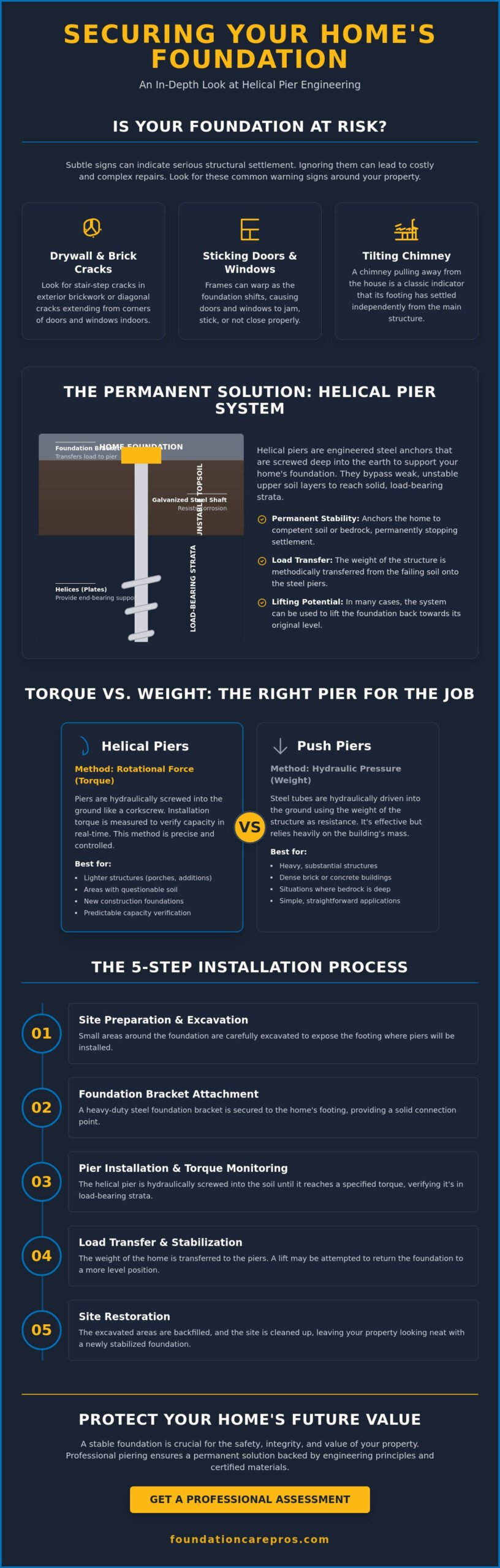
Identifying settlement early is the best way to protect your investment. You don’t need to be an engineer to spot the warning signs. Look for stair-step cracks in exterior brickwork, chimneys that lean away from the roofline, or window frames that seem to be pulling out of the wall. These aren’t just cosmetic flaws. They indicate that the soil beneath your foundation is shifting or collapsing. Many homeowners try to hide these issues with masonry tuckpointing or cosmetic crack injections. These surface-level fixes are temporary and dangerous. They mask the damage without addressing the fact that your home is still sinking.
The primary role of these piers is to bypass unstable topsoil. The upper layers of earth are often prone to moisture changes and poor compaction. A professional piering system transfers the structural load past these problematic layers. It reaches down to the load-bearing strata, which is the dense soil or bedrock capable of supporting thousands of pounds of pressure. This method ensures your home remains level regardless of what happens in the top few feet of soil.
The Anatomy of a Helical Pier
Every pier starts with a lead section. This is the first piece into the ground, featuring the helical plates that provide the necessary lift and capacity. The helix pitch is carefully calculated to determine how much the pier advances with each turn. We add steel extensions until the pier reaches the required depth and torque. A foundation bracket then attaches the pier to your home’s footing. We use galvanized steel for every component to prevent corrosion. This protective layer ensures the steel doesn’t degrade in the moist, underground environment, providing a permanent fix.
When is Settlement a Serious Structural Threat?
Minor seasonal settling is common, but differential settlement is a crisis. This occurs when soil moisture changes cause one section of the foundation to drop while others remain stable. These shrink-swell cycles are typical in areas with heavy clay. You can learn more about identifying these issues by studying types of foundation cracks and what they mean. If you see active movement, you need foundation settlement repair. Waiting only increases the cost and complexity of the eventual fix.
The Engineering Principles of Helical Underpinning
Helical pier foundation systems operate on a mechanical principle similar to a standard wood screw. While traditional push piers require the immense weight of a heavy masonry building to drive steel into the ground, helical piers use hydraulic rotational force. This allows us to install them with minimal downward pressure. It’s a safer method for structures that aren’t heavy enough to resist hydraulic ramming, such as porches, decks, or wood-frame additions. By using torque instead of raw weight, we can stabilize a wider variety of home styles without risking damage to the existing footings.
The system achieves stability through the end-bearing principle. Instead of relying on skin friction along the length of the shaft, the weight of the home rests on the helical plates. These plates are screwed down until they bypass soft, expansive clays to reach load-bearing strata. This layer of competent soil or bedrock provides the necessary resistance to stop settlement permanently. By focusing the load on the plates, the system ensures that the shaft itself remains a conduit for the weight rather than the primary support. This design prevents the pier from sinking further even if the upper soil layers become saturated or dry out.
We use real-time data monitoring during every installation to ensure accuracy. Technicians track the torque levels as the pier advances through different soil densities. This verification process ensures that every installed pier meets the specific engineering requirements for your home’s unique footprint. If you’re concerned about your home’s stability, getting a professional assessment of your foundation pier systems is a logical first step toward a permanent solution.
Torque-to-Capacity Correlation: How Stability is Verified
The most critical part of the engineering process is the torque-to-capacity correlation. As the pier enters denser soil, the hydraulic pressure required to turn it increases. We measure this torque in foot-pounds to calculate the pier’s ability to hold weight. We continue driving the pier until it hits the point of refusal, where the torque indicates the soil is strong enough to support the structure. Ultimate capacity is the maximum load a pier can handle before failure. This mathematical approach removes the guesswork from foundation repair, providing a validated result for every pier installed.
Round vs. Square Shafts: Which Design Fits Your Soil?
Choosing the right shaft design for your helical pier foundation systems depends on your soil conditions and the structural load. Round shaft piers are the industry standard for residential compression loads. Their shape provides superior resistance to bending and buckling under the vertical weight of a house. Square shaft piers are often used in high-torque situations or when tension is a major factor. Soil types like dense sand or stiff clay might require specific helix configurations to ensure the pier bites correctly into the earth. Every component we use carries ICC-ES certification. This validation confirms that the steel meets international standards for quality, safety, and long-term structural performance.
Helical Piers vs. Push Piers: Selecting the Right Stabilization Method
Choosing between helical and push piers depends on the weight of your home and the specific soil conditions on your property. While both systems provide deep structural support, they function through different mechanical processes. Push piers rely on the existing weight of a building to drive steel sections into the earth. If a structure is too light, the hydraulic ram will simply lift the house instead of driving the pier. Helical pier foundation systems avoid this issue by using torque to screw into the ground. This makes helical piers the superior choice for lighter structures such as porches, decks, or modern wood-frame additions. For a detailed technical breakdown of how these two methods compare under 2026 engineering standards, review our comprehensive guide on helical piles vs push piers.
Heavy masonry structures often benefit more from push piers. In these cases, the massive “dead load” of the brick and concrete serves as a perfect counterweight for hydraulic installation. Soil composition also dictates the choice. Helical piers perform exceptionally well in expansive clay or areas with high water tables. The helical plates provide immediate load-bearing capacity even in less dense soils. Understanding these differences ensures that the stabilization method matches the engineering needs of your specific foundation type.
Soil Conditions and Structural Weight Requirements
Push piers require a heavy house to act as a resistance point during the driving process. Without sufficient structural weight, the pier cannot reach the necessary depth to find competent soil. Helical piers are independent of the building’s weight. This independence allows us to use them for pre-construction, where we install the piers before the foundation is even poured. This proactive approach prevents future settlement issues in known problem soils. Budgeting for these repairs varies based on the system chosen. You can review a foundation stabilization cost guide to understand how these technologies compare as a long-term investment.
New Construction vs. Existing Foundation Repair
New construction helical piers are a specialized application for building on sites with poor surface soil. We install these piers to a predetermined torque, ensuring the future home sits on a verified foundation from day one. For existing homes, we use an underpinning process to stop active sinking. Existing homes experiencing foundation settlement require a careful diagnostic to determine the best pier placement. We attach heavy-duty brackets to the existing footing and then install the piers to stabilize or even lift the structure back toward its original level.
- Select Helical Piers for: Porches, decks, new additions, pre-construction, and lighter wood-frame homes.
- Select Push Piers for: Multi-story masonry homes, heavy concrete structures, and areas where bedrock is extremely deep.
- Soil Factor: Use helical piers in sandy or loose soils where friction-based systems might struggle.
- Access: Helical equipment is often more portable, making it ideal for tight spaces between properties.
The Helical Pier Installation Process: From Site Prep to Stabilization
Professional installation of helical pier foundation systems follows a disciplined, five-step sequence. This methodical approach ensures that the structural repair is both accurate and permanent. We don’t just drive steel into the ground; we execute a calibrated engineering plan designed for your specific property. Every step focuses on precision and data verification to ensure the home’s weight is safely transferred to stable soil.
Diagnostic Assessment and Footing Preparation
Technicians begin by mapping settlement patterns to determine the exact placement of each pier. Spacing is critical. If piers are too far apart, the foundation may still flex. If they are too close, it creates unnecessary costs. Once we finalize the engineering plan, we carefully remove landscaping or concrete to reach the foundation’s footing. We then clean and prep the footing to receive the heavy-duty steel brackets. This preparation often involves “notching” the concrete so the bracket sits directly under the stem wall for maximum support. In some cases, we may recommend basement wall stabilization if inward bowing accompanies the settlement. Preparing the site correctly is the only way to guarantee a secure connection between the home and the piers.
Installation Sequence and Final Load Transfer
The driving sequence uses specialized hydraulic equipment to rotate the piers into the earth. This process creates very little vibration. This is a significant benefit for homeowners with fragile masonry or historical finishes that could be damaged by the heavy pounding of other methods. We monitor the hydraulic pressure in real-time to verify when the piers have reached the load-bearing strata. After all piers are installed to the required torque, we utilize a hydraulic manifold system. This tool allows us to lift different sections of the foundation simultaneously. By distributing the pressure across multiple points, we can safely stabilize the home or attempt to close existing cracks in the drywall and brickwork.
The final step is the permanent locking of the piers. We secure the brackets and transfer the home’s weight onto the new, stable foundation system. Once the structure is secure, we backfill the excavation sites and restore the landscaping. Our goal is a clean installation that leaves your property looking as though we were never there. If you are ready to secure your home’s future, you can schedule an inspection for our foundation pier systems today. We prioritize a methodical cleanup so your home’s curb appeal is restored immediately after the structural work is complete.
Securing Your Home’s Future with Professional Foundation Piering
Investing in your foundation is a commitment to the permanence of your home. Helical pier foundation systems offer a level of security that surface-level repairs simply cannot provide. However, the true value of the repair lies in the engineering of the components and the precision of the installation. We utilize ICC-ES certified pier systems to ensure every repair meets international building standards for safety and load capacity. This certification acts as a validation of quality, confirming that the steel components will perform as expected under the immense pressure of a residential structure.
Foundation Care Pros operates as a principled specialist in structural restoration. We focus on evidence-based results rather than quick fixes. Our methodical diagnostic process identifies the root cause of settlement, allowing us to implement a solution that stops movement permanently. This professional approach lowers the stress associated with foundation failure by replacing uncertainty with a warrantied, engineered result. We take pride in being a local authority that is personally invested in the welfare of your property.
Our Commitment to Quality Components and Expertise
Foundation Care Pros upholds the highest industry standards for foundation repair components. Every bracket, lead section, and extension undergoes rigorous testing to verify its structural integrity under extreme conditions. Our technicians participate in specialized training programs to master the complexities of soil mechanics and torque-to-capacity correlation. This high level of expertise ensures that every pier we install reaches the competent load-bearing strata required for your home’s specific weight. We prioritize high-grade, American-made steel for all structural components to ensure maximum resistance to corrosion and bending. Using superior materials is a fundamental part of our commitment to your home’s long-term safety.
Protecting Home Value with Transferable Warranties
Protecting your home’s equity requires documented proof of structural stability. A history of foundation settlement can deter potential buyers or complicate the mortgage process. We provide transferable structural warranties that turn a past repair into a verified asset. This certification gives future owners confidence that the property is anchored to stable ground. Our team often combines piering with other advanced solutions, such as I-Beam wall braces, to provide a comprehensive stabilization plan for both the footing and the foundation walls. This integrated approach ensures every structural vulnerability is addressed with professional care. If you suspect your foundation is shifting, contact Foundation Care Pros for a professional structural assessment to begin the process of securing your home’s future.
Restore Your Home’s Structural Integrity Today
Securing your foundation is the most important step you’ll take to protect your home’s long-term value. You now understand how helical pier foundation systems bypass unstable soil to provide a permanent, engineered solution. By choosing a system that relies on torque-verified capacity and ICC-ES certified components, you’re replacing structural uncertainty with a validated result. These systems don’t just stop current settlement; they provide a stable platform that protects your property against future soil shifts.
Foundation Care Pros is a locally owned and operated specialist dedicated to professional structural care. As a proud Supportworks Network member, we use the highest quality American-made steel and advanced diagnostic tools to ensure every pier reaches the required load-bearing strata. Our methodical approach ensures your home is stabilized with minimal disruption to your daily life. We don’t let foundation cracks compromise your peace of mind or your equity. It’s time to invest in a permanent fix that’s backed by technical expertise and a commitment to quality.
Schedule Your Structural Diagnostic with Foundation Care Pros and take the first step toward a stable, worry-free home.
Frequently Asked Questions
How deep do helical piers usually go?
Helical piers typically reach depths between 10 and 25 feet, though they can go much deeper depending on your local soil conditions. We add steel extensions until the pier reaches a layer of earth dense enough to provide the required torque. This ensures the pier rests in competent soil that won’t shift or sink under the weight of your home.
Can helical piers actually lift my house back to its original level?
Lifting a house back to its original level is often possible, but stabilization is always the primary objective. We use a hydraulic manifold system to apply even pressure across multiple piers, which can close drywall cracks and realign doors. The success of a lift depends on the structural integrity of your foundation and how long the settlement has been occurring.
How long does a typical helical pier installation take?
Most residential helical pier foundation systems are installed in just one to three days. The timeline depends on the number of piers required and the ease of access to the foundation. Because the installation doesn’t require large-scale excavation or concrete curing time, we can complete the project quickly and efficiently.
Will helical pier installation damage my landscaping or driveway?
Landscaping and driveway damage is kept to an absolute minimum during installation. We use compact, specialized hydraulic equipment that can navigate tight spaces without destroying your yard. While we must excavate small areas to attach the brackets to your footing, we backfill these holes and restore the soil as part of our final cleanup process.
What is the difference between a helical pier and a push pier?
The main difference lies in how the piers are driven into the earth. Helical piers are screwed into the soil using hydraulic torque, making them ideal for lighter structures or pre-construction. Push piers use the weight of the house itself as a counterweight to drive steel sections down. We select the specific pier type based on your home’s weight and the density of your soil. Understanding the full technical comparison of helical piles vs push piers can help you make the most informed decision for your property.
How many helical piers does my house need for stabilization?
A typical home requires one pier every six to ten feet along the settled area of the foundation. The exact number depends on the structural load of your home and the severity of the settlement. A professional diagnostic assessment identifies these exact locations to ensure the weight is distributed safely across the new support system.
Are helical pier systems covered by a structural warranty?
Professional helical pier systems installed by certified specialists come with long-term, transferable structural warranties. This warranty protects your investment and provides peace of mind for future buyers if you decide to sell your home. It serves as a guarantee that the foundation has been permanently stabilized according to rigorous engineering standards.
What happens if a helical pier doesn’t hit bedrock?
Bedrock isn’t always the target for a successful installation. helical pier foundation systems rely on torque-to-capacity correlation, meaning they are driven until the soil provides enough resistance to support the load. Once the technician monitors the hydraulic pressure and hits the required torque, the pier is secure even if it hasn’t reached solid bedrock.