The heaviest solution isn’t always the most effective one for a bowing basement wall. While a thick steel column looks more secure, a carbon fiber strip actually offers up to ten times the tensile strength of steel. Choosing between carbon fiber straps vs steel beams depends entirely on the specific degree of deflection in your foundation. If your wall has moved less than two inches, a low profile strap is often the superior choice. However, if the inward movement exceeds that two inch threshold, structural standards typically require the rigid reinforcement of a steel I-beam meeting ASTM A36 specifications.
You likely feel the weight of this decision every time you notice a new crack or a slight curve in the masonry. It’s difficult to balance the fear of structural failure with the concern of losing valuable living space to bulky repairs. This guide provides the technical clarity you need to select a permanent fix that fits your goals. We will compare the installation requirements of both systems, their impact on future basement finishing, and the diagnostic steps required for professional verification. You deserve a solution that ensures your home remains stable and secure for the long term.
Key Takeaways
- Identify how hydrostatic pressure and expansive clay soils exert thousands of pounds of lateral force against your foundation.
- Discover how aerospace-grade carbon fiber provides a low-profile, high-strength solution that allows for future basement finishing.
- Compare carbon fiber straps vs steel beams to determine which system provides the necessary structural rigidity based on your wall’s specific deflection.
- Evaluate installation timelines and long-term maintenance requirements to select a permanent, engineered solution for your home.
- Learn why professional diagnostic tools like laser levels and moisture meters are essential for a verified and secure structural repair.
Understanding the Forces Behind Bowing Foundation Walls
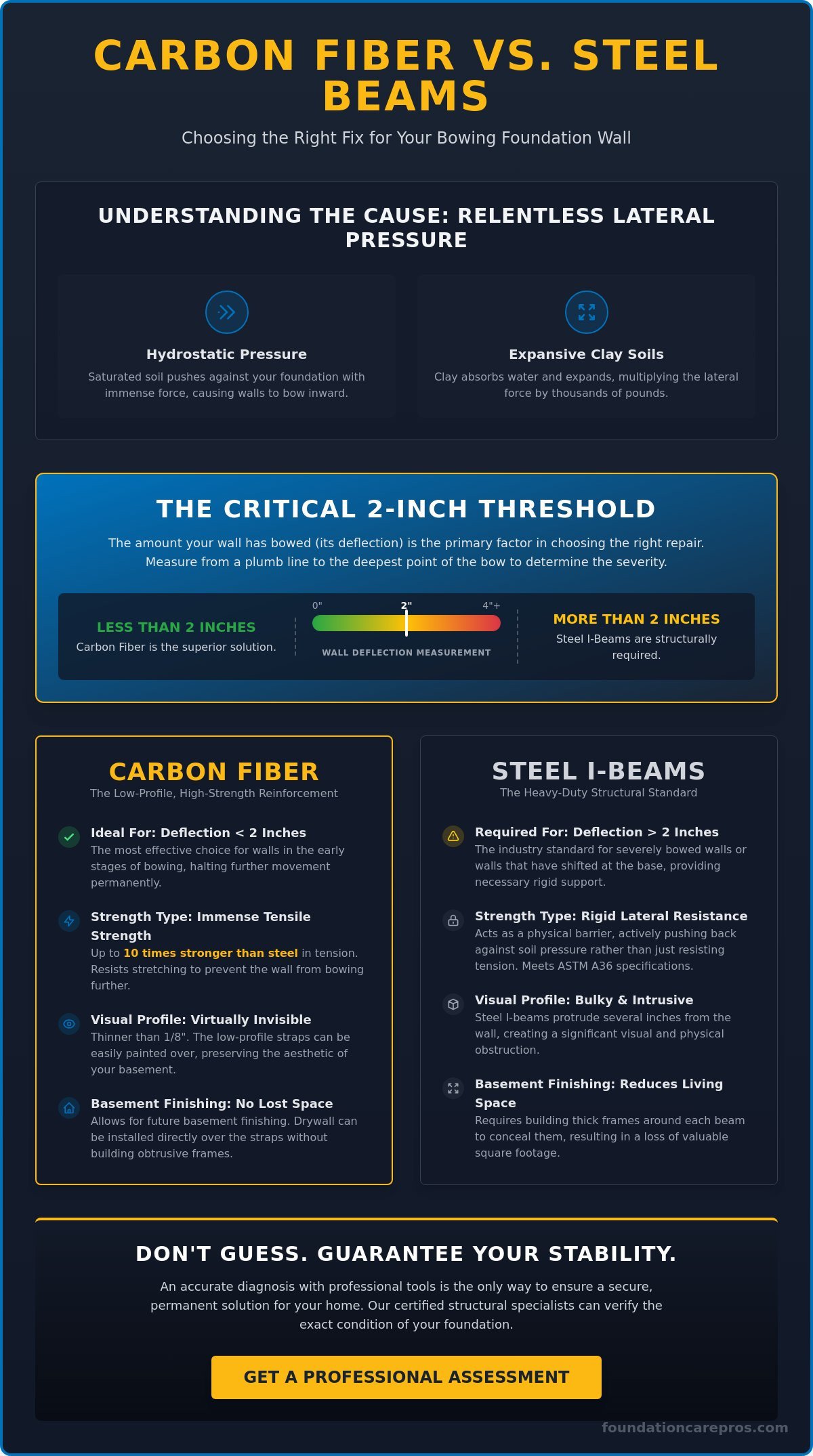
Structural failure stems from a relentless environmental process known as hydrostatic pressure. This force occurs when the soil surrounding your home becomes saturated with water. As the water table rises, the weight of the wet soil pushes against your basement walls with immense force. In regions with expansive clay soils, this pressure is significantly magnified. Clay absorbs water and expands, exerting thousands of pounds of lateral force that your foundation was not engineered to withstand. Over time, the masonry reaches its breaking point, and the wall begins to lose its vertical alignment.
Early indicators of structural stress often manifest as horizontal cracks appearing in the mortar joints or through the blocks themselves. These cracks typically form in the middle third of the wall, where the lateral pressure is most concentrated. As the masonry weakens, the wall starts to tilt or “bow” inward. Identifying these signs early is essential when evaluating carbon fiber straps vs steel beams. At this stage, the primary objective is stabilization. Stabilization focuses on halting any further movement to protect the home’s integrity. This differs from straightening, which requires external excavation to physically push the wall back to its original vertical position.
The Role of Tensile vs. Lateral Strength
Engineers select repair materials based on the specific type of stress a foundation faces. Carbon fiber relies on immense tensile strength to provide reinforcement. A Carbon-fiber-reinforced polymer (CFRP) strap is designed to resist stretching. When bonded to the interior face of a wall with high-strength epoxy, it creates a tension-resistant reinforcement that prevents the wall from expanding further into the basement. Steel, conversely, provides lateral resistance through its rigid structural profile. A steel I-beam doesn’t just resist stretching; it provides a physical barrier that counters the external weight of the soil. Understanding this distinction is critical. Different degrees of force require different material responses to ensure a permanent, secure fix.
Identifying the Severity of the Bow
Determining the appropriate stabilization method requires precise measurement. You can assess the degree of deflection by hanging a plumb line from the top of the wall to the floor. Measure the distance from the string to the wall at its deepest point of the bow. Most structural standards identify a “critical point” of instability once a wall has moved beyond two inches. If the deflection is minor, carbon fiber is often the most efficient and least invasive choice. If the bow is severe or the wall has shifted at the base, the rigidity of steel becomes mandatory. For a detailed breakdown of what your specific wall cracks indicate, consult our diagnostic guide on foundation cracks. Accurate diagnostics prevent the mistake of applying a light-duty fix to a heavy-duty structural problem.
Carbon Fiber Straps: The Low-Profile Reinforcement
Carbon fiber technology has transitioned from aerospace engineering to residential foundation repair because of its extreme strength-to-weight ratio. These straps consist of thousands of individual carbon filaments woven into a dense, flexible fabric. When applied to a foundation, the material provides immense tensile strength, meaning it’s nearly impossible to stretch or break under the pressure of a bowing wall. Unlike traditional methods that rely on bulk, carbon fiber uses advanced material science to stabilize masonry with a thickness of less than one-eighth of an inch.
The installation process is meticulous and relies on chemical bonding rather than mechanical fasteners. A specialist first grinds the surface of the foundation wall to remove paint, debris, and loose concrete. This creates a porous surface for the high-strength epoxy resin to penetrate. The technician applies the resin to the wall, embeds the strap, and then adds a second layer of epoxy to saturate the fibers. This process fuses the strap to the masonry, creating a reinforced “skin” that stops inward movement. If you suspect your wall is in the early stages of deflection, carbon fiber straps offer a permanent, non-obtrusive fix that integrates directly into the existing structure.
One of the primary benefits of this system is its low-profile nature. Once the epoxy cures, the straps can be painted over, making them virtually invisible to the naked eye. This addresses a common homeowner anxiety regarding the “industrial” look of basement repairs. However, this method has specific physical limits. Carbon fiber is best suited for walls with less than two inches of total inward bowing. Because the straps are flexible during installation, they cannot “push” a wall back or provide the same rigid lateral resistance as a heavy steel member. When evaluating carbon fiber straps vs steel beams, the degree of your wall’s movement is the most critical factor in the decision.
Advantages of Carbon Fiber Reinforcement
Homeowners often choose carbon fiber because it maintains the original footprint of the basement. There is zero loss of square footage, as the straps sit flush against the wall. The installation is also non-invasive; it requires no heavy machinery, no excavation, and creates minimal dust or disruption. Furthermore, carbon fiber is a corrosion-proof material. It will never rust or degrade when exposed to the moisture often found in basement environments, ensuring the reinforcement lasts for the life of the structure.
When Carbon Fiber is the Optimal Choice
Carbon fiber is the superior choice for early-stage structural intervention. It’s ideal for stabilizing horizontal cracks before they develop into a severe bow. This method is also the preferred option for homeowners who plan to finish their basement with drywall. Since the straps are nearly flush with the wall, you can install studs and wallboard directly over them without building out extra-thick partitions. For a comprehensive understanding of how this technology works and why it outperforms traditional methods, review our complete guide to carbon fiber reinforcement for foundation stabilization. For minor structural corrections, it remains a highly cost-effective and efficient way to guarantee long-term stability.
Steel I-Beam Braces: The Heavy-Duty Structural Standard
Steel I-beams provide a rigid mechanical solution for foundations that require more than just surface reinforcement. Unlike adhesive-based systems, I-Beam wall braces utilize the existing structure of your home to create a counter-force against external soil pressure. These beams are engineered from high-strength structural steel, typically meeting ASTM A36 standards for yield strength. This mechanical approach ensures that even under extreme hydrostatic load, the wall remains locked in position. Because the system doesn’t rely on a chemical bond with the masonry, it’s an ideal choice for walls where the surface concrete is too degraded or damp for epoxy to adhere properly.
Installation involves securing the beam at two critical points: the basement floor and the overhead floor joists. Technicians anchor the base of the beam into the concrete slab, often creating a recessed pocket to prevent the bottom of the wall from sliding inward, a condition known as “shear.” The top of the beam is fastened to the floor joists using a heavy-duty steel bracket. A significant advantage of this setup is the inclusion of a tension bolt. This allows specialists to adjust the pressure of the beam over time. While carbon fiber is a “passive” system that holds a wall in its current state, steel beams are an “active” system. When comparing carbon fiber straps vs steel beams, the ability to periodically tighten the hardware is a decisive factor for homeowners dealing with significant structural movement.
Durability remains a core priority in basement environments. Modern structural beams feature zinc-plated or galvanized finishes to resist the corrosive effects of moisture and humidity. This protective coating ensures the steel maintains its integrity for the life of the home. It won’t rust or weaken, even if the basement experiences high humidity or minor seepage.
Why Steel Beams Outperform Straps in Severe Cases
Steel beams are the industry standard for walls showing more than two inches of inward deflection. At this stage, the masonry has often lost its internal structural bond, making it too unstable for straps. Beams provide the lateral rigidity necessary to resist shear forces at the base and top of the wall. Additionally, the adjustable bracket system provides the option to slowly push the wall back toward its original vertical position during dry seasons when soil pressure is lower. This capability is something carbon fiber cannot offer.
Managing the Footprint of Steel Braces
Many homeowners worry about losing usable space, but modern low-profile beams minimize this impact. These beams typically extend only a few inches from the wall surface. During basement remodeling, contractors can easily box in the beams with wood framing or integrate them into deep-set wall designs. While you lose a small amount of floor space, the trade-off is a guaranteed level of structural security that preserves the total value of your property. Ensuring the wall never moves again is a higher priority than a few inches of square footage.
Side-by-Side Comparison: Straps vs. Beams
Efficiency and longevity differ significantly between these two stabilization systems. A standard 20-foot wall section typically requires less than a full day for carbon fiber installation. Steel beams involve more intensive labor, often requiring two days to properly anchor the units into the floor slab and overhead joists. When analyzing carbon fiber straps vs steel beams, it’s clear that carbon fiber offers a faster turnaround with less job-site disruption. This makes it an ideal choice for homeowners who need a swift resolution without a major construction footprint.
Long-term maintenance is another area where the systems diverge. Carbon fiber is a passive, zero-maintenance solution. Once the epoxy cures, the repair is permanent and requires no further adjustment. Steel beams are an active system. They feature adjustable tension bolts that a specialist may need to tighten periodically to maintain optimal pressure against the wall as soil conditions change. Both methods contribute positively to home resale value. They provide the structural certifications and transferable warranties that lenders and buyers require to verify a home’s safety and structural integrity.
Decision Matrix: Severe Bowing vs. Minor Movement
The “2-inch rule” serves as the primary technical benchmark for choosing a repair method. If your basement wall has deflected less than two inches, carbon fiber straps provide more than enough tensile strength to stop the bow. However, if the movement exceeds two inches, the wall has reached a level of instability where only the lateral rigidity of steel can guarantee safety. You must also consider the foundation material. Block walls often experience localized failure in mortar joints, while poured concrete walls tend to tilt as a single unit. If you’re dealing with expansive clay soil and poor external drainage, the higher pressure often mandates the use of steel for added security. In cases where wall anchors are also being evaluated as part of a comprehensive repair plan, understanding the foundation wall anchor cost can help you budget accurately across all available stabilization options.
Aesthetic and Finishing Considerations
Aesthetics often drive the final choice for homeowners with finished basement goals. Carbon fiber straps sit flush against the masonry. You can paint directly over them for a nearly invisible look. Steel I-beams are more industrial and require framing or “boxing in” if you plan to install drywall. When choosing between carbon fiber straps vs steel beams, consider your future plans for the space. It’s also important to remember that neither system is designed to stop water. If you have active leaks, you should install an interior basement drainage system to manage moisture before finalizing your structural repairs.
Professional Assessment: The Only Way to Guarantee Stability
DIY attempts at foundation stabilization often lead to catastrophic failure. A homeowner might misjudge the soil pressure or use inadequate materials that cannot withstand intense lateral forces. Structural repair requires an engineered approach to ensure the safety of the entire property. Attempting a temporary fix on a bowing wall can mask deeper issues until the masonry reaches a point of total collapse. Professional intervention is the only way to verify that a repair will hold for the life of the home. We prioritize accuracy and long-term results to prevent the high costs associated with secondary structural failures.
Specialists utilize advanced diagnostic tools to remove the guesswork from structural repair. Laser levels provide precise measurements of wall deflection, identifying even the smallest changes in vertical alignment. Moisture meters help locate areas where hydrostatic pressure is most intense, indicating potential drainage failures. This data is essential when deciding between carbon fiber straps vs steel beams. Foundation Care Pros uses these evidence-based diagnostics to recommend the most effective stabilization method for your specific site conditions. We don’t rely on visual estimates; we rely on verified engineering data.
True stability requires addressing the root cause of the movement. If exterior drainage isn’t managed, the soil will continue to expand and push against the foundation regardless of the reinforcement used. A comprehensive solution often involves combining structural reinforcement with interior drainage systems or sump pump installations. Our team specializes in both carbon fiber and steel applications. This expertise allows us to match the repair to the severity of the structural damage rather than offering a one-size-fits-all solution.
What to Expect During a Structural Consultation
A structural consultation begins with a thorough interior and exterior inspection of your foundation. We examine the grade of the soil, the condition of the masonry, and the presence of any secondary cracks. Following the assessment, we provide a customized repair plan that outlines exactly why a specific technology was chosen. This transparent process ensures you understand the stabilization timeline and the technical requirements of the job. We focus on providing a clear, logical progression from identification to resolution.
Securing Your Home’s Future
Investing in a permanent, warrantied structural repair protects your home’s equity and ensures long-term safety. Professional stabilization stops the progression of damage and prevents the need for a total wall replacement, which is a far more invasive and disruptive procedure. Taking action now secures your foundation and provides the peace of mind that comes with a verified solution. Schedule your professional foundation assessment today to verify the integrity of your home and stop the cycle of structural decline.
Restore Your Foundation’s Structural Integrity
Protecting your home requires a definitive solution that addresses the specific severity of your wall’s movement. Whether your foundation requires the low-profile tensile strength of carbon fiber or the rigid lateral support of steel, the goal remains the same: total stabilization. Choosing between carbon fiber straps vs steel beams is a matter of technical necessity. The right system effectively counters the hydrostatic pressure unique to your property and prevents further deflection.
Foundation Care Pros is a locally owned structural specialist and a member of the Supportworks Network. We utilize A+ rated expert diagnostics to identify the root cause of your bowing walls and deliver a permanent, warrantied fix. Our methodical approach prioritizes the long-term safety and financial value of your home. You don’t have to manage structural anxiety alone. Professional intervention provides the verification you need to move forward with confidence. Get a Permanent Fix for Your Bowed Walls and ensure your foundation remains secure for years to come.
Frequently Asked Questions
Can carbon fiber straps fail if the wall continues to move?
Carbon fiber straps can fail if they are applied to a wall that has already surpassed the two-inch deflection threshold. These straps rely on a perfect bond between the high-strength epoxy and the masonry surface. If the wall continues to shift due to unaddressed hydrostatic pressure or poor surface preparation, the bond may shear or the fibers may snap under excessive tension.
Do steel I-beams require maintenance or tightening after installation?
Steel I-beams are an active stabilization system that requires periodic inspection. The top bracket of the beam includes a tension bolt that allows a technician to adjust the pressure against the wall. While they don’t require daily maintenance, having a specialist check the tension during extreme dry or wet seasons ensures the system continues to provide optimal lateral resistance.
Will installing carbon fiber straps lower the resale value of my home?
Professional structural repairs protect your home’s resale value by providing a permanent, warrantied solution. Lenders and home inspectors often require proof of stabilization before approving a sale. When comparing carbon fiber straps vs steel beams, both methods offer the certified verification that buyers look for when evaluating a property’s long-term safety.
How many steel beams or straps are typically needed for a single wall?
Structural standards generally require one strap or beam for every four to five feet of wall space. A typical 20-foot foundation wall usually needs five units to distribute the lateral load effectively. The exact spacing depends on the height of the wall and the intensity of the soil pressure identified during the initial diagnostic assessment.
Is it possible to use both carbon fiber and steel beams on the same wall?
Using both systems on a single wall is uncommon but technically possible in complex structural scenarios. A specialist might install steel beams in a section with severe bowing while using carbon fiber on a less affected area. However, most engineered plans favor a single, consistent technology to ensure the entire wall responds uniformly to external soil pressure.
How long does a typical foundation stabilization project take to complete?
The timeline for a foundation project depends on the choice between carbon fiber straps vs steel beams and the length of the wall. Most carbon fiber jobs are completed in one day. Steel beam installations typically require two days to ensure all mechanical anchors are properly secured into the concrete slab and overhead joists.
Can I install carbon fiber straps myself to save on labor costs?
DIY installation is highly discouraged because of the high stakes involved in structural integrity. Professional technicians use specialized grinding equipment and industrial-grade resins that aren’t available in standard retail kits. A failed DIY attempt can lead to rapid wall deterioration, making the eventual professional repair much more expensive and complex.
Does insurance typically cover the cost of bowing wall repairs?
Homeowners’ insurance policies typically do not cover the cost of repairing bowing walls. Most standard coverage excludes damage caused by hydrostatic pressure, groundwater seepage, or earth movement. You should review your specific policy or speak with your agent to see if you have any structural endorsements or specialized riders that apply to foundation failure.