
Your basement wall is currently losing a silent battle against thousands of pounds of external soil pressure. When you notice a curve or a tilt in your foundation, it isn’t just a minor settling issue. It’s a structural emergency that requires a permanent, mechanical response. Installing i-beam braces for bowed walls is one of the most effective ways to counteract this hydrostatic force and secure your home’s skeleton.
You probably feel a sense of urgency to fix the problem before it leads to a total collapse, yet you don’t want to lose the functionality of your basement. It’s normal to feel overwhelmed by technical jargon and the fear of a failing foundation. This guide will show you how steel I-beams provide a reliable, engineered fix that stabilizes your home and restores your peace of mind. We’ll explore the specific physics behind these braces, the requirements of the 2024 International Existing Building Code, and exactly what to expect during the professional installation process.
Key Takeaways
- Identify how vertical steel members provide a permanent mechanical response to the lateral earth pressure pushing against your foundation.
- Understand the engineering advantages of using zinc-plated, low-profile steel to ensure maximum corrosion resistance and minimal impact on your basement space.
- Compare i-beam braces for bowed walls with alternative methods like carbon fiber or wall anchors to determine the best fit for your specific level of structural damage.
- Learn why a professional structural diagnostic is essential before any installation to ensure the repair system is calibrated for your home’s unique requirements.
- Discover how advanced stabilization systems like PowerBrace™ offer adjustable tension to secure and potentially improve your wall’s alignment over time.
Understanding I-Beam Braces for Bowed Foundation Walls
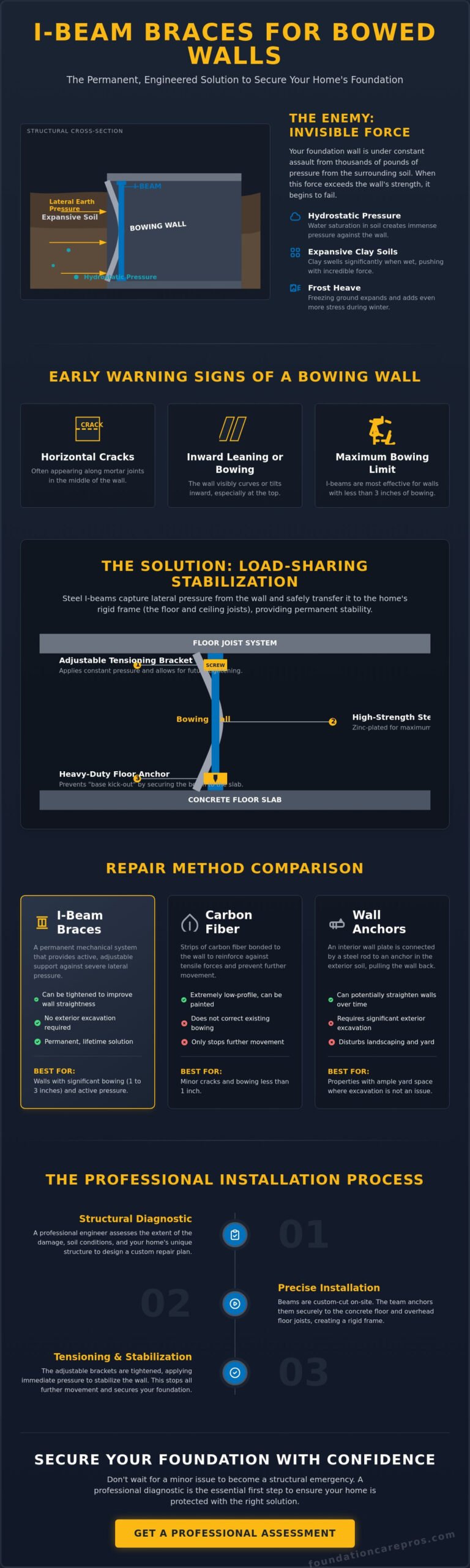
I-beam braces for bowed walls are heavy-duty steel members installed vertically along the interior of a foundation. These braces anchor into the basement floor and the overhead floor joists to create a rigid structural frame. This system stops the wall from leaning or curving further into your living space. Most homeowners choose this method because it’s a non-invasive alternative to total wall replacement. You don’t have to excavate your yard or tear down the existing structure to regain stability. It’s a surgical, professional-grade fix that addresses the root of the problem without destroying your landscaping.
Identifying the symptoms early is key to avoiding a total foundation collapse. Look for horizontal cracks that run along the mortar joints, usually in the middle of the wall. You might also notice the top of the wall leaning inward or the bottom sliding out. These are clear indicators that the soil pressure has exceeded the wall’s design capacity. While highly effective, i-beam braces for bowed walls are generally not recommended for walls with more than 3 inches of bowing. For those extreme cases, more aggressive intervention might be necessary to ensure the safety of the structure.
The Physics of Bowing: Why Foundation Walls Fail
Your foundation is under constant attack from hydrostatic pressure. This occurs when water builds up in the soil and pushes against your masonry. The Engineering Behind Retaining Walls explains how these structures must counteract lateral earth pressure to remain upright. Expansive clay soils swell when wet, putting immense stress on the concrete. During winter, frost heave adds more force as the ground freezes and expands. Horizontal mid-wall cracks are the first sign the wall is buckling under these external loads.
How I-Beams Provide Permanent Structural Stabilization
An I-beam system works through a principle called load sharing. The steel beam captures the pressure from the wall and distributes it across the floor slab and the ceiling joists. In engineering terms, this provides lateral support that the wall can’t provide on its own. Steel is the ideal material for this job because it handles high-tension applications without warping or failing. Once installed, these beams act as a permanent skeleton. They ensure your home’s structural integrity remains intact for the life of the property. The process is clean, fast, and results in a wall that simply cannot move anymore.
The Engineering Behind High-Performance I-Beam Systems
Modern engineering has transformed i-beam braces for bowed walls from simple passive supports into active, high-performance stabilization systems. Older methods often relied on heavy, bulky steel beams that merely sat against the wall to prevent further collapse. Today’s systems utilize high-strength, low-profile steel designed to provide maximum reinforcement without consuming valuable square footage. These beams are custom-cut on-site to match the exact height of your basement, ensuring a precise fit that addresses the specific geometry of your foundation’s failure.
Durability is a non-negotiable requirement for underground structural repairs. Because basements are naturally damp environments, standard raw steel is prone to oxidation and structural weakening over time. High-performance systems use zinc-plated or galvanized steel to provide long-term corrosion resistance. This protective coating ensures the hardware remains structurally sound for decades, even when exposed to high humidity or minor seepage. If you’re concerned about the longevity of your repair, a professional structural assessment can help determine the right material specifications for your home’s environment.
The Adjustable Tensioning Bracket
The most critical advancement in modern i-beam technology is the adjustable tensioning bracket. Located at the top of the beam, this heavy-duty screw system allows for the application of constant, controlled pressure against the bowing wall. Unlike “fixed” beams that only stop further movement, these active systems can be tightened during dry seasons when the soil shrinks. This periodic adjustment creates the potential to gradually improve the wall’s alignment over several years. Fixed beams without this adjustment capability are often considered inferior because they cannot adapt to the changing cycles of soil expansion and contraction.
Floor and Joist Integration
Structural stability depends on how well the beam is integrated into the home’s existing frame. The base of each beam is secured with a heavy-duty floor bolt system. This anchor prevents “base kick-out,” a common failure where the bottom of the wall slides inward under pressure. At the top, the system distributes lateral loads across multiple ceiling joists. This is a vital engineering step. If the load were concentrated on a single joist, it could cause the wood to split or rotate. In cases where the existing framing is weak, professionals install additional joist reinforcement to ensure the house can safely absorb the tension provided by the i-beam braces for bowed walls. This comprehensive anchoring creates a closed loop of support that effectively turns your foundation into a rigid, unyielding structure.
I-Beam Braces vs. Alternative Repair Methods
Selecting the right foundation repair method requires a precise measurement of the wall’s deflection. While several technologies exist to stabilize a home, i-beam braces for bowed walls offer a unique balance of high-capacity strength and indoor-only installation. The decision-making framework usually starts with the severity of the bow. For walls with minor movement, low-profile options might suffice. However, as the lateral pressure increases, the mechanical mass of steel becomes a structural necessity. Steel wins on sheer force and reliability when the integrity of the home is at risk.
Total cost of ownership is another critical factor. While some methods might have a lower initial price point, they may lack the ability to adapt to future soil movement. Adjustable I-beams allow for long-term maintenance and potential wall straightening, which adds significant value over the life of the home. In many scenarios, such as severe bowing or restricted outdoor access, steel beams are the only viable solution that meets modern engineering standards. Understanding the professional cost to install i-beams in basement walls, including permit requirements and soil pressure variables, can help you make a fully informed investment decision.
Steel Beams vs. Carbon Fiber Straps
Carbon fiber straps are popular for their low visual impact. They sit nearly flush against the masonry and are easy to paint over. However, carbon fiber is designed primarily for tension. It prevents cracks from expanding but offers limited resistance against massive, ongoing lateral shifts. Most structural experts follow a strict 2-inch rule for carbon fiber viability. If the wall has bowed more than 2 inches, straps often lack the rigid leverage needed to ensure safety. In these cases, i-beam braces for bowed walls are the superior choice. They provide a physical, unyielding barrier that cannot be bypassed by soil pressure.
When to Choose I-Beams over Foundation Wall Anchors
Foundation wall anchors are an effective solution when you have sufficient outdoor space. They involve burying a steel plate in the yard and connecting it to the basement wall with a long steel rod. This process requires significant excavation and at least 10 to 15 feet of clearance from the foundation. Many properties face property line restrictions or have existing structures like decks, pools, or sunrooms that make anchors impossible. I-beams provide equivalent stabilization without touching your landscaping. The installation is faster and avoids the mess and disruption of heavy machinery in your yard. For homeowners who value their finished outdoor space, the interior-based approach of the I-beam is often the most logical path forward.
Professional Installation: What Homeowners Should Expect
Professional installation of i-beam braces for bowed walls is a methodical, engineering-led process. This is not a project for general handymen or DIY enthusiasts. It requires specialized heavy-duty equipment and a deep understanding of structural loads. Every successful repair begins with a comprehensive structural diagnostic. This assessment determines the exact placement and spacing of the beams based on the specific degree of wall deflection. Most residential projects are completed efficiently, typically requiring only one to two business days for a full installation.
A common concern for many homeowners is the potential loss of usable basement space. Modern systems utilize low-profile steel designs that hug the foundation wall closely. This ensures the footprint of the repair is minimal. While the beams do sit on the interior of the wall, they are designed to be as unobtrusive as possible. This allows you to maintain the functionality of your basement while gaining the permanent stabilization your home requires. If you want to see how these systems fit your specific layout, schedule a professional foundation inspection to get an expert layout plan.
The Step-by-Step Installation Process
Precision is the priority during every phase of the installation. The process follows a logical sequence to ensure the load is transferred safely from the failing wall to the home’s framing. The steps include:
- Step 1: Measuring and Marking: Technicians mark exact beam locations based on engineering specifications. Beams are typically spaced three to six feet apart depending on the severity of the bow.
- Step 2: Securing Floor Anchors: The crew secures heavy-duty steel anchors directly into the concrete floor slab to prevent the base of the wall from sliding.
- Step 3: Attaching Top Brackets: Adjustable brackets are bolted to the rim joist or floor framing. This creates the upper anchor point for the stabilization system.
- Step 4: Tensioning: The I-beam is placed into the brackets and the top screw is tightened. This applies the initial tension needed to stop further wall movement.
Basement Finishing and Aesthetics
You don’t have to choose between a safe home and a beautiful basement. I-beam braces for bowed walls are compatible with standard basement finishing techniques. You can easily hide the steel members behind a traditional 2×4 stud wall. Some homeowners prefer to create “bump-outs” or soffits that frame the beams as architectural features. The most important requirement is that the adjustable brackets at the top remain accessible. Small access panels or removable ceiling tiles allow for the periodic tightening necessary to potentially straighten the wall over time. This approach preserves your home’s aesthetic value while maintaining a high standard of structural care.
Securing Your Foundation with Foundation Care Pros
Foundation Care Pros is a specialized member of the Supportworks network. We provide homeowners with access to industry-leading engineering and validated structural solutions. Our team utilizes the PowerBrace™ system to deliver high-spec i-beam braces for bowed walls. This advanced technology is designed to stabilize your foundation permanently without the need for disruptive exterior excavation. We focus on providing direct, non-alarmist solutions that prioritize the long-term safety of your property.
Every installation we perform includes a lifetime transferable warranty. This is a significant asset for your home’s resale value. It provides documented proof to future buyers that the foundation has been professionally stabilized by certified specialists. We don’t just offer temporary fixes. We reinforce the structural integrity of the entire building to ensure it remains a safe environment for your family.
Our Methodical Diagnostic Approach
Our diagnostic process is rooted in technical accuracy and evidence-based assessment. We use laser levels and precision digital tools to measure wall deflection to the millimeter. This data allows us to design a repair plan that is custom-calibrated for your home’s specific geometry. Identifying the root cause of the bow is our first priority. We analyze soil conditions and hydrostatic pressure variables before recommending any hardware installation. You can learn more about these variables in our detailed guide on how to fix a bowing basement wall.
Long-Term Protection and Reliability
Reliability is the hallmark of a principled structural repair. Once we install i-beam braces for bowed walls, the system provides a permanent barrier against lateral soil movement. You gain peace of mind knowing the wall is mechanically locked in place and cannot move further into your living space. Our service doesn’t end when the crew leaves your driveway. We maintain a methodical follow-up process to perform tension adjustments as the soil cycles through seasonal expansion and contraction. This ensures the system remains at peak performance for the life of the structure. Schedule your professional foundation inspection today to start the process of securing your home’s future.
Protect Your Home with Permanent Structural Stabilization
Restoring your foundation’s integrity is a critical step in maintaining your home’s safety and long-term market value. You’ve seen how i-beam braces for bowed walls offer a high-strength, adjustable response to the relentless pressure of expansive soils. This engineered system provides a permanent mechanical fix without the mess of total wall replacement or extensive yard excavation. By choosing a solution that includes a lifetime transferable warranty, you’re securing your property’s future for yourself and any future owners.
Foundation Care Pros serves the community with over 20 years of structural repair expertise as a proud Supportworks Network Member. Our methodical approach ensures that your foundation receives a validated, professional-grade solution tailored to its specific needs. Request a Free Structural Consultation today to gain a clear understanding of your home’s structural health. You can move forward with confidence knowing that your foundation is backed by a team of principled specialists dedicated to permanent results.
Frequently Asked Questions
Will I-beam braces straighten my bowed wall completely?
I-beam braces are designed primarily to stabilize a wall and prevent further movement. While they provide the mechanical leverage necessary to potentially straighten a wall over time, this is a gradual process. Professionals adjust the tensioning brackets during dry seasons when soil pressure is lowest. Total straightening depends on the severity of the initial bow and the responsiveness of the masonry to these incremental adjustments.
How many I-beam braces do I need for my basement?
The number of beams required depends on the length of the failing wall and the degree of structural damage. Standard engineering specifications typically require beams to be spaced between three and six feet apart. For a standard 20-foot wall, you might require four to six i-beam braces for bowed walls to ensure the load is distributed evenly. A structural diagnostic is necessary to determine the exact spacing for your home.
Can I-beams be installed in a finished basement?
Installation in a finished basement is common but requires temporary removal of sections of drywall and wall studs. Technicians must access the foundation wall and the overhead floor joists to secure the anchors and brackets. Once the structural work is complete, you can rebuild the finished wall. Many homeowners use “bump-outs” to conceal the beams while leaving the adjustable top brackets accessible for future maintenance.
How much space do I-beam braces take up?
Modern high-performance systems use a low-profile design to minimize the impact on your usable square footage. The beams typically extend only a few inches from the foundation wall. Because they are installed vertically and hug the masonry closely, they don’t interfere with most basement activities. This design allows you to maintain a functional living space while ensuring the structural integrity of your home’s foundation.
Do I-beam braces require maintenance after installation?
Yes, these systems require periodic monitoring and minor adjustments. The adjustable tensioning bracket at the top of the beam should be tightened during dry periods when the soil outside has shrunk. This active maintenance is what allows the system to potentially improve the wall’s alignment over several years. A professional technician can provide a schedule for these adjustments to ensure the system remains at peak performance.
Is it better to use I-beams or wall anchors?
The choice between I-beams and wall anchors depends largely on your property’s exterior conditions. Wall anchors are effective but require significant excavation and at least 10 to 15 feet of clearance in your yard. If you have property line restrictions, decks, or landscaping you wish to preserve, i-beam braces for bowed walls are the superior choice. They provide equivalent stabilization using an entirely interior-based installation process.
Can I install I-beam braces myself to save money?
DIY installation is strongly discouraged due to the high stakes of structural failure. Installing these braces requires specialized hydraulic equipment and a precise understanding of load-bearing engineering. Incorrect installation can lead to floor joist damage or a total wall collapse. Professional installers ensure the system complies with the 2024 International Existing Building Code and often provide transferable warranties that protect your home’s future resale value. Before committing to any repair approach, reviewing a detailed breakdown of the cost to install i-beams in basement walls can help you budget accurately and understand the full return on your investment.
How long do steel I-beam braces last?
Steel I-beam braces are designed to last for the life of the structure. High-quality systems use zinc-plated or galvanized steel to resist the humidity and moisture common in basement environments. Because steel doesn’t warp, rot, or degrade like organic materials, these braces provide a permanent solution. When installed by specialists, the system effectively becomes a part of the home’s permanent skeleton, requiring no eventual replacement.