
Your bowing basement wall isn’t just a cosmetic flaw; it’s a structural warning sign that the soil around your home is winning a battle against your foundation. Most homeowners feel a sense of dread when they notice that first crack or a slight inward lean. You might worry about a total collapse or assume that fixing it requires a massive, disruptive excavation of your entire property. It’s a stressful situation, but understanding the mechanical science behind the solution can provide much-needed peace of mind. To truly solve the problem, you need to understand how do wall anchors work to counteract the thousands of pounds of hydrostatic pressure pushing against your home.
This guide clarifies the engineering and physics that allow wall anchors to provide a permanent, non-invasive fix for failing foundations. We will explain how these systems use the stable soil deep in your yard as a mechanical lever to pull your walls back into alignment. You will learn about the specific components of the anchor system, why it’s often a superior choice to interior I-beams, and why it remains a gold standard for structural stabilization in 2026. By the end of this article, you’ll have the technical knowledge to make a confident decision about the safety and longevity of your home.
Key Takeaways
- Foundation wall anchors provide a permanent structural solution for bowing basement walls using heavy-duty galvanized steel components.
- Gain a clear understanding of how do wall anchors work by utilizing the stable soil outside your home to create a powerful mechanical lever.
- Learn how this system counteracts hydrostatic pressure to stop wall movement and, in many cases, pull the foundation back toward its original position.
- Identify the differences between anchors, I-beam braces, and carbon fiber straps to choose the most effective stabilization method for your property.
- Understand why expert installation and precise tensioning are required to ensure the system remains effective for the life of the structure.
What Are Foundation Wall Anchors? Defining the Structural Solution
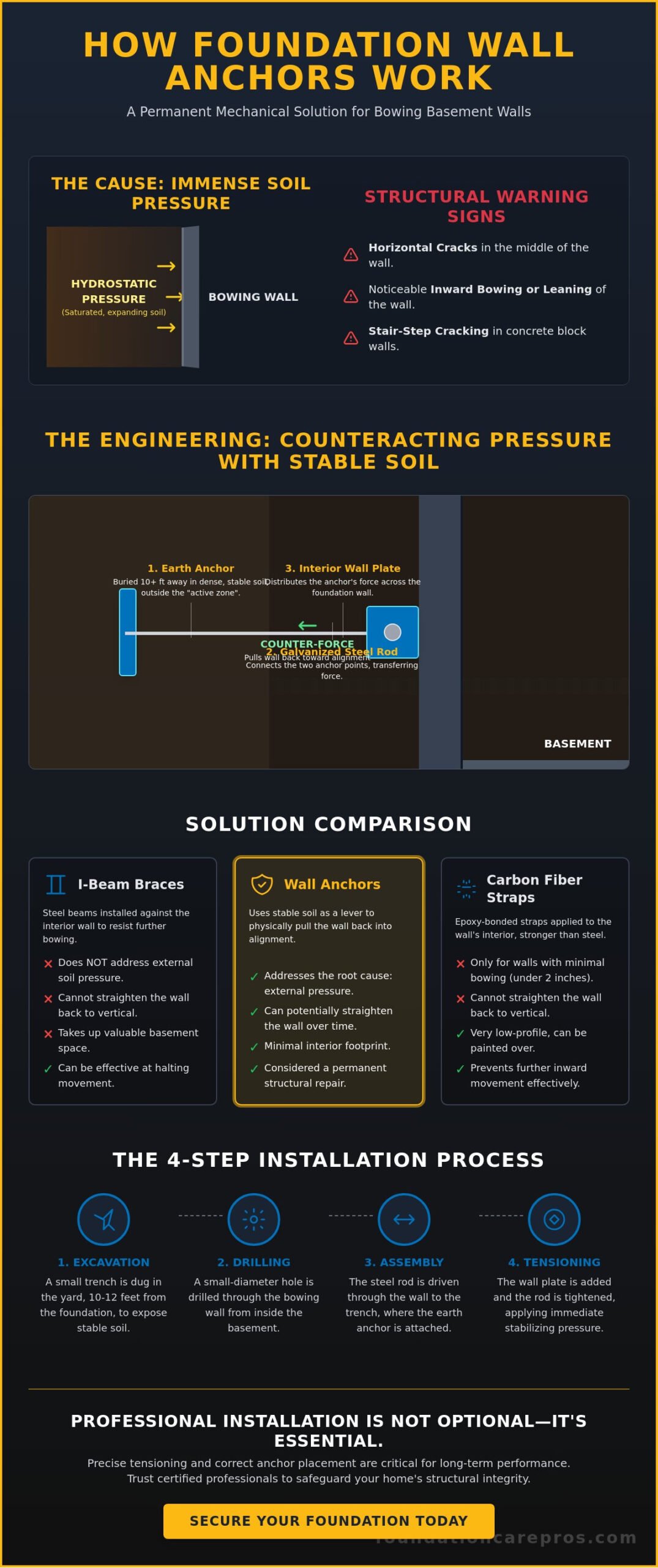
Foundation wall anchors are heavy-duty structural systems engineered to restore stability to a home’s foundation. These aren’t simple hardware store fixes. They are robust, industrial-grade assemblies made from galvanized steel. To understand how do wall anchors work, you must first recognize them as a mechanical solution to a massive physical problem: shifting earth. The system consists of three primary components: a heavy-duty interior wall plate, an exterior earth anchor buried deep in the yard, and a high-strength threaded steel rod that connects the two. Galvanized steel is used specifically to prevent underground corrosion, ensuring the system remains functional for the lifetime of the structure. This material choice is vital because the rod and earth anchor are permanently exposed to soil moisture. Without this protection, the system would eventually weaken, leaving the foundation vulnerable once again.
Foundation Anchors vs. Drywall Anchors: A Critical Distinction
A common misconception found in online forums is confusing foundation anchors with the small plastic sleeves used to hang pictures. The distinction is critical. A drywall anchor is designed to support a few pounds of static weight. In contrast, foundation anchors are designed based on geotechnical engineering principles to resist several tons of lateral pressure. While a drywall anchor grips the thin gypsum board, a foundation anchor reaches ten feet or more into “competent” soil. This is soil that remains stable regardless of surface moisture levels. By studying how do wall anchors work, engineers can determine the exact tension required to stabilize a specific soil type. Confusing these two terms can lead to dangerous DIY attempts that fail to address the underlying structural risk.
When Are Wall Anchors Recommended?
Structural specialists recommend these systems when foundation walls exhibit specific failure patterns. Horizontal cracks, especially those located in the middle third of the wall, are a primary indicator. You might also notice the wall bowing inward, stair-step cracking in concrete blocks, or tilting at the top. These symptoms suggest that the external pressure is exceeding the wall’s design capacity. Anchors are often the preferred choice when the goal is not just to stop movement but to potentially pull the wall back toward its original vertical position over time. For homeowners seeing these signs, professional basement wall stabilization is the only way to ensure the home remains safe and the property value is protected. Delaying this assessment only allows the lateral pressure to increase, potentially leading to more expensive repairs or total wall failure.
The Mechanics of Stabilization: How Wall Anchors Work Step-by-Step
The physical installation of a wall anchor system is a disciplined procedure that balances mechanical force with structural safety. To understand how do wall anchors work in a real-world application, you have to look at the methodical three-stage installation process. First, a technician excavates a small, targeted hole in your yard. This hole is typically located about 10 to 12 feet away from the foundation wall. Next, a high-strength steel rod is driven through a small 1-inch hole drilled in the foundation from the inside. This rod travels through the earth until it reaches the excavated hole. Finally, the interior wall plate is secured to the rod inside the basement, and the exterior earth anchor is attached on the other side. This creates a continuous connection between your home and the stable earth deep in your yard.
The Role of the Earth Anchor
The earth anchor acts as the primary point of resistance for the entire system. By placing it several feet away from the home, we ensure it sits outside the active soil zone. This is the area of earth directly next to your house that is prone to saturation and movement. Instead, the anchor is embedded in competent soil. Competent soil is defined as dense, undisturbed earth that provides the necessary friction and resistance to hold the anchor in place against several thousand pounds of pressure. The large surface area of the anchor plate prevents it from pulling through the soil, creating a secure point of leverage. This setup follows a proven Cure for a Bulging Foundation by transferring the load from the failing wall to the stable earth.
Restoring the Wall: The Tightening Process
Tensioning is where the stabilization actually begins. Once all components are connected, a specialist uses a calibrated torque wrench to tighten the assembly. This creates immediate structural stability. Homeowners often worry about over-tightening, but professionals use specific torque specifications to prevent damage to the concrete. One of the unique benefits of this system is its ability to restore the wall over time. By performing incremental tightening during dry seasons when the soil shrinks, the wall can often be pulled back toward its original position. If you are noticing significant inward movement, it’s wise to request a professional structural assessment to determine the correct tension requirements for your specific soil conditions. This gradual approach ensures the wall remains stable while the how do wall anchors work mechanism does the heavy lifting of structural restoration.
The Physics of Bowing Walls: Hydrostatic Pressure and Counter-Force
Hydrostatic pressure is the weight of water exerted against a surface. In the context of your basement, this surface is your foundation wall. When heavy rain or rapid snowmelt occurs, the soil surrounding your home becomes saturated. This water-logged earth is significantly heavier than dry soil, creating a massive amount of lateral force. To understand how do wall anchors work, you must first recognize that the wall is failing because the load outside exceeds the strength of the concrete or block inside. This pressure is most intense in the “active soil zone,” which is the area of backfilled earth directly surrounding your home. This zone lacks the structural integrity to support the wall, often leading to the structural distress homeowners fear. Understanding the causes of basement moisture problems is the first step in diagnosing why a wall begins to bow under this relentless weight.
A wall anchor functions as a tie-back system. It effectively transfers the load from the bowing wall to the stable ground located well beyond the reach of the foundation’s original excavation. The system succeeds because it anchors into soil that is not moving. While the active soil zone near your house is shifting and expanding, the earth ten feet away remains dense and undisturbed. By linking the two, the anchor uses the mass of the stable earth to hold the wall in place.
Understanding Lateral Force and Soil Expansion
Clay-heavy soils are particularly problematic for residential foundations. These soils act like a high-capacity sponge, expanding significantly as they absorb water and contracting as they dry. This constant cycle of expansion and contraction puts immense, repetitive stress on the foundation. In colder climates, frost heave adds another layer of complexity. As water in the soil freezes, it expands by approximately 9 percent, pushing with even greater force against the basement wall. Identifying specific types of foundation cracks and what they mean can help you determine if your home is suffering from these specific environmental pressures. Horizontal cracks and stair-step patterns are the most common indicators that lateral force has reached a critical level.
Mechanical Advantage: Using the Yard as a Lever
Engineers utilize the concept of a “deadman” anchor to solve these structural failures. This involves burying a heavy object in stable ground to provide a fixed point of resistance. By connecting the interior wall plate to this fixed point, the system creates a powerful clamping force. The tensioned rod acts as a bridge between the failing wall and the stable earth. This is a primary reason why how do wall anchors work so effectively; it doesn’t just brace the wall from the inside, it uses the yard as a mechanical lever to pull the wall back. Unlike interior I-beams that simply resist further movement, anchors provide the mechanical advantage necessary to restore structural integrity. This clamping effect secures the wall between the interior plate and the exterior anchor, creating a permanent state of stability that interior-only solutions cannot match.
Comparing Systems: Wall Anchors vs. Braces and Straps
Selecting the right structural fix requires a clear understanding of your home’s specific failure points and the physical limitations of your property. While you now understand how do wall anchors work to restore vertical alignment, they are not a universal fit for every basement. Site constraints often dictate the choice. For instance, wall anchors require approximately 10 to 12 feet of usable yard space to seat the earth anchor in competent soil. If your home is close to a property line, a neighbor’s structure, or a swimming pool, installing anchors may be physically impossible. In these cases, interior-based systems become the primary solution. Professional diagnostics determine whether a wall needs the active pulling force of an anchor or the reactive support of an interior brace.
Complex structural failures sometimes require a multi-faceted approach. A wall suffering from both inward bowing and vertical settlement might need a combination of foundation piers and wall anchors. This integrated strategy ensures the home is supported from the bottom and the sides simultaneously. Decisions are based on the degree of wall deflection, soil composition, and the long-term goals for the basement space.
Anchors vs. I-Beam Braces
The most significant difference between these systems is their ability to move the wall. Anchors can actually straighten a foundation over time. I-Beam braces are generally designed to stop movement and provide rigid reinforcement. While beams are highly effective, they have a larger interior footprint. A steel beam typically protrudes several inches into the room, which can complicate basement finishing projects. Anchors are much lower profile, with only a flat plate visible on the interior wall. However, beams require no exterior digging, making them a cleaner option for finished landscapes. You can learn more about the technical requirements for these supports in our guide to i-beam wall braces installation.
Anchors vs. Carbon Fiber Straps
Carbon fiber straps offer the least invasive installation process. They are thin, incredibly strong, and can be painted over to become nearly invisible. The limitation lies in their mechanical function. Straps are a passive reinforcement. They excel at preventing further bowing in walls with less than 2 inches of deflection, but they cannot pull a wall back to its original position. To understand how do wall anchors work differently, remember that anchors provide active tension. If your wall has significant cracking or severe inward leaning, carbon fiber may not provide enough counter-force. For a deeper dive into these material differences, see our analysis of carbon fiber straps vs steel beams.
Determining which system fits your home’s needs is a precise engineering task. If you are seeing signs of structural distress, contact our specialists for a structural evaluation to identify the most permanent solution for your property.
Professional Installation and Long-Term Performance
Attempting a DIY installation of foundation components is a significant safety risk. Foundation walls support the entire vertical load of your home, and the lateral pressure from the soil can exceed several tons. Professional installation is mandatory because it requires precise engineering calculations to determine exactly where and how many anchors are needed. If the rods are placed incorrectly or tensioned without the proper equipment, you risk cracking the wall further or causing a localized collapse. A certified specialist understands how do wall anchors work within the specific geological context of your local soil, ensuring the system provides the intended counter-force without compromising the concrete’s integrity.
Material quality is the next pillar of long-term performance. Because the rods and earth anchors remain underground indefinitely, they are vulnerable to soil acidity and moisture. We utilize galvanized steel for all components to prevent corrosion and structural degradation. This protective coating ensures that the mechanical connection between the interior plate and the exterior anchor remains high-strength for decades. Beyond the hardware, professional oversight includes a long-term warranty and the validation of a structural engineer, providing the permanence and reliability homeowners need for true peace of mind.
Maintenance is a unique benefit of the anchor system. Unlike passive repairs, anchors are adjustable. During dry seasons when the soil pulls away from the foundation, the system can be incrementally tightened to encourage further wall straightening. This proactive approach allows the homeowner and the specialist to work with the natural cycles of the earth to restore the home’s original structural geometry.
The Supportworks Advantage
Utilizing a proven, engineered system like Supportworks offers distinct advantages over generic hardware. These systems feature high-strength, low-profile wall plates that take up minimal space in your basement. The design allows for maximum clamping force while remaining aesthetically unobtrusive. In some complex scenarios, carbon fiber reinforcement serves as a complementary tool. While the anchors handle the heavy lifting of pulling the wall back, carbon fiber can be used to stabilize sections of the wall where exterior excavation isn’t feasible, creating a comprehensive structural shield.
Investment and Property Value
Stabilizing a bowing wall is an essential investment in your home’s resale value. A foundation with visible structural failure is a major red flag for inspectors and potential buyers, often leading to failed sales or massive price reductions. Proactive repair is always more cost-effective than waiting. If left unaddressed, a bowing wall eventually reaches a point of total failure, requiring a full wall replacement that is significantly more expensive and disruptive. To plan your project effectively, you can review our detailed breakdown of foundation wall anchor cost. Understanding how do wall anchors work as a long-term value protector helps shift the perspective from a simple repair to a critical preservation of your largest asset.
Secure Your Home With Permanent Structural Solutions
Understanding the mechanics of foundation repair is the first step toward reclaiming your home’s stability. You now know that wall anchors aren’t just passive braces; they are active engineering tools that utilize the stable soil of your yard to counteract massive hydrostatic pressure. By transferring the load away from the failing wall, these systems offer a unique opportunity to restore your foundation’s original alignment over time. This permanent fix addresses the root cause of bowing and cracking without the need for total wall replacement. It is a methodical approach that prioritizes long-term safety over superficial fixes.
As a Certified Supportworks Network Member, Foundation Care Pros specializes in advanced I-Beam and anchor systems. Our team provides expert diagnostics for bowed and cracked walls to ensure your property receives the most effective, evidence-based solution available. Don’t let structural concerns compromise your safety or property value. Request a Professional Foundation Inspection from Foundation Care Pros today. Our disciplined assessment process ensures that you understand exactly how do wall anchors work for your specific foundation needs. We are here to help you protect your home for the long term with confidence and professional care.
Frequently Asked Questions
Do foundation wall anchors really work to straighten walls?
Yes, wall anchors are specifically designed to incrementally straighten foundation walls over time. Because the system uses active tension, it provides a pulling force that passive systems like braces cannot match. By adjusting the tension during dry seasons when the soil shrinks, we can often restore the wall toward its original vertical position. This process is gradual and controlled to maintain the integrity of the concrete structure.
How far out into the yard do wall anchors need to go?
Most installations require the earth anchors to be placed approximately 10 to 12 feet away from the foundation wall. This distance is necessary to reach competent soil that sits well beyond the active soil zone. Placing the anchor in this undisturbed earth provides the required resistance to hold the wall securely. A professional site assessment will confirm if your property has the necessary clearance for this specific repair method.
Will wall anchors damage my landscaping or pipes?
Installation is designed to be minimally invasive to your property. Instead of large trenches, we excavate small, targeted holes for each earth anchor to protect your yard’s appearance. We also coordinate with local utility companies to perform a comprehensive locate of underground pipes and wires before any rods are driven. This careful planning protects your essential services while ensuring the structural components are placed in the most effective locations.
How long do foundation wall anchors last?
Wall anchors made from galvanized steel are engineered to provide a lifetime solution for foundation stabilization. The galvanization process creates a protective barrier that prevents rust and corrosion even in saturated soil conditions. When installed by professionals, these systems remain structurally sound for the life of the home. This permanence is a primary reason why they are a preferred choice for addressing severe structural failures in residential properties.
Can I install foundation wall anchors myself?
DIY installation is not possible and presents significant safety risks to you and your home. The process requires specialized hydraulic equipment, calibrated torque wrenches, and precise structural engineering oversight. Incorrect placement or improper tensioning can cause immediate wall failure or localized cracking. Professional installers have the training to manage the immense forces involved, ensuring the repair is both safe and effective for your specific foundation type.
What happens if I don’t fix my bowing basement wall?
Neglecting a bowing wall allows hydrostatic pressure to continue its damage unchecked. The inward curve will eventually worsen, leading to severe structural instability and potential collapse. What starts as a manageable repair can quickly turn into a total wall replacement project. Addressing the issue early prevents more catastrophic damage and protects your home’s resale value from plummeting due to documented structural failure and safety concerns.
Are wall anchors better than carbon fiber for foundation repair?
The superior choice depends entirely on the degree of wall deflection and your specific structural goals. Anchors are the better option for walls with significant bowing because they provide active tension to pull the wall back. Carbon fiber straps are a passive reinforcement, meaning they only stop further movement and cannot straighten a wall. During a diagnostic visit, we evaluate the specific failure pattern to determine which system offers the most reliable protection.
How much tightening is required after the initial installation?
Periodic tightening is often recommended during dry weather cycles to maximize the straightening potential of the system. This maintenance allows the anchor to take advantage of soil contraction to pull the wall outward safely. Understanding how do wall anchors work over the long term involves recognizing that restoration is a gradual process. A specialist will provide a specific schedule for these adjustments based on your home’s unique structural needs and soil composition.