
Your foundation wall does not bow because of age; it bows because the earth around it is winning a slow-motion battle of physics. It is natural to feel a sense of dread when you notice a curve in your basement masonry or see wide horizontal cracks forming. You likely want a permanent fix that does not involve turning your backyard into a massive excavation site or guessing which repair method actually works. Understanding how to fix a bowing basement wall requires looking past temporary patches and focusing on the hydrostatic pressure driving the movement.
We agree that your home’s safety should never be a matter of trial and error. This guide provides the precise engineering methods used to permanently stabilize foundation walls and protect your structural integrity. You will discover how modern solutions like carbon fiber straps, I-beam wall braces, and wall anchors provide the counter-pressure needed to stop wall deflection. We also explain how professional assessments and updated 2026 building codes ensure your repair meets the highest safety standards. By the end of this article, you will know exactly which specialized method fits your specific foundation needs and how to secure a solution backed by a long-term warranty.
Key Takeaways
- Learn to identify wall deflection using the “Plumb Line” test and understand why any curve over one-eighth of an inch requires a professional engineering assessment.
- Discover how to fix a bowing basement wall using non-invasive carbon fiber straps or high-strength I-beam wall braces depending on the severity of the movement.
- Understand the critical engineering difference between stabilizing a foundation to prevent further movement and the more intensive process of wall straightening.
- Prepare for a streamlined professional repair process that typically takes only one to two days, utilizing proven, permanent solutions.
- Learn why a comprehensive structural solution often requires combining reinforcement with interior drainage systems to address the root cause of soil pressure.
Table of Contents
- Identifying and Diagnosing a Bowing Basement Wall
- The Mechanics of Structural Stabilization
- Selecting the Right Repair Method for Your Foundation
- The Professional Repair Process: What Homeowners Should Expect
- Securing Your Home with Foundation Care Pros
Identifying and Diagnosing a Bowing Basement Wall
A bowing wall is more than a cosmetic blemish; it’s a structural failure in progress. In the engineering world, we define a bowed wall as any foundation surface that has moved inward by more than one-eighth of an inch. While this might seem minor, it indicates that the external forces pressing against your home are overcoming the wall’s design capacity. Identifying the problem early is the first step in learning how to fix a bowing basement wall before it reaches a critical point of collapse.
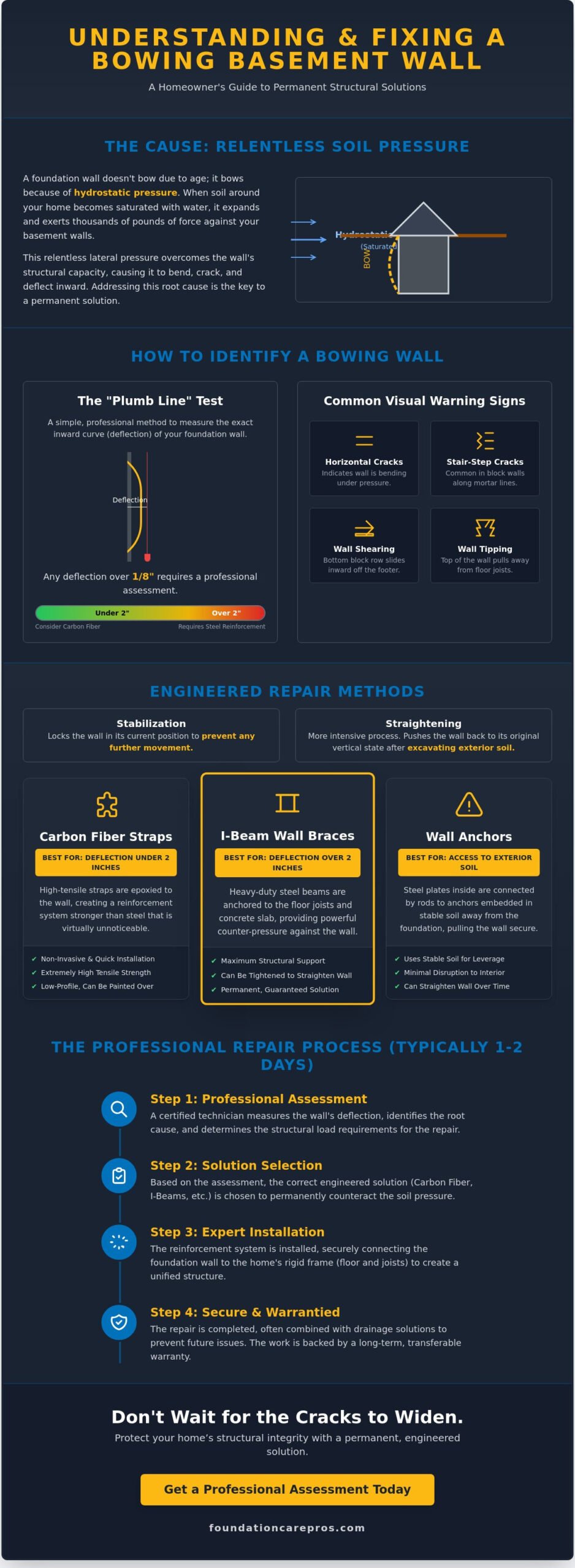
Professionals use a “Plumb Line” test to determine the exact degree of deflection. By hanging a weighted string from the top of the wall to the floor, we can measure the gap between the string and the wall at its furthest point. This measurement is not just a diagnostic tool; it dictates which repair method is appropriate. If the deflection is under two inches, low-profile reinforcements are often sufficient. If the curve exceeds that threshold, more robust structural steel is required to ensure safety.
The most common warning sign is a horizontal crack running along the mid-point of the wall. This crack typically appears where the pressure from the outside soil is most intense. Unlike small hairline cracks, these horizontal openings show that the wall is literally snapping under the weight of the earth. If you notice these cracks widening, the structural integrity of the entire home is at risk.
The Role of Hydrostatic Pressure
Saturated soil exerts immense weight. When groundwater cannot drain away from your foundation, it creates hydrostatic pressure. This force can reach thousands of pounds per square foot, pushing relentlessly against the concrete. Understanding The Mechanics of Structural Stabilization is vital here because your basement wall acts as a retaining wall. Poor gutter drainage often compounds this issue by dumping gallons of water directly next to the foundation. This creates a cycle where the soil expands, pushes the wall, and then contracts, leaving the wall permanently displaced.
Visual Signs of Structural Distress
Block foundations often show “stair-step” cracks along the mortar lines. These differ from vertical cracks, which might indicate settling rather than bowing. You should also look for signs of shearing. Shearing occurs when the bottom row of blocks slides inward across the floor. Conversely, tipping happens when the top of the wall pulls away from the wooden floor joists. Each of these patterns tells a story about where the pressure is highest and helps our team determine how to fix a bowing basement wall effectively for the long term.
The Mechanics of Structural Stabilization
Structural stabilization is not about patching cracks. It is about restoring the equilibrium of your home’s skeletal system. When homeowners evaluate how to fix a bowing basement wall, the primary goal must be to neutralize the lateral pressure exerted by the surrounding soil. Surface-level masonry repairs are purely cosmetic. Applying fresh mortar or waterproof paint might hide a crack, but these materials lack the tension or compression strength required to resist earth movement. Without structural reinforcement, the wall will continue to deflect until the masonry reaches its breaking point.
A critical distinction exists between stabilization and straightening. Stabilization uses high-tensile materials to lock the wall in its current position, preventing any further inward movement. Straightening, however, is a more intensive process. It involves excavating the soil outside the foundation to relieve pressure before physically pushing the wall back toward its original vertical state. Not every wall is a candidate for straightening. If the concrete is severely degraded or the footer is compromised, stabilization is often the safest path forward. Utilizing professional foundation repair methods ensures that the chosen approach matches the specific structural needs of the building and the soil type surrounding it.
Permanent repairs require anchoring the reinforcement system to the strongest parts of the structure. This involves securing supports to the basement floor slab and the wooden floor joists above. This creates a continuous load path. It transfers the external soil pressure into the entire home’s frame rather than letting the basement wall bear the load in isolation. This mechanical connection is what provides a permanent solution rather than a temporary patch.
Step 1: Professional Engineering Assessment
Every repair begins with a meticulous measurement of total inward deflection. We use high-precision tools to determine if the wall has moved enough to compromise the sill plate or the footer. This assessment confirms whether the wall can be safely straightened or if it requires immediate stabilization. Repairing a wall in expansive clay requires different tension levels than in sandy soil. Clay holds water longer, creating sustained pressure that demands higher-strength reinforcement. Skipping this diagnostic step leads to mismatched solutions that fail under stress.
Step 2: Neutralizing External Forces
Structural supports alone may not be enough if the root cause remains unaddressed. Hydrostatic pressure is the force of water-saturated soil against a foundation. To protect your home, you must manage this water source. Interior drainage systems complement structural wall supports by relieving the water pressure before it reaches the concrete. If you suspect your foundation is shifting, it is best to consult with the experts at Foundation Care Pros to evaluate your specific soil conditions and structural health.
Selecting the Right Repair Method for Your Foundation
Engineering precision is required to match a repair method to the specific failure pattern of a foundation. Minor bowing often allows for internal, non-invasive solutions, while severe structural shifts require heavy-duty steel reinforcement. Deciding how to fix a bowing basement wall involves weighing the degree of deflection against your long-term goals for the space. Choosing the wrong method can lead to wasted investment and continued structural decline.
Foundation wall anchors are a common choice when there is enough yard space to work. These systems use a steel plate inside the basement connected by a rod to an anchor buried in the stable soil of your yard. By tightening the rod, the system uses the earth’s own resistance to pull the wall back toward its original position. For extreme structural failure where the wall is at risk of immediate collapse, helical tiebacks provide industrial-strength support. These systems screw deep into the soil to provide massive tension that traditional anchors cannot match.
I-Beam Wall Braces: The Supportworks Advantage
When yard space is limited or the wall deflection is significant, i-beam braces for bowed walls provide a superior internal solution. We utilize the PowerBrace™ system, which secures heavy-duty steel beams to the basement floor and the floor joists above. This system features a patented tightening mechanism that allows for gradual wall straightening over time. Unlike standard steel beams that can rust in damp environments, these are made of zinc-plated steel to resist corrosion. This ensures the system remains structurally sound and adjustable for decades. It’s a disciplined approach that prioritizes long-term results over a quick, superficial fix. Homeowners who want to understand the full financial scope of this solution can review a detailed breakdown of the cost to install i-beams in basement walls, including 2026 price factors and return on investment.
Carbon Fiber Reinforcement
Carbon fiber straps are the preferred choice for homeowners who want to maintain a finished basement. This material is ten times stronger than steel in tension, yet it sits nearly flush against the wall. Once installed with high-strength epoxy, the straps bond to the masonry to stop all inward movement. Because the causes of bowing basement walls often involve consistent lateral pressure, this high-tensile strength is crucial. It’s a permanent fix that can be easily painted over or hidden behind drywall. However, carbon fiber is a stabilization tool; it cannot be used to push a wall back into place. If your goal is to straighten the structure, steel bracing or anchors are the necessary path. Knowing how to fix a bowing basement wall starts with selecting the material that matches the current deflection and health of your foundation.
The Professional Repair Process: What Homeowners Should Expect
Professional foundation repair is a methodical sequence of events designed to restore stability without turning your home into a construction zone. Many homeowners fear that structural work requires weeks of heavy machinery and massive piles of dirt in the yard. However, modern engineering allows us to address these issues quickly and cleanly. Determining how to fix a bowing basement wall involves a strategy that prioritizes efficiency and minimizes impact on your daily routine.
The process begins with pre-installation preparation. Our crews clear the immediate workspace and lay down protective coverings to shield your basement floor from debris. We value your property and treat the site with the same care we would our own homes. Most bowing wall repairs are completed within one to two days. This compressed timeline is possible because we utilize high-precision components that are prepared for your specific wall deflection before we arrive.
- Workspace clearing to ensure safety and speed.
- Floor protection to prevent damage to finished or unfinished surfaces.
- Final torque checks to verify that every component is under the correct tension.
- Comprehensive site cleanup to leave your basement in better condition than we found it.
Non-Invasive Structural Support
Internal systems like I-Beam wall braces provide a significant advantage by avoiding exterior excavation. We secure the steel beams to the heavy-duty rim joist of your home and anchor the base into the concrete floor slab. This configuration ensures the load is distributed evenly across the entire floor system rather than concentrating stress on a single point of the wall. Our “clean-site” promise means we manage dust and debris throughout the installation. Once the beams are in place, the basement remains functional and ready for future finishing or storage.
Long-Term Monitoring and Maintenance
Your involvement doesn’t end the moment the crew leaves; it evolves into a period of monitoring. If your project includes adjustable braces, you can watch the “straightening” progress as the system is tightened over time. Annual inspections play a vital role in maintaining the integrity of the repair and ensuring that the system is performing as designed. Professional stabilization systems often come with a transferable lifetime warranty. This provides you with peace of mind and adds tangible value to your home should you decide to sell. If you’re ready to secure your home’s future, reach out to the specialists at Foundation Care Pros for a professional assessment.
Securing Your Home with Foundation Care Pros
A bowing wall represents a significant structural threat to your property. Resolving this issue requires more than a general contractor; it requires a principled specialist who understands the physics of soil pressure. We combine the personal attention of a locally owned business with the engineering power of the Supportworks national network. This partnership ensures that every diagnostic step we take is backed by rigorous testing and proven results. When you are deciding how to fix a bowing basement wall, you deserve a solution that eliminates the risk of future collapse and restores the full value of your property.
Permanent Stabilization Systems
We prioritize long-term safety over quick, superficial fixes. Our team specializes in installing high-performance I-Beam wall braces and carbon fiber straps. These systems do not just stop movement. They provide the precise counter-pressure necessary to stabilize your home’s foundation permanently. By utilizing the PowerBrace™ system, we can often achieve gradual wall straightening that other methods cannot offer. This system uses a unique tightening mechanism that allows us to improve the wall’s vertical position over time. This methodical approach provides the peace of mind that comes from knowing your home stands on a validated, secure base. We don’t just patch the symptom. We resolve the structural failure at its source.
Comprehensive Moisture Management
Structural repairs are most effective when they are paired with professional moisture control. Soil pressure is driven by water saturation, so managing that water is essential for a lasting fix. We provide a comprehensive approach by integrating sump pump installation and interior basement drainage systems into our structural plans. These systems divert groundwater away from your foundation walls, neutralizing the hydrostatic pressure before it can cause new damage. Additionally, crawl space encapsulation protects the wooden components of your floor system from rot and moisture-related weakening. This prevents the sill plate and joists from losing the strength needed to support your foundation walls. This multi-layered strategy is the most reliable way to address how to fix a bowing basement wall while protecting the rest of your home’s infrastructure.
Your home is your most significant investment. Protecting it requires a disciplined approach to structural maintenance. Don’t let a bowing wall compromise your safety or your property’s equity. Take the first step toward a permanent solution by verifying the health of your foundation with a specialized assessment. Protect your home today-schedule a professional inspection with Foundation Care Pros.
Restore Your Home’s Structural Integrity
A bowing basement wall is a progressive engineering failure that requires immediate, methodical intervention. You now understand that identifying movement early, specifically any deflection exceeding one-eighth of an inch, is vital for a successful outcome. By choosing validated solutions like I-beam wall braces or high-tensile carbon fiber straps, you can neutralize the lateral pressure that threatens your foundation. Professional repair is not just about stopping movement; it is about restoring safety and protecting your property’s long-term value.
As A+ rated structural specialists and members of the Supportworks network, we provide the technical expertise needed to determine exactly how to fix a bowing basement wall in your specific soil conditions. Our systems are backed by lifetime transferable warranties to ensure your peace of mind remains permanent. Don’t wait for structural distress to become a total collapse. Request Your Free Foundation Inspection today and take the first step toward a stabilized, secure home. Your foundation is your home’s most critical asset; let’s ensure it remains solid for decades to come.
Frequently Asked Questions
How much does it cost to fix a bowing basement wall?
Total cost varies based on the degree of deflection and the number of supports required. Factors like soil type and basement accessibility also influence the final investment. While stabilization is more affordable than total wall replacement, homeowners should prioritize a method that includes a long-term warranty to protect their home’s equity. Professional inspections provide a clear scope of work before any construction begins.
Can I fix a bowing basement wall from the inside?
Interior repairs are the standard for modern foundation maintenance. Methods such as I-Beam wall braces and carbon fiber straps allow specialists to address how to fix a bowing basement wall without disturbing your yard or landscaping. These techniques are installed directly against the basement masonry, providing immediate stabilization while keeping the exterior of your property intact and undisturbed.
Is a bowing basement wall a deal-breaker when buying a house?
A bowing wall is a significant finding during a home inspection, but it is manageable with the right expertise. Buyers often request that the seller pays for a professional stabilization system before closing. If the repair includes a transferable lifetime warranty, it can actually instill confidence in the buyer. It shows that the structural integrity has been validated and secured by experts.
How far can a basement wall bow before it is dangerous?
Engineering standards suggest that any wall bowing more than two inches requires immediate structural reinforcement. When deflection reaches three to four inches, the risk of a sudden collapse increases significantly. Even minor movement of one-eighth of an inch indicates that external pressures are winning the battle against your foundation. You should seek a professional diagnostic assessment at the first sign of a horizontal crack.
Will insurance cover the cost of repairing a bowing foundation wall?
Most standard homeowner’s insurance policies do not provide coverage for bowing foundation walls. These issues are generally classified as “earth movement” or “hydrostatic pressure,” which are common exclusions in typical policies. Since bowing is usually a gradual process rather than a sudden event, insurance companies view it as a maintenance responsibility. It is best to check your individual policy for specific structural endorsements.
How long do I-Beam wall braces last?
High-quality steel I-Beam systems are engineered to provide a permanent solution for the remaining life of the home. Systems like the zinc-plated PowerBrace™ resist corrosion in damp basement environments, ensuring they never lose their structural capacity. Because these beams are mechanically anchored to the floor system and the concrete slab, they offer a level of durability that surface-level patches simply cannot match.
Can carbon fiber straps really stop a wall from bowing further?
Carbon fiber straps are incredibly effective at halting inward movement when the bow is less than two inches. This material is ten times stronger than steel in tension, meaning it will not stretch or break under pressure. While it is an excellent choice for how to fix a bowing basement wall through stabilization, it cannot be used to straighten a wall that has already moved significantly.
What happens if I ignore a bowing basement wall?
Neglecting a bowing wall eventually leads to catastrophic structural failure. As the masonry continues to curve, the weight of the home above can cause the wall to buckle or snap entirely. This results in massive repair bills and potential safety hazards for your family. Addressing the movement early through professional stabilization is the only way to prevent a total foundation collapse and keep your home safe.