
A foundation crack isn’t just a structural flaw; it’s a direct threat to your family’s largest financial asset. You recognize that ignoring signs of settlement leads to higher costs and lost equity. However, the upfront investment for professional stabilization often feels out of reach. It’s a difficult position to be in when you need to protect your home but don’t want to drain your life savings. Fortunately, modern financing options for foundation repair allow you to address critical issues immediately while maintaining your financial liquidity.
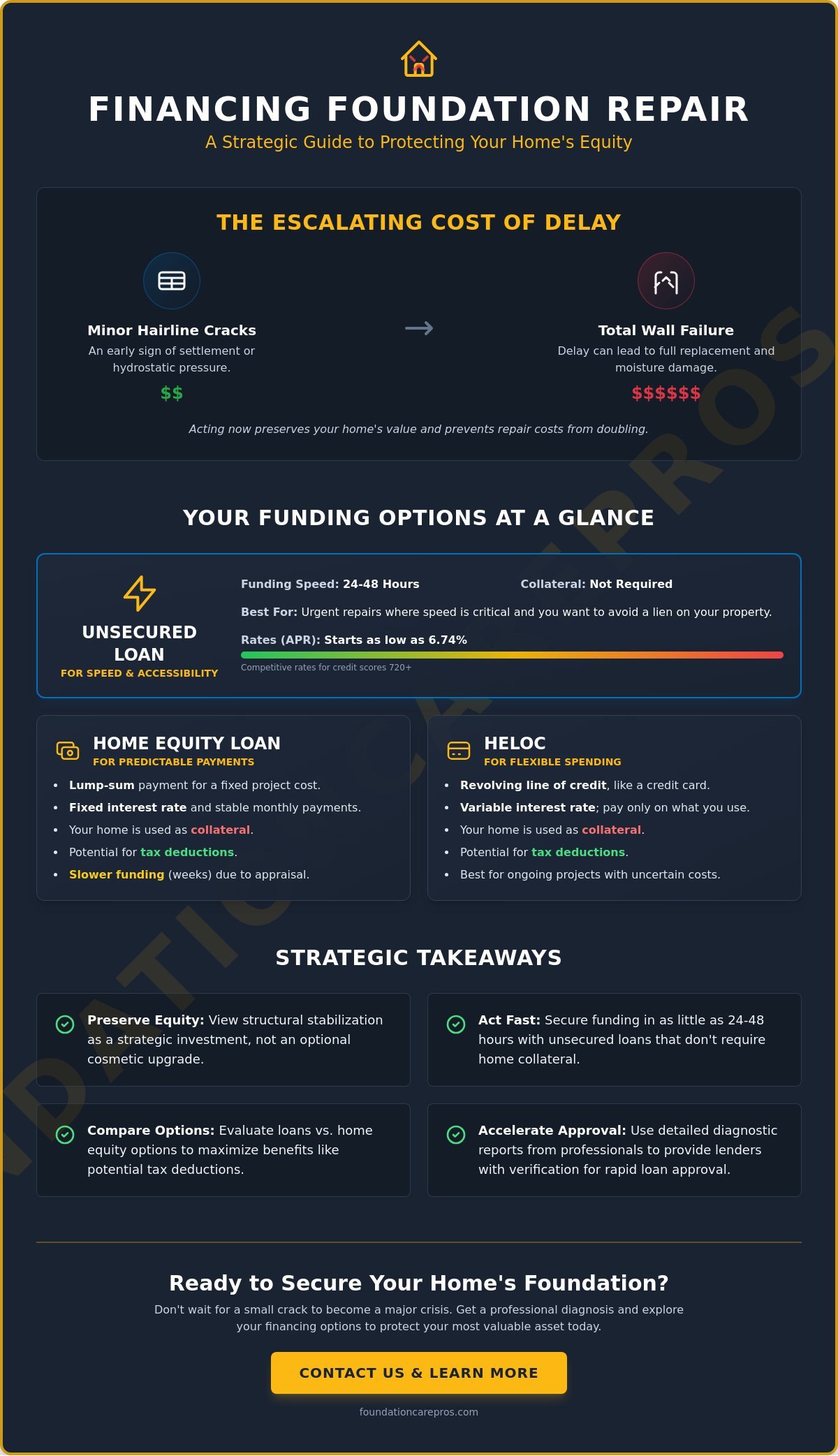
This guide provides a clear path to funding your structural repairs by breaking down the most effective tools available in 2026. You’ll learn how to leverage personal loans with fixed rates starting as low as 6.74% or utilize the equity in your home through a HELOC. We also examine specialized government programs like the FHA Title I loan for those who qualify. Every option we discuss focuses on securing your property and keeping your monthly payments manageable. You can restore your home’s value without the financial strain.
Key Takeaways
- View structural stabilization as a strategic preservation of your home’s equity rather than an optional cosmetic upgrade.
- Secure funding in as little as 24 to 48 hours using unsecured personal loans that do not require your home as collateral.
- Compare the most effective financing options for foundation repair, including HELOCs and home equity loans, to maximize potential tax deductions.
- Align your funding strategy with the urgency of the structural damage and your intended timeline for staying in the property.
- Leverage detailed diagnostic reports to provide lenders with the professional verification needed for rapid loan approval.
Why Financing Foundation Repair is a Strategic Home Investment
Foundation financing is a specialized category of home improvement funding designed specifically for structural stabilization. Unlike elective upgrades, these funds provide the capital necessary to restore the load-bearing integrity of your property. Structural repairs are forced investments. You cannot ignore a shifting base without risking the entire building envelope. While a new kitchen adds aesthetic appeal, a stable foundation prevents the total loss of your home’s marketability. Most homeowners quickly discover that standard insurance policies don’t cover settlement or soil movement. This creates a critical financial gap. Utilizing financing options for foundation repair ensures you can act before the damage escalates beyond your current budget.
The True Cost of Structural Delay
Soil pressure is a relentless force. Minor hairline cracks often indicate deeper issues with settlement or hydrostatic pressure. If left unaddressed, these small gaps evolve into total wall failure. Delaying a project like bowed basement wall stabilization is a high-risk gamble. What requires a simple reinforcement today might necessitate a full wall replacement in twelve months. Moisture infiltration accelerates this decay, weakening the concrete and compromising the interior environment. Waiting typically doubles the required scope of work as the structure continues to shift and settle further into unstable soil.
Foundation Repair vs. Cosmetic Remodeling
Lenders view structural integrity as a high-priority, protective investment. A failed foundation drastically reduces an appraised value, often by significantly more than the actual cost of the repair. Buyers cannot secure traditional mortgages on homes with documented structural instability. This makes repair work a prerequisite for maintaining your home’s resale potential. When you are understanding home equity, it becomes clear that protecting the structure is the most effective way to preserve your net worth. Foundation financing serves as a strategic tool to secure the building envelope and protect your long-term wealth. Professional stabilization restores the home’s value and provides the documented safety that future buyers and lenders require.
Unsecured Home Improvement Loans: Speed and Accessibility
Unsecured loans provide a critical bridge for homeowners facing immediate structural threats. These products function as personal loans, meaning they don’t require you to pledge your home as collateral. This distinction is vital for those who want to avoid placing additional liens on their property. Because the lender’s decision is based on creditworthiness rather than home value, the approval process is significantly faster than traditional mortgage products. It’s a direct, functional solution for high-stakes repairs.
Speed is the primary advantage of this funding route. When a foundation system fails, the damage is often progressive and relentless. You can’t afford to wait weeks for a full property appraisal or a lengthy title search. Most lenders in the market for unsecured home improvement loans can provide approval and funding within 24 to 48 hours. This rapid turnaround allows you to engage a contractor and begin stabilization before the next heavy rainfall or seasonal soil shift causes further movement.
Credit score requirements vary, but the most competitive rates, starting around 6.74% as of June 2026, typically require a score of 720 or higher. While rates can reach up to 35.49% for lower credit tiers, these loans remain one of the most accessible financing options for foundation repair for those needing immediate intervention. They offer a path to action that doesn’t rely on how much equity you’ve built in your home.
Benefits of Non-Equity Financing
Non-equity financing protects your home’s existing financial standing. You won’t have to navigate the complexities of a second mortgage or the intrusive paperwork associated with traditional banking. The application is usually digital and streamlined, prioritizing clarity over complexity. Fixed monthly payments offer total predictability, ensuring your repair costs don’t fluctuate with market interest rates. This stability helps you maintain a clear household budget while securing your home’s structure. It’s a methodical way to manage a sudden, necessary expense.
Qualifying for Unsecured Structural Loans
Lenders prioritize your Debt-to-Income (DTI) ratio when reviewing applications. A DTI below 36% is generally preferred, though some lenders offer flexibility for structural emergencies. Loan terms usually range from 24 to 84 months, though some specialized providers extend this to 15 years for larger projects. You should carefully evaluate “no-interest” promotional periods. While they offer short-term relief, they often carry high deferred interest if the balance isn’t cleared. A long-term fixed rate is frequently the safer, more disciplined choice for major stabilization. If you’re unsure about the scope of your project, consulting with a specialist at Foundation Care Pros can help define the exact funding you’ll need to request.
Home Equity Options: HELOCs vs. Home Equity Loans
Home equity products represent a highly strategic approach to funding major structural work. These are secured loans, meaning your property serves as collateral. Because the lender’s risk is lower than with unsecured debt, you typically receive more favorable interest rates. As of June 2026, the national average for a Home Equity Line of Credit (HELOC) sits at 7.43%, while standard home equity loans average 8.12%. These rates are significantly lower than most personal loans. Using equity is often the most cost-effective of the financing options for foundation repair when the project scope is extensive.
Tax advantages provide an additional layer of financial benefit. Interest paid on home equity debt is often tax-deductible if the funds are used to “buy, build, or substantially improve” the home that secures the loan. Foundation stabilization is the definition of a substantial improvement. It restores the structural integrity of the building envelope and prevents total loss of value. You should consult a tax professional to verify how these deductions apply to your specific financial situation. This benefit effectively lowers the net cost of your structural investment.
The Home Equity Line of Credit (HELOC) Advantage
A HELOC functions like a credit card tied to your home’s value. You receive a maximum credit limit and draw only what you need as the project progresses. This flexibility is ideal for complex, multi-phase efforts like basement waterproofing. You might draw funds for the initial excavation and then make a separate draw for the installation of an interior drainage system. During the initial draw period, many lenders offer interest-only payment options. This keeps your monthly obligation low while the heavy lifting of the repair is underway.
Fixed-Rate Home Equity Loans for Large Projects
Home equity loans provide a one-time lump sum with a fixed interest rate. This predictability is a major asset when dealing with a defined foundation stabilization cost. You won’t have to worry about future market fluctuations or rising interest rates during your repayment term. While these loans often involve closing costs similar to a primary mortgage, the lower interest rate usually offsets these fees over the life of the loan. It is a disciplined, methodical way to fund a massive stabilization project without the variability of a line of credit. You know exactly what your monthly payment is from day one until the balance is cleared.
Evaluating Your Financing Path: A Decision Framework
Selecting the correct funding model requires a methodical assessment of your property’s immediate needs and your long-term financial goals. You must balance the urgency of the structural threat against the total cost of the debt. If you’re seeing rapid crack expansion or visible wall movement, the speed of an unsecured personal loan often outweighs the slightly higher interest rate. Conversely, if you’re planning a comprehensive structural overhaul for a home you intend to keep for decades, the lower rates of a secured equity product are more logical. Your length of homeownership is a primary factor in this decision. Short-term owners may prefer the simplicity of a personal loan to keep their title clear for a future sale.
Every disciplined financial plan starts with accurate data. You should never apply for credit based on a guess or a rough estimate. Secure a professional diagnostic quote before finalizing any application for financing options for foundation repair. This ensures your loan amount matches the verified engineering requirement, preventing you from over-borrowing or finding yourself short of funds mid-project. A clear, itemized quote also provides the documentation many lenders require to approve structural high-priority loans. It’s a protective measure for your credit and your equity.
Credit Score and Interest Rate Correlations
Your credit profile is the most significant variable in determining your monthly obligation. As of June 2026, a credit score of 720 or higher typically unlocks the most competitive interest rates, often falling below 7% for qualified borrowers. Homeowners with scores in the fair range, generally between 620 and 680, will face higher APRs but still have access to specialized structural loans. You should avoid using standard emergency credit cards for major stabilization. These revolving lines often carry interest rates exceeding 20%, which can turn a necessary repair into a compounding financial burden. A fixed-rate loan is a much more stable way to manage a structural investment.
Calculating the ROI of Foundation Stabilization
Investing in professional systems like I-Beam wall braces provides a documented solution that restores your home’s marketability. When you go to sell, a repaired foundation with a transferable warranty is a selling point; an unrepaired one is a liability. “Cash-only” investors and bargain hunters typically demand steep discounts, often 20% or more of the home’s total value, when they encounter unresolved foundation issues. Structural repair is often the highest ROI maintenance task because it preserves the entire value of the property. To get an accurate assessment of your home’s needs, contact Foundation Care Pros for a detailed diagnostic estimate.
Securing Your Home with Foundation Care Pros
Foundation Care Pros acts as your technical advocate throughout the funding process. Lenders require more than just a verbal estimate; they need a validated scope of work that justifies the capital expenditure. Our diagnostic reports provide the engineering data necessary to prove the loan’s purpose. We identify the specific failure points, whether they involve soil saturation or lateral pressure, and present a methodical plan for resolution. This precision ensures you only borrow what is necessary to achieve permanent stabilization. Navigating the various financing options for foundation repair becomes much simpler when you have a detailed, evidence-based plan in hand.
Structural integrity is the baseline for all property value. While a cosmetic remodel may offer a high percentage of cost recovery, a compromised foundation acts as a value-killer that no amount of granite or hardwood can mask. Buyers and appraisers prioritize safety and permanence. By choosing to stabilize your home now, you shift your property from a liability back to a secure asset. This strategic move preserves your equity and ensures your home remains marketable in any economic climate. It’s a disciplined approach to asset management that pays dividends when it’s time to sell.
Professional Documentation and Lender Approval
Lenders often mandate a signed professional contract before releasing funds for home improvement. Our engineering-based approach validates the loan’s purpose by providing clear technical specifications that banks trust. We assist with the detailed specs required for crawl space encapsulation funding or wall reinforcement projects. This transparency lowers the lender’s perceived risk and can lead to faster approval times. You get a clear, documented path from initial assessment to a fully funded project without the typical administrative friction.
A Permanent Solution for Your Property
We move beyond temporary patches to install permanent stabilization systems. Whether your home requires a pier system installation or carbon fiber reinforcement, our goal is a one-time, definitive resolution. Every project includes the peace of mind that comes with a transferable structural warranty. This document is a powerful tool during future resale. It proves to buyers that the home’s base is secure and has been professionally maintained. You aren’t just fixing a crack; you’re protecting your family’s financial future. Schedule your professional foundation inspection and get a detailed quote for your lender today.
Secure Your Home’s Future with Strategic Funding
Securing your home’s structural integrity is a disciplined investment that preserves your equity and ensures long-term safety. You now understand the functional differences between rapid-funding personal loans and the strategic use of home equity. By selecting the right financial tool, you can address critical settlement or moisture issues before the damage requires a more expensive, invasive intervention. Navigating the various financing options for foundation repair doesn’t have to be a source of stress when you have a methodical plan and professional documentation.
As a locally owned structural specialist since 2004 and a proud member of the Supportworks Network, Foundation Care Pros provides the technical expertise and engineered stabilization systems your property requires. Our repairs include transferable warranties that protect your home’s resale value for years to come. We are committed to providing transparent, evidence-based solutions that fit your budget and your timeline.
Request a Free Foundation Inspection and Financing Consultation today to get a clear, diagnostic assessment of your home’s needs. You can restore your home’s stability and your peace of mind with a solution built to last.
Frequently Asked Questions
Is foundation repair typically covered by homeowners insurance?
Standard homeowners insurance policies generally do not cover foundation repairs caused by gradual settlement, soil movement, or poor drainage. Coverage is typically restricted to sudden, accidental events like a burst pipe or a major fire. You should review your specific policy declarations for exclusions. Because most structural issues are considered maintenance responsibilities, homeowners often rely on specialized financing to manage these necessary stabilization costs.
What credit score is needed for foundation repair financing?
A credit score of 720 or higher is usually required to secure the most competitive interest rates. Borrowers in this tier can often access fixed rates as low as 6.74% for home improvement loans as of June 2026. If your score falls between 620 and 680, you can still find financing options for foundation repair, though the interest rates will be higher. Lenders also evaluate your debt-to-income ratio to ensure you can manage the monthly payments.
Can I get a foundation repair loan with no equity in my home?
You can secure a foundation repair loan without using your home as collateral by applying for an unsecured personal loan. These loans are based on your creditworthiness and income rather than built-up equity. This is a common choice for homeowners who recently purchased their property or those who want to avoid adding a lien to their title. Approval and funding for these products can occur in as little as 24 to 48 hours.
How long are the typical repayment terms for foundation loans?
Repayment terms for foundation loans typically range from 24 to 84 months for unsecured personal loans. If you utilize a secured product like a home equity loan or an FHA Title I loan, terms can extend up to 20 years. Longer terms result in lower monthly payments but increase the total interest paid over the life of the loan. You should choose a term that balances immediate affordability with long-term financial health.
Are the interest payments on foundation repair loans tax-deductible?
Interest payments on home equity loans or HELOCs are often tax-deductible if the funds are used for substantial home improvements that increase the property’s value. Foundation stabilization is considered a qualifying improvement because it restores the building’s structural integrity. Interest on unsecured personal loans is not tax-deductible. It’s important to consult with a tax professional to confirm your eligibility for these deductions based on current IRS regulations.
What happens if I can’t afford to fix my foundation right now?
Delaying foundation repairs leads to compounding structural damage and exponentially higher costs. Minor cracks can evolve into wall failure or total settlement, which significantly reduces your home’s resale value. Most structural issues do not stabilize on their own; they worsen under constant soil and hydrostatic pressure. Securing financing options for foundation repair now prevents a manageable repair from becoming an unfixable financial disaster later.
Is it better to use a credit card or a personal loan for foundation cracks?
A personal loan is almost always a better choice than a credit card for structural repairs. Personal loans offer fixed interest rates and a set repayment schedule, whereas credit cards carry high, variable interest rates that can exceed 20%. Using a credit card for large projects can also negatively impact your credit utilization ratio. A fixed-rate loan provides predictable monthly payments and a clear path to debt resolution.
Can I finance both foundation repair and basement waterproofing together?
You can certainly combine foundation stabilization and basement waterproofing into a single financing package. Many homeowners choose a Home Equity Line of Credit (HELOC) for these multi-phase projects because it allows them to draw funds as each stage is completed. This approach ensures that your entire building envelope is protected from both structural failure and moisture infiltration. Financing both together often streamlines the application process and secures a consistent interest rate.