
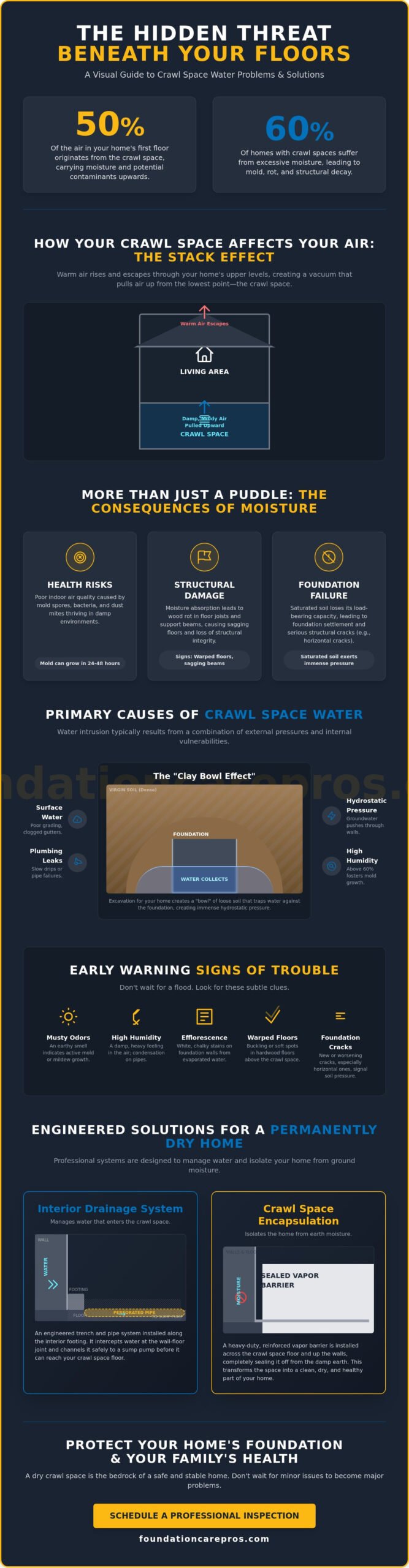
Nearly 50% of the air inside your home’s living area originates from the area directly beneath your floorboards. When you discover water in crawl space sections of your property, you aren’t just looking at a puddle. You’re looking at a catalyst for mold growth and structural decay. Research shows that over 60% of homes with these spaces suffer from moisture problems, often caused by poor exterior grading or groundwater seepage through the foundation.
It’s natural to feel a sense of urgency and concern for your family’s health. You want to ensure your wooden support beams remain solid and your foundation stays secure without facing runaway repair costs. This guide provides the technical clarity you need to diagnose the root cause of moisture and evaluate permanent waterproofing options. We will examine how to assess structural risks, identify specific entry points, and implement engineered solutions like encapsulation or interior drainage systems to ensure your home remains dry, stable, and odor-free.
Key Takeaways
- Understand how the “Stack Effect” draws moisture and potential contaminants from the crawl space into your living area.
- Identify the physical forces, such as hydrostatic pressure and improper soil grading, that drive water through foundation walls.
- Follow a systematic approach to identify the source of water in crawl space areas by evaluating exterior drainage and soil slope.
- Discover how engineered solutions like Interior Basement Drainage Systems intercept water at the footing before it reaches the floor.
- Evaluate the long-term protection provided by professional crawl space encapsulation to block soil-based moisture and maintain structural integrity.
Is Water in Your Crawl Space Normal? Understanding the Structural Risks
Many homeowners believe that finding a small amount of seasonal water in crawl space areas is a standard feature of older properties. This is a dangerous misconception. A healthy home is designed to remain dry from the foundation up. Any presence of moisture, whether it is a puddle or high humidity, represents a critical deviation from safe structural standards. Water doesn’t just sit; it changes the chemistry and physical integrity of your home’s skeleton.
To understand the full scope of these issues, it helps to start with the basics of What is a Crawl Space? and how it interacts with your environment. While these areas provide essential access to mechanical systems, their proximity to the earth makes them vulnerable to moisture. This vulnerability is amplified by the “Stack Effect.” Physics dictates that warm air in your living space rises and escapes through the upper levels. This movement creates a vacuum that pulls air upward from the lowest point. Because nearly 50% of the air you breathe on the first floor originates from the area beneath it, mold spores and damp air are constantly being cycled into your living room.
When moisture enters, organic materials like wooden floor joists and support beams begin to absorb it. According to EPA research, mold can begin to grow on damp surfaces within 24 to 48 hours. Over time, this constant saturation leads to wood rot. This compromises the structural integrity of your home, often manifesting as warped or buckled hardwood floors or sagging supports.
The Difference Between Humidity and Standing Water
Standing water is an obvious threat, but high relative humidity is just as destructive. If your crawl space maintains a humidity level above 60%, it creates an ideal environment for mold and dust mites. Most unconditioned spaces hover between 70% and 85% year-round. You might notice efflorescence; these are white, chalky salt deposits on your foundation walls. These minerals are left behind when water evaporates after passing through porous masonry. These deposits are early warning signs that your home is under stress before puddles ever form.
Structural Implications of Saturated Soil
Saturated soil loses its load-bearing capacity, which directly threatens the stability of your home. When the ground beneath your foundation becomes waterlogged, it can no longer support the weight of the structure evenly. This instability often leads to foundation settlement and the appearance of structural defects. For instance, you might wonder is a horizontal foundation crack serious? The answer is yes. These cracks often indicate that the soil is exerting excessive pressure against the walls or that the foundation is shifting due to moisture-related soil failure.
The Primary Causes of Crawl Space Water Accumulation
Finding water in crawl space areas usually stems from three distinct environmental failures: surface water mismanagement, groundwater pressure, or internal mechanical leaks. One of the most overlooked causes is the “Clay Bowl Effect.” When your home was built, contractors excavated a large hole and then backfilled it with loose soil once the foundation was set. This disturbed earth is far more porous than the surrounding virgin soil. It effectively creates a subterranean basin that traps rain and runoff directly against your foundation walls. Over time, this trapped water searches for a path of least resistance, which is often through your crawl space floor or walls.
Surface water issues are frequently the result of simple maintenance oversights. Clogged gutters and downspouts that discharge within three feet of the house dump hundreds of gallons of water onto the “clay bowl” during a heavy storm. Similarly, improper yard grading or landscape berms can act as dams, forcing water to pool against the structure. Beyond exterior factors, the crawl space is often the first place where slow-drip plumbing leaks manifest. Because these spaces are rarely visited, a small pipe failure can saturate the soil and rot support beams for months before the homeowner notices a musty odor or soft spot in the floor.
Hydrostatic Pressure and Foundation Stress
Groundwater doesn’t just sit; it exerts physical force. As soil saturates, it creates hydrostatic pressure, which can place thousands of pounds of force against your foundation. This pressure drives moisture through porous concrete and mortar joints. If left unaddressed, this relentless force can lead to severe structural issues. You can learn more about what causes basement walls to bow to see how this pressure compromises vertical stability. Simply pumping water out of the space is a temporary fix. It doesn’t solve the external pressure problem that is actively pushing against your home’s skeleton.
External Drainage Failures
Effective water management requires moving liquid away from the foundation as quickly as possible. When downspouts are too short, they create localized saturation points that overwhelm the soil’s natural drainage capacity. This is especially problematic in geographic regions with high water tables or heavy clay content. According to moisture control research from the USDA, managing these external factors is the first step in a professional diagnostic process. If you suspect your yard’s slope is contributing to the problem, a professional foundation assessment can help identify the specific points of failure before structural damage accelerates.
How to Diagnose Crawl Space Moisture: A Step-by-Step Inspection
The primary goal of a professional-grade home inspection is to isolate environmental variables and identify specific entry points to move from observation to engineered resolution. Diagnosing the source of water in crawl space areas requires a methodical approach that starts outside before moving into the confined space. By following a structured checklist, you can provide a specialist with the data needed to design a permanent waterproofing strategy.
Step 1: Exterior Perimeter Check. Walk the perimeter of your home during or immediately after a heavy rain. Verify that your gutters are clear of debris and that downspouts discharge at least five to ten feet away from the foundation. Observe the soil slope. If the ground is flat or tilting toward the house, surface water will inevitably pool in the excavated “clay bowl” area described previously.
Step 2: The Flashlight Test. Once inside the space, use a high-lumen flashlight to scan the foundation walls for “telltale” water marks. Look for dark staining or streaks that indicate where water has traveled down the masonry. You should also check for efflorescence, which appears as white, crusty salt deposits. These marks confirm exactly where moisture is breaching the barrier under hydrostatic pressure.
Step 3: Plumbing Audit. Not all moisture comes from the ground. Inspect HVAC condensate lines to ensure they are draining properly and not leaking directly into the soil. Examine all overhead supply pipes and drain lines for slow drips. Even a minor leak can saturate the earth and lead to significant rot over time.
Step 4: Mechanical Verification. If your home already has a sump pump, test its functionality. Lift the float switch to ensure the motor engages immediately. Check the discharge line for obstructions or leaks that might be recycling water back into the crawl space.
Safety Precautions During Inspection
Safety is the highest priority when entering a confined space. Never enter a crawl space with standing water if electrical components or exposed wiring are present. Wear proper Personal Protective Equipment (PPE), including a high-quality respirator to protect against mold spores and durable gloves to guard against pests. If you encounter a strong sewage smell or notice significant structural shifting, stop your inspection immediately and contact a professional.
Documenting Your Findings
Accurate documentation is vital for a successful repair. Take clear photos of active water intrusion during a storm, as these images help contractors see the problem in real-time. Track the “dry time” after rain stops to determine how efficiently your current drainage is working. This data is essential when preparing a summary for the foundation repair process, ensuring that the final solution addresses the root cause rather than just the symptoms.
Effective Strategies for Removing and Preventing Crawl Space Water
Resolving moisture issues requires moving beyond “band-aid” fixes like floor fans or shop vacuums. These temporary measures only address the symptoms of water in crawl space sections without stopping the intrusion at its source. A professional approach focuses on permanent, engineered solutions that manage both water volume and vapor pressure. This starts with using high-performance materials designed for harsh subterranean environments. A heavy-duty vapor barrier, for instance, must be thick enough to resist punctures and properly sealed to the foundation walls to block soil-based moisture effectively.
Standard hardware-store dehumidifiers are generally insufficient for the unique demands of a crawl space. These units are designed for finished rooms with stable temperatures and lower air volumes. In a crawl space, they often struggle with the high humidity loads and lower ambient temperatures, which leads to premature motor failure or frozen coils. Additionally, any drainage system is only as reliable as its discharge line. Professional protection against freezing or clogging is essential. This ensures that water actually leaves the property during a winter thaw or a heavy spring rain event.
The Power of Crawl Space Encapsulation
Encapsulation is the process of creating a “conditioned” space by completely sealing the area from the outside environment. This involves lining the floor and foundation walls with a heavy-duty reinforced polyethylene barrier. You can review the technical specifications and benefits in our crawl space encapsulation guide. One of the most critical steps in this process is sealing foundation vents. While older building codes once required these vents for airflow, modern engineering proves that open vents allow humid summer air to enter. This air then condenses on cold support beams and pipes, creating a constant cycle of dampness.
Managing Groundwater with Sump Pumps
When groundwater levels rise due to hydrostatic pressure, a professional Sump Pump Installation provides the primary line of defense. The system must include a dedicated basin with a airtight, sealed lid to prevent collected water from evaporating back into the air. Because heavy storms frequently cause local power outages, battery backup systems are a non-negotiable component of a reliable installation. Modern “smart” pumps now offer integrated sensors that alert homeowners to mechanical failures or high water levels via smartphone apps. If you’ve noticed standing water after recent storms, you should schedule a professional crawl space inspection to evaluate your specific drainage needs.
Professional Solutions: From Drainage Systems to Structural Support
When environmental management fails to keep a property dry, engineered hardware becomes necessary to maintain structural integrity. Interior Basement Drainage Systems serve as the “sub-floor” solution for persistent water in crawl space areas. Unlike exterior drains that can clog with soil and roots, these interior systems are installed along the internal perimeter of the footing. They are designed to intercept groundwater at its entry point before it can ever reach the crawl space floor. This intercepted water is then directed to a sump pump for mechanical discharge, effectively lowering the water table beneath your home.
If hydrostatic pressure has already compromised your foundation walls, drainage alone isn’t enough. You may require structural reinforcements like I-Beam Wall Braces or Foundation Wall Anchors to counteract the force of saturated soil. These systems provide immediate stabilization for walls that have begun to bow or lean inward. For homeowners, the long-term ROI of professional waterproofing is significant. Beyond protecting the home’s resale value, it ensures a healthy living environment by permanently eliminating the moisture that fuels mold growth and wood rot.
When Water Leads to Structural Damage
There is a critical point where waterproofing must be combined with structural stabilization to prevent total foundation failure. If the presence of water has caused the soil to wash away or lose its load-bearing capacity, the home may begin to settle unevenly. In these cases, Foundation Pier Systems are utilized to transfer the weight of the structure from unstable surface soil to competent load-bearing strata or bedrock. Addressing these issues is essential for long-term safety, especially if you are considering selling a house with foundation issues. Buyers and inspectors look for validated, permanent repairs rather than superficial patches.
Why Choose Foundation Care Pros?
We take a methodical, evidence-based approach to every property we evaluate. As members of the Supportworks Network, we utilize engineered and rigorously tested products that are designed specifically for structural repair and moisture control. We don’t rely on “one-size-fits-all” sales pitches. Instead, we perform a detailed diagnostic assessment to identify the exact physics behind your moisture problems. Our goal is to provide you with a dry, stable home through professional execution and transparent communication.
Don’t let moisture compromise your home’s stability or your family’s health. Contact us today to schedule a professional inspection and develop a clear plan for a dry, odor-free crawl space.
Secure Your Home’s Future with Engineered Solutions
Identifying the source of water in crawl space areas is the first step toward reclaiming your home’s health and stability. You now understand that seasonal moisture is a structural failure rather than a normal occurrence. By addressing hydrostatic pressure and implementing professional encapsulation, you can stop the upward movement of damp air and protect your wooden support beams from wood rot. These steps transition your home from a state of vulnerability to one of permanent security.
Foundation Care Pros has served as a specialist in structural stabilization since 2004. As an A+ rated professional service and a proud Supportworks Network member, we use only validated, engineered products to secure your property. Our methodical diagnostic process ensures that we solve the root cause of your moisture issues rather than just treating the symptoms. We prioritize long-term results over superficial fixes to ensure your investment is protected.
Take the final step toward a dry, odor-free home. Schedule Your Professional Crawl Space Inspection with Foundation Care Pros today. You deserve the confidence that comes with a structurally sound and healthy foundation.
Frequently Asked Questions
Is it normal to have standing water in a crawl space after heavy rain?
No, standing water is never normal and indicates a specific failure in your home’s drainage or grading systems. While some homeowners believe seasonal puddles are standard in older properties, any liquid accumulation represents a deviation from healthy structural standards. Standing water provides the moisture necessary for mold growth and wood rot to begin within 24 to 48 hours of a storm event.
How much water in a crawl space is too much?
Any amount of visible liquid or a relative humidity level consistently above 60% is considered too much water in crawl space areas. Even a thin film of moisture on the soil can evaporate and trigger the “Stack Effect,” pulling damp air and potential allergens into your living quarters. Constant saturation also weakens the soil, which compromises the load-bearing capacity of your foundation footings.
Can water in the crawl space cause the foundation to settle or crack?
Water is a primary driver of foundation settlement and structural cracking. When the soil beneath your home becomes saturated, it loses its ability to support the weight of the structure evenly. This instability leads to shifting and settling, which often results in vertical or horizontal cracks in foundation walls as the masonry struggles to adapt to the moving ground.
Will a dehumidifier get rid of standing water in my crawl space?
A dehumidifier is designed to remove water vapor from the air, not to pump out standing liquid. Attempting to use a dehumidifier while puddles are present will cause the machine to run constantly without resolving the source of the intrusion. You must first install a sump pump or an interior drainage system to remove liquid water before a dehumidifier can effectively manage air quality.
How long does it take for a crawl space to dry out on its own?
A crawl space rarely dries out on its own fast enough to prevent microbial growth or structural decay. Because these areas lack natural sunlight and significant airflow, moisture often remains trapped for weeks after a rain event. This prolonged dampness provides an ideal environment for mold spores to colonize organic materials like wooden floor joists and support beams.
What is the best way to stop water from entering through crawl space vents?
The most effective method is to seal the vents permanently as part of a professional crawl space encapsulation process. Closing these openings prevents humid exterior air from entering and condensing on cold surfaces during the summer. If surface water is entering through vents at ground level, you must also evaluate your yard’s grading to ensure water flows away from the foundation.
Does homeowners insurance cover water in the crawl space?
Standard homeowners insurance policies typically do not cover damage caused by gradual water seepage, high humidity, or poor maintenance. Coverage is generally reserved for sudden and accidental events, such as a major pipe burst. Most policies specifically exclude flood damage and groundwater intrusion, making preventative waterproofing a necessary investment for long-term protection.
Should I pump out the water myself or wait for a professional?
You can use a utility pump to remove large volumes of standing water as a temporary measure, but a professional assessment is required to identify the root cause. Pumping water yourself does not address the entry points or the hydrostatic pressure pushing against your walls. A specialist will use diagnostic tools to design a permanent solution that prevents the water from returning during the next storm.