
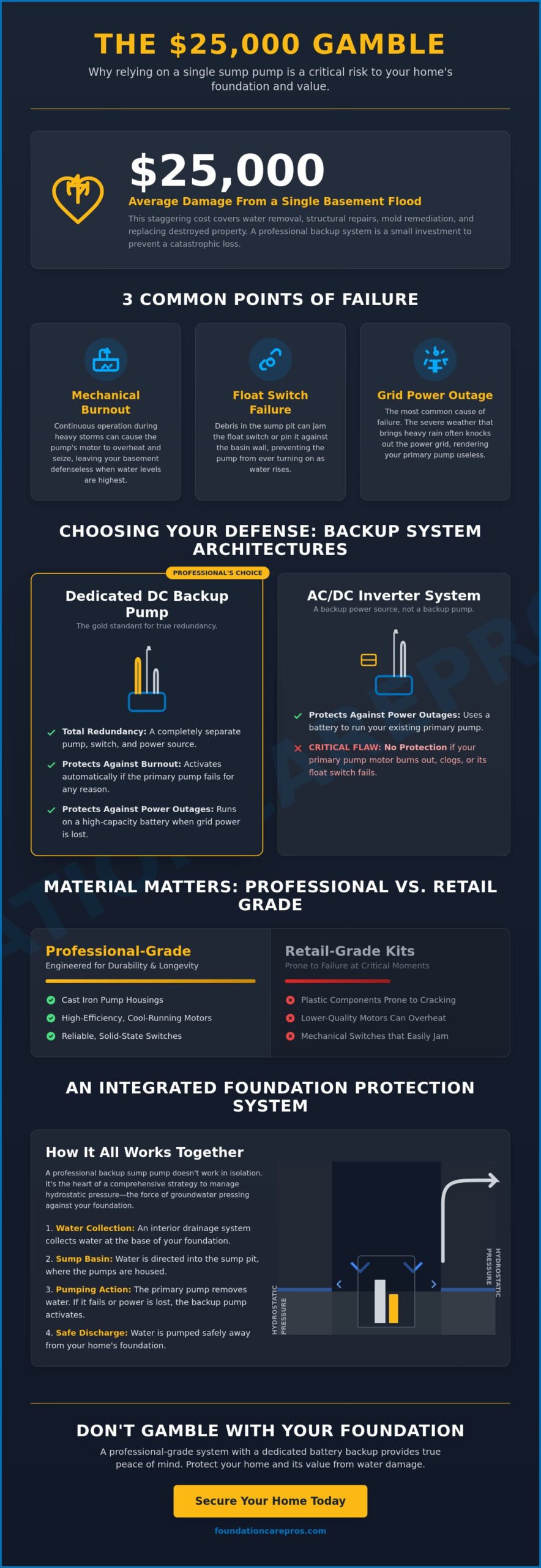
A single basement flooding event causes an average of $25,000 in damage, yet many homeowners rely on a single mechanical switch to protect their entire property. This is a high-stakes gamble that often fails during the exact moments you need protection most. A professional sump pump with battery backup installation provides the necessary redundancy to handle both power outages and primary pump failures simultaneously. This dual-pump architecture ensures your home remains dry even when the grid goes dark or the main motor reaches its limit.
You shouldn’t have to worry about your foundation every time the wind picks up or the lights flicker. We will show you how to select a professional-grade system that offers true peace of mind. This guide details the critical differences between AGM and lithium-ion battery technology and explains the 2026 National Electrical Code requirements for GFCI protection. You will gain a clear understanding of how to maintain a fail-safe setup that preserves your home’s structural integrity and long-term value.
Key Takeaways
- Compare DC backup pumps and inverter systems to determine which redundant architecture best handles your home’s specific power demands during an outage.
- Evaluate the longevity and maintenance requirements of AGM versus lead-acid batteries to ensure your backup power remains reliable for years to come.
- Identify why professional-grade cast iron components provide superior durability over the common failure points found in retail-grade plastic kits.
- Learn the technical requirements for a successful sump pump with battery backup installation, including pit depth optimization and proper check valve placement.
- Understand how a verified backup system works in tandem with interior basement drainage to manage hydrostatic pressure and protect your home’s structural foundation.
The Critical Role of Battery Backups in Basement Waterproofing
A Sump pump serves as the primary defense for your home’s foundation, but a single unit creates a dangerous point of failure. A battery backup system is a secondary, independent assembly designed to activate the moment your primary system loses power or suffers a mechanical breakdown. Adopting a “Zero-Fail” mindset is essential for long-term structural security. Hydrostatic pressure, which is the force of water pushing against your foundation, doesn’t pause when the electrical grid fails. In many cases, the peak of a storm is exactly when your primary pump is most likely to be overwhelmed.
The cost of a professional sump pump with battery backup installation is a proactive investment in your property’s permanence. A single basement flooding event can result in an average of $25,000 in cleanup, mold remediation, and property loss. Redundancy is the only reliable insurance against these costs. By installing a high-capacity backup, you ensure that your basement remains dry even during the most severe weather events when the risk of water infiltration is at its highest.
Why Primary Sump Pumps Fail When You Need Them Most
Primary pumps are vulnerable to several failure modes during heavy rain. Mechanical fatigue is common when high-volume cycles cause motors to overheat or capacitors to fail. Float switches, the mechanical triggers for the pump, can also become obstructed by sediment or pinned against the side of the pit. Most importantly, the severe weather that necessitates pump operation often brings down power lines. Without a backup system, your basement is entirely unprotected during the most critical hours of a storm.
- Mechanical Burnout: Continuous operation during flash floods can lead to motor seizure.
- Float Failure: Debris in the sump pit can jam the switch in the “off” position.
- Grid Outages: Storm-related power loss is the leading cause of pump failure.
The Difference Between a Backup Pump and a Backup Power Source
Homeowners must choose between two redundant technologies. A dedicated DC backup pump is a separate, secondary motor installed in the same pit. It functions independently of the primary pump and has its own float switch. Alternatively, an AC/DC inverter system uses a battery to power your existing primary pump during an outage. Most professional specialists prefer the dual-pump architecture. This setup provides a redundant flow path and ensures that if the primary motor burns out, the secondary pump is there to manage the water. A professional sump pump with battery backup installation typically utilizes this dual-pump configuration to maximize reliability. This comprehensive approach is often integrated with interior basement drainage systems to ensure water is consistently directed away from the foundation.
Evaluating Backup Technology: DC Pumps vs. Inverter Systems
Reliability in flood protection depends on the specific technology driving your secondary system. Homeowners generally choose between a dedicated DC backup pump and an AC/DC inverter system. An inverter uses a battery to power your existing primary pump during a grid failure. While this keeps your most powerful pump running, it offers zero protection if the primary pump’s motor suffers a mechanical seize. A professional sump pump with battery backup installation typically utilizes a dedicated DC pump for this reason. It provides a completely separate motor and float switch, ensuring a redundant flow path even if the main unit fails entirely.
System performance is measured in Gallons Per Hour (GPH), but this number changes based on “head pressure.” Head pressure is the vertical distance the pump must lift water to reach the discharge pipe. As this height increases, the GPH decreases significantly. High-quality systems maintain strong flow rates even at 10 feet of lift. Modern installations also feature smart controllers. These modules perform weekly self-diagnostic tests to verify the pump is operational and the battery is holding a charge. Since 42% of new installations now include IoT connectivity, these controllers can send real-time alerts to your smartphone if a fault is detected during these tests.
DC Backup Pumps: The Gold Standard for Redundancy
A secondary DC pump acts as a mechanical safety net. If your primary pump burns out from heavy rain fatigue, the DC unit activates automatically as the water level rises. You must ensure the backup’s flow rate can handle peak inflow during a storm. Professional installers evaluate whether your pit requires a dual-discharge setup, where each pump has its own pipe, or a single-discharge line with high-quality check valves. If you’re concerned about your current setup, a professional sump pump installation assessment can identify the best configuration for your home’s specific risk level.
Battery Selection: AGM vs. Traditional Deep-Cycle
The battery is the heart of any backup system. Traditional lead-acid batteries are common but require regular water top-offs and can emit corrosive fumes. Absorbed Glass Mat (AGM) batteries are the superior choice for basement environments. They’re maintenance-free, sealed against leaks, and typically last 5 to 7 years compared to the 3 to 5 years expected from lead-acid models. AGM technology also handles deep discharges better, providing more reliable runtime when the power stays out for extended periods. Always house your battery in a dedicated protective box to prevent terminal corrosion from basement moisture and humidity.
Professional-Grade vs. Retail Backup Kits: What Homeowners Need to Know
Professional-grade equipment is defined by its ability to perform under extreme stress. While retail stores offer convenient kits, these systems often rely on thermoplastic components that degrade over time. A professional sump pump with battery backup installation prioritizes cast iron or stainless steel construction. Cast iron is a superior material because it effectively dissipates heat from the motor. This prevents the thermal overload common in plastic units during high-volume cycles. Stainless steel components offer critical resistance to the corrosive environment found in most sump pits, ensuring the pump doesn’t seize after months of inactivity.
The mechanism that triggers the pump is another major differentiator. Retail units frequently use tethered float switches that require significant space to move. In the confined environment of a sump pit, these floats can easily become pinned against the wall or caught on discharge piping. Professional systems utilize vertical float switches or solid-state sensors. These designs have a smaller footprint and move on a fixed axis. This virtually eliminates the risk of mechanical hang-ups and ensures the pump activates exactly when the water reaches the designated level.
The Hidden Costs of Cheap Backup Systems
Choosing a low-cost system often results in performance gaps when you need protection most. Many retail kits have lower GPH ratings that cannot keep pace with the rapid water entry seen during severe weather. Climate change has led to a 12% increase in rainfall intensity in flood-prone regions, making high-capacity pumps more critical than ever. Plastic impellers inside budget pumps are prone to cracking if they encounter sediment or small debris. Additionally, cheap chargers lack the sophisticated algorithms needed to maintain battery health. This leads to premature battery failure, often leaving you unprotected despite the initial savings on hardware. Homeowners who have already attempted a basement leak repair with surface-level patches frequently discover that inadequate pump capacity is the underlying reason moisture continues to infiltrate.
Features of a Professional Installation
A high-quality installation includes more than just the pump and battery. Professional setups utilize dual check valves. These valves ensure that water cannot flow back into the pit once it’s pumped out. This prevents the pumps from cycling unnecessarily and wearing out the motor prematurely. Integrated high-water alarms are also standard. These provide an audible and often digital alert before water reaches your floor level. Because 42% of new installations now feature smart home connectivity, many professional systems allow for remote monitoring. You can verify your system status from anywhere, ensuring your basement remains protected while you’re away from home.
Step-by-Step: Sump Pump with Battery Backup Installation
A professional sump pump with battery backup installation requires a methodical approach to both plumbing and electrical integration. Begin by thoroughly cleaning the sump pit. Removing silt and gravel prevents the new pump’s intake from clogging during its first cycle. Per the 2024 International Plumbing Code, verify that your pit is at least 18 inches in diameter and 24 inches deep. This volume provides enough space for both pumps to operate without their float switches interfering with each other. If your current pit lacks the depth for a dual-pump setup, consider a professional sump pump installation to upgrade your home’s flood defense.
Position the primary pump on the bottom of the pit. Place the backup pump on a dedicated riser or slightly higher than the primary unit. This staggered height ensures the backup only activates if the primary pump fails or the water level exceeds the primary’s capacity. Testing the switch-over is the final critical step. Unplug the primary pump and fill the pit with water to verify the backup activates and discharges correctly. This simulation confirms that the system will perform as intended during a real-world power failure.
Plumbing Architecture for Dual Pumps
Install a “Y” connector to merge the discharge lines of both pumps into a single exit pipe. A “Y” fitting is superior to a “T” fitting because it creates less friction and allows for smoother water flow. You must install a check valve on each individual discharge line before they meet at the connector. These valves prevent the active pump from pushing water back down through the idle pump. Without these, the water would simply circulate within the pit rather than exiting the home.
Electrical Configuration and Safety
Mount the battery box and controller on a wall at least two feet above the floor to protect them from potential seepage. Modern 2026 electrical codes in many regions now mandate Ground Fault Circuit Interrupter (GFCI) protection for sump pumps. Ensure the charger is plugged into a dedicated circuit to prevent nuisance tripping from other appliances. Secure all cables with zip ties to keep them away from the float switches and to prevent trip hazards in the basement area.
Long-Term Maintenance Checklist
Maintenance is the only way to guarantee the “Zero-Fail” promise of your system. Perform a manual test every quarter by lifting the backup float switch to hear the motor engage. Inspect the battery terminals twice a year for white, crusty corrosion. Clean the terminals with a mixture of baking soda and water if needed. You must replace lead-acid batteries every 3 to 5 years, while AGM batteries should be replaced every 5 to 7 years to ensure they maintain the capacity required for an extended storm event.
Integrating Backup Systems into a Comprehensive Foundation Strategy
Effective flood protection extends far beyond the confines of the sump pit. A professional sump pump with battery backup installation serves as the final, critical exit point for a home’s entire waterproofing network. This system manages the hydrostatic pressure that builds up in the soil surrounding your foundation. Without a reliable way to evacuate water, saturated soil exerts thousands of pounds of force against your basement walls. This pressure is the primary driver behind structural cracks and lateral movement. Understanding the full scope of basement waterproofing methods, costs, and structural protection helps homeowners make informed decisions about their entire moisture management strategy.
The synergy between different waterproofing methods is vital for long-term stability. Interior basement drainage systems are designed to collect water at the footing and channel it toward the pump. If the pump fails during a power outage, the drainage system fills and remains stagnant, which can undermine the floor slab. Similarly, an i-beam wall braces installation provides the strength needed to stop wall bowing, but the braces work most effectively when the underlying cause, excessive soil moisture, is controlled by a functioning sump system. Even in homes utilizing crawl space encapsulation, a high-capacity pump is necessary to prevent vapor barrier floating and ensure the area remains dry.
Protecting Your Home’s Structural Integrity
A pump failure is rarely just a cosmetic issue. It’s a direct threat to the home’s structural integrity. Excess water leads to soil expansion and contraction, which causes foundation settlement and uneven floors. Once the soil reaches full saturation, the risk of a catastrophic wall failure increases. Adopting a “Zero-Fail” approach means recognizing that your pump is a structural component. It preserves the permanence of your foundation by ensuring that water never has the chance to accumulate and exert damaging forces against the masonry.
When to Call a Professional Specialist
Identifying the need for professional intervention before a flood occurs is a hallmark of responsible home ownership. You should seek a specialist’s assessment if you notice your current pump cycles constantly even during light rain, or if your sump pit appears undersized for the volume of water entering the home. A professional evaluation ensures your sump pump with battery backup installation meets current 2026 National Electrical Code standards for GFCI protection and dedicated circuitry. Specialists also verify that discharge locations comply with local municipal codes, preventing issues with insurance claims or property transfers in the future.
Secure Your Home’s Long-Term Structural Integrity
True flood protection requires moving beyond the vulnerabilities of a single-pump setup. By prioritizing high-capacity cast iron components and advanced AGM battery technology, you eliminate the common failure points associated with retail kits. A professional sump pump with battery backup installation ensures that your basement remains dry during the exact moments when the grid fails or primary mechanical components reach their limit. This redundancy is the most effective way to manage hydrostatic pressure and preserve the permanence of your foundation walls.
Foundation Care Pros is a principled specialist and a proud Supportworks Network Member. We are experts in structural stabilization and moisture control; we specialize in dual-pump redundant system installations that provide verified results. Don’t wait for the next severe storm to test your home’s defenses. Schedule a Professional Waterproofing Inspection with Foundation Care Pros to verify your system’s readiness. Taking this proactive step today provides the lasting peace of mind that your property is fully protected against water infiltration.
Frequently Asked Questions
How long will a battery backup sump pump run during a power outage?
A battery backup typically provides between 6 and 12 hours of continuous pumping or several days of intermittent protection. The exact duration depends on the battery’s ampere-hour rating and the frequency of the pump’s cycles. Higher capacity AGM batteries often sustain operation longer than standard lead-acid models. Professional installers calculate your home’s specific water inflow rate to ensure the battery capacity matches the risk level of your basement.
Can I add a battery backup to my existing sump pump without replacing it?
You can add a secondary DC pump to your existing pit as long as there is sufficient physical space. Most professional sump pump with battery backup installation projects involve adding this separate motor and float switch to create a redundant system. If your current pit is too small, a specialist can enlarge the basin to accommodate the dual-pump architecture. This upgrade provides protection against both power loss and primary motor failure.
What is the difference between a backup pump and an inverter?
A backup pump is a completely separate DC-powered motor that sits alongside your primary unit. An inverter system is a power conversion device that allows your existing AC primary pump to run off battery power. While inverters utilize the primary pump’s higher flow rate, they provide no protection if the primary motor itself burns out. Professional specialists usually recommend a dedicated backup pump for true mechanical redundancy.
Do I need a battery backup if I already have a whole-house generator?
Redundancy is still necessary even with a whole-house generator. Generators can take several seconds to engage, and they offer no protection if your primary sump pump suffers a mechanical seizure or a float switch failure. A dedicated battery backup provides an immediate secondary response. It ensures that your foundation remains protected during the gap between grid failure and generator activation or during a primary pump motor breakdown.
How often should I replace the battery in my backup sump pump system?
Battery replacement intervals depend strictly on the chemistry of the unit installed. Standard lead-acid batteries require replacement every 3 to 5 years to maintain reliability. Higher-grade AGM batteries typically last between 5 and 7 years. If your system utilizes lithium-ion technology, you can expect a lifespan of approximately 10 years. Regular testing is the only way to verify that the battery still holds the charge required for a major storm.
Why is my battery backup sump pump beeping or chirping?
Beeping or chirping typically indicates a system fault that requires immediate attention. Common triggers include a disconnected power cord, a low battery charge, or a failed self-diagnostic test. Modern smart controllers perform these tests weekly to ensure the motor is operational. If the alarm sounds, check the display panel for specific error codes. This alert system is a critical feature of a professional sump pump with battery backup installation.
Is an AGM battery better than a deep-cycle lead-acid battery for a sump pump?
AGM batteries are the superior choice for residential basement environments because they are sealed and maintenance-free. Unlike traditional deep-cycle lead-acid batteries, AGM models don’t require water top-offs and don’t emit corrosive fumes. They also offer a longer lifespan of 5 to 7 years and handle deep discharge cycles more effectively. This reliability makes them the preferred standard for high-performance waterproofing systems.
Can a backup sump pump handle the same volume of water as my primary pump?
Most backup pumps have a lower Gallons Per Hour (GPH) rating than primary AC pumps, but professional-grade models are designed to handle significant volume. A standard primary pump might move 3,000 GPH, while a high-quality DC backup can often manage 2,400 GPH. It’s important to verify that the backup’s flow rate can keep up with your basement’s peak water infiltration during a heavy rain event to prevent the pit from overflowing.