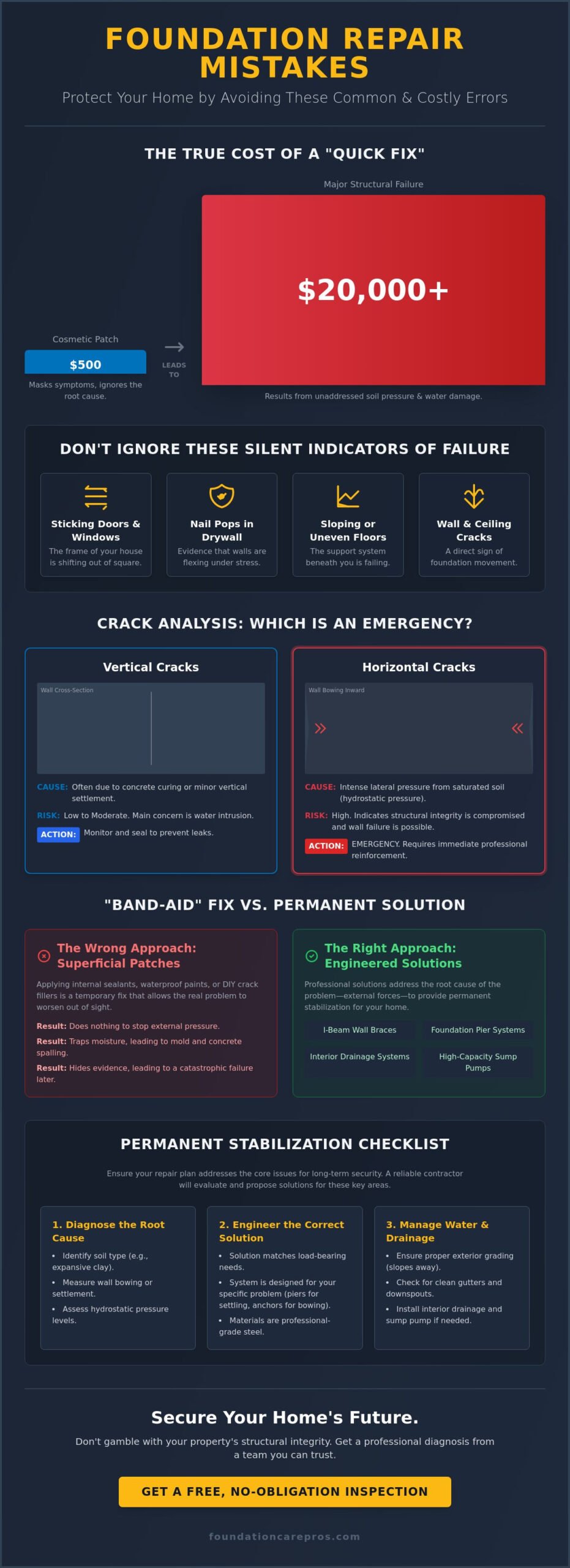
What if the $500 you spent sealing a basement crack actually masked a $20,000 structural failure? Many homeowners prioritize cosmetic fixes because they fear the escalating costs of major construction. However, ignoring the underlying cause of soil instability or hydrostatic pressure is one of the biggest foundation repair mistakes to avoid. You deserve a solution that addresses the root of the problem rather than just the visible symptoms.
It’s understandable to feel overwhelmed by the choice between piers, beams, and drainage systems. You want to protect your property value without falling victim to unreliable contractors or “quick-fix” methods that fail within a year. This guide provides the technical clarity you need to evaluate repair methods with confidence. We’ll examine how professional systems like I-beam wall braces and foundation pier systems provide the permanent stabilization your home requires. You’ll gain a clear framework for selecting a repair strategy that ensures your home remains safe and secure for the long term.
Key Takeaways
- Identify the silent indicators of structural failure, such as sticking windows and nail pops, before they lead to catastrophic damage.
- Understand why sealing basement cracks from the inside is a temporary measure that ignores the root cause of external soil pressure.
- Master the foundation repair mistakes to avoid by ensuring your solution, such as wall anchors or I-beams, is engineered for your home’s specific load-bearing needs.
- Detect red flags in contractor bids to ensure you are investing in a verified, permanent fix rather than a superficial patch.
- Use our comprehensive stabilization checklist to audit your home’s perimeter drainage and grading for long-term structural security.
Missing the Warning Signs: The Cost of Diagnostic Errors
Accurate diagnosis is the foundation of any successful structural project. One of the most frequent foundation repair mistakes to avoid is misinterpreting early warning signs as mere cosmetic issues. Homeowners often assume that a new crack is just the house “settling.” While minor settlement occurs in many homes, active structural movement is a progressive failure that requires immediate intervention. Ignoring these indicators doesn’t just put your home at risk; it significantly increases the eventual cost of stabilization as the damage spreads to the upper levels of the structure.
You must look beyond the foundation walls to find the silent indicators of movement. If you notice windows that suddenly stick or doors that no longer latch properly, the home’s frame is likely shifting out of square. Nail pops in the drywall and uneven or sloping floors are physical evidence that the support system beneath your feet is failing. These symptoms suggest that the soil beneath the home is no longer providing uniform support, which may eventually require professional underpinning to restore permanent stability.
Horizontal vs. Vertical Cracks: Which One is the Emergency?
Vertical cracks are common in many residential structures. They often appear as hairline fractures and typically result from the vertical settlement of the home into the soil. While these cracks should be monitored and sealed to prevent water intrusion, they aren’t always a sign of immediate structural failure. Horizontal cracks are a different matter entirely. These cracks indicate that the foundation wall is bowing or tilting inward because of intense lateral pressure from the outside. Hydrostatic pressure is the force exerted by stagnant water or saturated soil against your foundation walls. When you see horizontal cracking, the wall’s structural integrity is already compromised. This is an emergency that requires professional reinforcement with systems like I-beam wall braces or foundation wall anchors.
The Hidden Impact of Soil Saturation
Expansive clay soils are a primary driver of foundation failure. These soils swell significantly when they absorb moisture and shrink as they dry out. This constant expansion and contraction cycle puts immense pressure on your foundation footings. Poor yard grading often accelerates this damage. When water pools near the base of your home instead of draining away, it creates a zone of high saturation that weakens the soil’s load-bearing capacity. Choosing to wait until a more convenient season to address these issues is a high-stakes gamble. Delaying a professional diagnostic often leads to total wall collapse, turning a manageable reinforcement project into a full-scale structural replacement.
The Risks of DIY ‘Band-Aid’ Fixes and Cosmetic Cover-ups
Attempting to fix structural issues with retail-grade sealants is a high-risk strategy. Many homeowners turn to DIY solutions to save money, but these “band-aid” fixes often lead to more expensive repairs later. Patching a crack from the inside might stop a visible leak temporarily. It does nothing to address the external pressure causing the wall to move. This is one of the primary foundation repair mistakes to avoid, as it allows structural deterioration to continue out of sight.
Internal sealants fail because they fight against the natural flow of water. Concrete is a porous material. When hydrostatic pressure builds up outside your home, water will eventually find a path through mortar joints or microscopic pores. Surface coatings like “waterproof” paints are equally ineffective against structural forces. These products cannot withstand the pressure exerted by saturated soil. They quickly bubble and peel, leaving your foundation exposed while trapping moisture inside the wall where it can cause the concrete to weaken or spall.
Internal Sealing vs. External Drainage
Relying on internal patches ignores the physics of water management. Simply “pumping” concrete or foam into voids beneath a slab or behind a wall is often a wasted effort if the soil conditions aren’t stabilized. Without a way for water to escape, the pressure continues to mount. Effective management requires an interior basement drainage system paired with a high-capacity sump pump installation. This approach recognizes that water infiltration is inevitable and provides a controlled path for it to exit your home, protecting your foundation from the destructive power of stagnant water.
The ‘Aesthetic Trap’ of Finished Basements
Finishing a basement over a compromised foundation is a recipe for financial loss. Drywall and insulation might hide cracks, but they also trap moisture, leading to mold growth and wood rot in your wall studs. Future buyers and inspectors are trained to look for the subtle signs of movement that these “cover-ups” cannot fully hide. Discovering a structural failure after a basement is finished often requires the complete removal of your new walls and flooring to access the foundation. Improper crawl space fixes like unmanaged plastic sheeting can also trap moisture against floor joists, leading to sagging and rot.
Inspect your raw foundation walls thoroughly before starting any renovation. If you see signs of bowing or cracking, prioritize structural reinforcement. Investing in a professional I-beam wall braces installation ensures your walls are permanently stabilized before you add aesthetic value. If you aren’t sure about the integrity of your crawl space or basement, it’s best to request a professional structural assessment to avoid trapping moisture behind your finished work.
Engineering Failures: Choosing the Wrong Repair Method
Structural integrity relies on precise calculations. Selecting a repair method without considering the specific load requirements of your home is one of the most critical foundation repair mistakes to avoid. A solution that works for a minor settlement crack will fail catastrophically when applied to a wall under heavy hydrostatic pressure. Professional stabilization requires a methodical approach that accounts for soil composition, wall height, and the degree of structural deflection.
Under-engineering is a frequent cause of repair failure. This often happens when a contractor attempts to reduce costs by increasing the spacing between support members. If I-beam wall braces are placed too far apart, the foundation wall can continue to bow in the gaps between the beams. Every structural component must be spaced according to strict engineering standards to ensure the load is distributed evenly across the entire system. Using generic, untested products from uncertified installers further compounds this risk. These products lack the validation required to guarantee performance under the extreme stresses of shifting soil.
Bowed Wall Stabilization: I-Beams vs. Carbon Fiber
Choosing between stabilization methods depends entirely on the severity of the wall’s movement. Carbon fiber straps are an excellent choice for walls with minor bowing, typically less than two inches. They are low-profile and provide incredible tensile strength. However, I-beam wall braces are the gold standard for severely compromised walls. These steel beams provide mechanical leverage that carbon fiber cannot match. For an I-beam system to be effective, it must be securely anchored to the concrete floor and the floor joists above. This connection creates a rigid support structure that halts further inward movement and can even be tightened over time to help straighten the wall.
Foundation Piering Mistakes: Depth and Load
Foundation Pier Systems only provide stability if they reach competent load-bearing strata or bedrock. A common engineering failure occurs when piers are driven to a “shallow” depth. If a pier rests in the same expansive clay soil that caused the original settlement, the house will continue to move as the soil fluctuates. Push piers use the weight of the structure to drive the pipe deep into the earth until they hit a solid layer. Helical piers, which feature screw-like plates, are often superior in specific soil types where the resistance is measured by torque during installation. Selecting the wrong pier type or failing to reach the necessary depth results in a “band-aid” fix that requires expensive corrective work in the future.
Selection Errors: Hiring Based on Price Instead of Value
Structural repair is a precise engineering requirement that leaves no room for guesswork. Many homeowners prioritize the bottom line when faced with rising home maintenance costs, but choosing a contractor based solely on the lowest bid is one of the most significant foundation repair mistakes to avoid. A low quote often masks a lack of technical expertise, the use of inferior materials, or a “one-size-fits-all” approach. This strategy fails to account for soil variations or the specific load-bearing needs of your home, leading to secondary failures that cost more to rectify in the long run.
High-quality specialists distinguish themselves through an evidence-based diagnostic process. Be cautious of companies that provide a quote without performing a full perimeter inspection or those that use high-pressure sales tactics to close a deal. Reliable firms use industrial-grade components that have undergone rigorous stress testing to ensure they meet modern building codes. These products are often galvanized to prevent corrosion and are designed to interface specifically with your home’s existing floor joists and concrete slabs. If a contractor cannot provide the engineering data behind their pier spacing or beam placement, they are likely guessing rather than calculating.
Vetting Your Foundation Specialist
Ask detailed questions about the diagnostic equipment used during the initial assessment. A true specialist uses laser levels and moisture meters to provide a quantified look at your home’s movement rather than relying on a visual scan. You should also demand a written, transferable warranty. This document is a critical asset during a home sale. It provides the next owner with verified proof that the structural integrity has been restored by a qualified professional, which protects the property’s resale value. Ensure the specialist understands how to integrate structural reinforcement with water management systems like a sump pump installation.
Understanding the Warranty: Real Protection vs. Fine Print
A “lifetime” warranty is only valuable if the company remains in business to honor it. You must understand the distinction between a product warranty and a labor guarantee. A product warranty covers manufacturing defects in items like I-beam wall braces or foundation pier systems. A labor guarantee ensures the installation was performed according to engineering specifications. Verify the company’s track record and their reputation for honoring service calls within your community. Local longevity is a strong indicator of reliability and ensures you have a partner available for future support if soil conditions shift years after the initial installation is complete.
Protecting your property requires a partner who values engineering accuracy over high-volume sales. You can connect with a structural specialist today to ensure your stabilization project is handled correctly the first time.
The Permanent Stabilization Checklist for Homeowners
Achieving permanent stabilization requires moving from awareness to action. You must look beyond the cracks in your walls to understand the external forces at play. By following a structured approach, you eliminate the guesswork and sidestep the most common foundation repair mistakes to avoid. This checklist ensures that every structural intervention is backed by engineering data rather than a contractor’s intuition. It’s about shifting the focus from a quick patch to a lifelong structural solution.
- Audit Perimeter Drainage: Verify that soil grading slopes away from the foundation and that downspouts discharge water far enough to prevent saturation near the footings.
- Inspect Roof Drainage: Ensure your roofing and gutter systems are effectively shedding water; experts like Colorado Pro Roofing can help optimize your home’s water management to protect your foundation.
- Validate Structural Load: Ensure any proposed piering system is designed to reach competent strata or bedrock to prevent future settlement.
- Integrate Water Management: Combine wall reinforcement, like I-Beam wall braces, with interior basement drainage systems to manage hydrostatic pressure effectively.
- Verify Product Engineering: Confirm that all materials, from carbon fiber straps to foundation wall anchors, are tested and validated for your specific soil type.
- Plan for Maintenance: Establish a schedule for testing sump pump installation performance and inspecting crawl space encapsulation seals.
Step 1: The Professional Diagnostic
A professional diagnostic is more than a simple walkthrough. During a Foundation Care Pros inspection, specialists use precision tools to quantify structural movement. Laser levels identify exactly how many inches a floor has sloped or a wall has tilted. Moisture meters detect hidden saturation points behind finished surfaces that might indicate a failing drainage system. Even if you receive a free estimate, it should include a technical breakdown of the load-bearing math and soil analysis. This data-driven approach prevents the mistake of applying a generic fix to a unique engineering problem.
Step 2: Executing the Permanent Fix
Execution begins with stabilizing the foundation’s footprint. If the home is sinking, installing structural supports like helical piers can take several days depending on the required depth and soil resistance. These piers are mechanically screwed into the earth until they hit stable ground. Once the vertical load is secure, specialists address lateral pressure. Interior drainage systems and high-capacity sump pumps work in tandem with wall braces to redirect water and reinforce concrete. The process concludes with a final verification of all anchor points. This ensures the system is functioning as intended and provides you with the confidence that your home is permanently stabilized.
Secure Your Home’s Structural Integrity
Stabilizing your home requires a shift from superficial fixes to engineering-based solutions. By identifying the root causes of movement, such as soil saturation and lateral pressure, you protect your property’s long-term value. Avoiding the most common foundation repair mistakes to avoid allows you to invest in a one-time stabilization that secures your home for decades. It isn’t just about closing cracks; it’s about restoring the structural core of your residence.
Foundation Care Pros brings decades of structural stabilization expertise to every project. We specialize in precision-engineered solutions like I-beam wall braces and helical pier systems that are designed to withstand extreme environmental stress. Our team focuses on transparent diagnostics and verified results to ensure your home remains safe and secure. Protect your home’s future with a professional foundation inspection from Foundation Care Pros. You can move forward with confidence knowing your property is supported by a foundation that’s built to last.
Frequently Asked Questions
What is the most common mistake in foundation repair?
Treating cosmetic symptoms like wall cracks without addressing the underlying structural cause is the most common error. Homeowners often apply surface sealants that fail because they don’t stop the external hydrostatic pressure pushing against the foundation. A permanent solution requires stabilizing the soil or reinforcing the wall with I-beam wall braces or anchors. This is one of the primary foundation repair mistakes to avoid if you want a one-time fix.
Can I fix a bowing basement wall myself?
You shouldn’t attempt to fix a bowing basement wall yourself because it involves complex engineering and high-tension forces. Structural reinforcement requires specialized equipment to install I-beam wall braces or foundation wall anchors safely. Improper DIY attempts can lead to total wall collapse or severe personal injury. Professional installation ensures that the load-bearing math is calculated correctly for your home’s specific structural requirements.
How much does it cost to fix a foundation properly?
National data for 2026 indicates that most homeowners pay between $2,200 and $8,400 for foundation repairs. Minor hairline crack sealing might cost $300 to $800, while major structural underpinning can range from $8,000 to over $25,000. These figures vary significantly based on your local soil conditions and the specific stabilization method required for your home’s unique load-bearing needs. You should check with a local specialist for a site-specific assessment.
Is it a mistake to use carbon fiber on a wall that is bowing more than two inches?
Using carbon fiber straps on a wall bowing more than two inches is generally considered an engineering error. Carbon fiber is highly effective for stabilizing minor movement, but severely compromised walls require the mechanical leverage of I-beam wall braces. Braces provide the structural rigidity needed to halt significant inward deflection. They can also be adjusted over time to help move the wall back toward its original position.
What happens if I ignore foundation cracks for too long?
Ignoring foundation cracks allows minor settlement to progress into total structural failure. Small vertical fractures can evolve into horizontal cracks, indicating that hydrostatic pressure is actively bowing your walls. Delaying a diagnosis increases the eventual repair cost and often leads to secondary damage throughout the home. You may see sticking windows, nail pops in drywall, or even collapsed floor joists as the structure continues to shift.
How do I know if a foundation repair company is reliable?
A reliable company utilizes precision diagnostic tools like laser levels and moisture meters to quantify structural movement. Look for specialists who belong to established networks, such as Supportworks, and provide written, transferable warranties. Reliable firms avoid “one-size-fits-all” quotes and instead conduct a thorough perimeter inspection. They should be able to explain exactly why a specific system, like a foundation pier system, is necessary for your soil type.
Does foundation repair increase the value of my home?
Professional foundation repair restores your home’s market value by ensuring the structure is safe and insurable. Unaddressed foundation issues are a major red flag for buyers and often result in failed home inspections. Providing a documented, permanent stabilization plan gives potential buyers confidence in the property’s long-term security. It transforms a liability into a verified asset by proving the home’s structural integrity has been professionally validated.
Can poor landscaping cause foundation failure even after a repair?
Poor landscaping and improper grading can cause foundation failure even after structural repairs are completed. If water pools near your foundation because of flat grading or short downspouts, the soil will continue to expand and put pressure on your walls. Effective stabilization must include managing water through interior basement drainage systems and maintaining a positive slope away from the home. Constant moisture management is essential to protect your structural investment.