The most discreet foundation repair isn’t always the safest choice for your home’s long-term stability. You are likely monitoring a bowing wall with growing concern, fearing a total structural failure while worrying about the cost of professional intervention. It’s a stressful situation, especially if you plan to finish your basement and want to avoid losing valuable square footage to intrusive hardware. Finding the right balance between strength and space requires a clear look at the engineering behind i-beam wall braces vs carbon fiber straps.
We will compare the load-bearing capabilities, installation footprints, and technical requirements of both systems to ensure your home remains secure. Carbon fiber straps offer a high-strength, low-profile option for walls with less than 2 inches of deflection. However, severe structural shifting often demands the mechanical tension and rigid support that only steel I-beams can provide. This guide provides the expert validation you need to select a permanent solution that stops wall movement and restores your confidence in your foundation.
Key Takeaways
- Identify the root cause of bowing walls and how modern stabilization methods counteract lateral soil pressure.
- Compare i-beam wall braces vs carbon fiber straps to determine which material matches your wall’s specific degree of deflection.
- Learn why steel I-beams are the necessary solution for severe structural shifting where mechanical tension is required.
- Discover how carbon fiber straps provide a low-profile, paintable solution that preserves your basement’s square footage.
- Understand why a professional structural assessment is the only way to guarantee a permanent, validated repair.
Understanding Bowed Walls and Stabilization Methods
Foundation walls act as retaining walls for the earth surrounding your home. When the soil becomes saturated with water, it expands and exerts massive lateral pressure against your basement’s exterior. This phenomenon, known as hydrostatic pressure, is the primary cause of inward wall movement. Understanding the mechanics of this force is essential before evaluating i-beam wall braces vs carbon fiber straps for your repair.
The Physics of Hydrostatic Pressure
Saturated clay soil exerts thousands of pounds of force against a foundation. This weight often exceeds the structural capacity of concrete blocks or poured concrete. You’ll first notice horizontal cracking in the mortar joints or mid-wall. Eventually, the wall begins to tip inward at the top or bow in the center. Carbon fiber straps are engineered to handle over 200 pounds per square foot of this lateral pressure, providing a high-tech barrier against soil movement. While moisture management through gutters and grading helps reduce the load, it cannot reverse structural damage once the wall has yielded.
Stabilization vs. Correction
Structural repairs generally fall into two categories: stabilization and correction. Stabilization is a passive reinforcement method. It locks the wall in its current position to prevent further movement. Correction is an active process that attempts to push the wall back toward its original vertical orientation. Both systems are engineered to counteract lateral soil pressure, but they manage the load differently. Early intervention is the most cost-effective path. Addressing a slight bow now prevents the eventual need for a full, invasive foundation replacement.
The choice between i-beam wall braces vs carbon fiber straps often depends on which of these goals you need to achieve. Carbon fiber is primarily a stabilization tool. It uses aerospace-grade technology to provide incredible tensile strength, stopping a wall from bowing further. Steel I-beams also stabilize the structure, but they offer the unique ability to apply mechanical tension over time. This vertical support runs from the concrete floor to the floor joists, creating a rigid column that physically blocks inward movement. Identifying the degree of your wall’s deflection is the first step in choosing the right material for a permanent fix.
I-Beam Wall Braces: The Heavy-Duty Solution for Severe Shifting
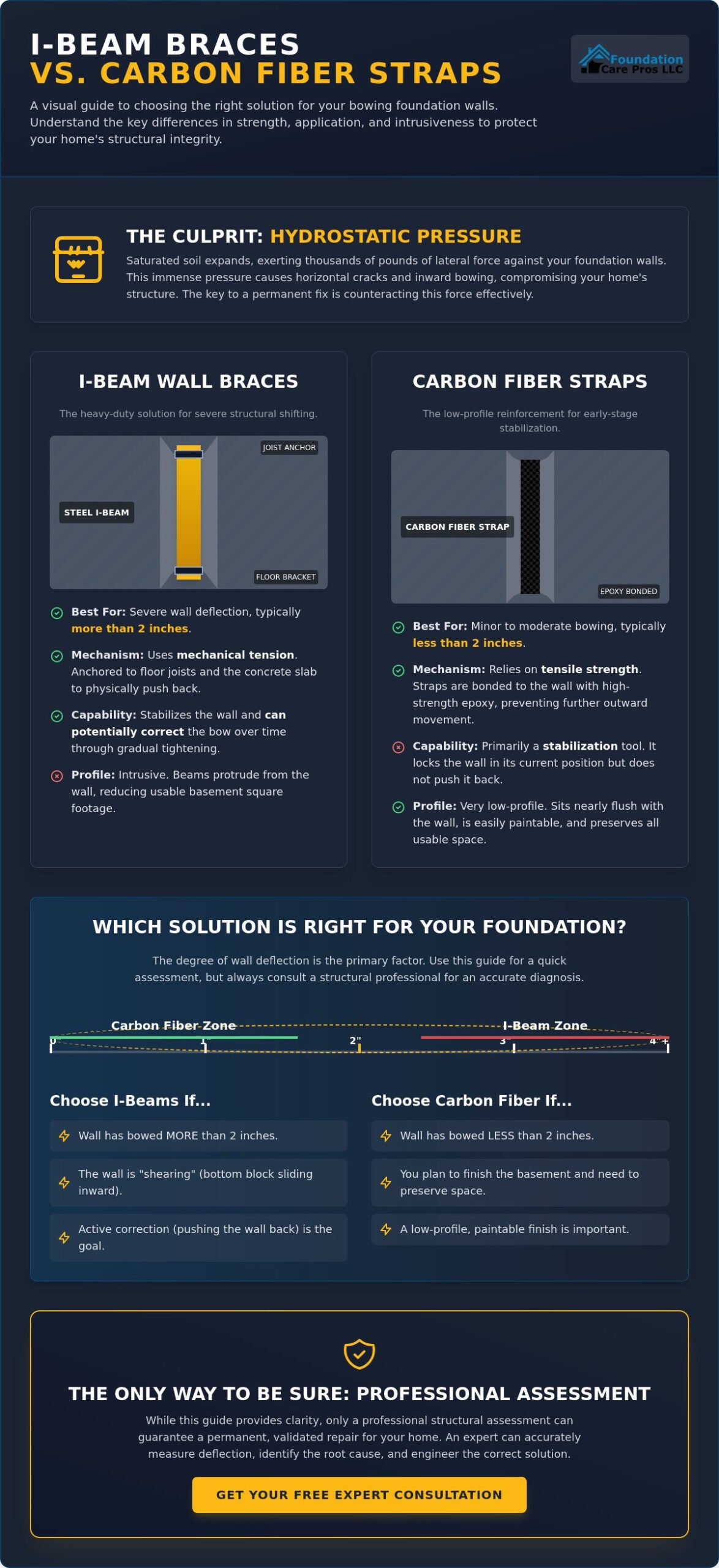
Severe foundation failure requires a solution that does more than just hold a wall in place. When a wall has bowed more than 2 inches, the structural load has shifted significantly. At this stage, the choice between i-beam wall braces vs carbon fiber straps is no longer a matter of preference but of engineering necessity. Steel I-beams provide the rigid, vertical reinforcement needed to counteract extreme lateral pressure that has already compromised the masonry’s internal strength.
Mechanical Leverage and Lateral Support
Unlike adhesive-based systems, steel braces don’t rely on the surface integrity of the concrete. The system consists of heavy-duty steel beams anchored into the concrete floor slab and secured to the wooden floor joists above. A specialized floor bracket prevents the bottom of the wall from sliding inward, while a tensioning bolt at the top allows for ongoing adjustments. This mechanical leverage bridges the weak point created by horizontal cracking, transferring the soil’s load directly into the home’s framing. Because the beam is a standalone structural member, it remains effective even if the concrete surface is crumbling or saturated. This setup allows for the potential of straightening the wall over time through controlled tensioning.
When Steel is Non-Negotiable
Every foundation has a “point of no return” where flexible reinforcement is no longer viable. If your wall is experiencing “shearing,” which is when the bottom row of blocks slides inward across the floor, straps cannot provide the necessary physical stop. I-beams are the industry standard for walls with significant top-of-wall sliding or severe deflection. The use of zinc-plated or galvanized steel ensures these supports resist corrosion in damp basement environments for decades. If you’re dealing with advanced structural shifting, installing I-Beam Wall Braces provides the mechanical strength required to stabilize the home safely.
A professional diagnostic is the only way to confirm if your foundation has crossed the threshold for steel reinforcement. While I-beams are more invasive than other methods, they offer a level of structural continuity that lighter materials cannot match. They provide a permanent, validated fix for walls that have moved beyond the limits of simple stabilization, ensuring the safety of the entire structure above.
Carbon Fiber Straps: High-Tech Reinforcement with a Low Profile
Carbon fiber reinforcement utilizes aerospace-grade technology to address residential foundation failure. This material is exceptionally strong yet lightweight. It provides a permanent solution for walls displaying minor to moderate bowing. When evaluating i-beam wall braces vs carbon fiber straps, homeowners often choose carbon fiber for its efficiency and minimal impact on the home’s interior. This system is best suited for walls with less than 2 inches of total inward movement. It stabilizes the structure without the need for heavy machinery or floor demolition. By catching the damage early, you can secure your home with a solution that is as durable as it is discreet.
Tensile Strength and Surface Bonding
Tensile strength refers to a material’s ability to resist being pulled apart under tension. Carbon fiber excels in this category because it has virtually zero stretch. Once installed, it acts as a rigid external skeleton for your foundation. The success of this repair depends entirely on the quality of the surface bond. Technicians must grind the concrete to expose a clean, porous surface. We then apply a high-strength epoxy resin that fuses the strap to the masonry. This bond ensures that lateral pressure is distributed across the entire height of the wall rather than concentrating on a single crack. Unlike mechanical systems, this bond becomes part of the wall’s structure, offering a permanent fix that requires zero maintenance after installation.
Aesthetic and Space-Saving Benefits
Preserving basement square footage is a major priority for many property owners. Carbon fiber straps are only about the thickness of a penny. They sit flush against the foundation wall. In contrast, steel I-beam systems typically protrude 4 to 6 inches into the room. This difference is critical if you plan to finish your basement. You can paint directly over the epoxy-sealed straps for a clean look. If you prefer a finished living area, you can install drywall or paneling without the need for complex framing or deep wall cavities. This low-profile design allows for a permanent structural fix that doesn’t compromise your home’s usable space. Choosing the right material in the i-beam wall braces vs carbon fiber straps debate often comes down to your future plans for the basement. If your goal is a modern, finished room, carbon fiber offers the most flexibility. It provides the expert-validated strength your foundation needs while keeping your renovation options open.
I-Beam Wall Braces vs. Carbon Fiber Straps: Side-by-Side Comparison
Choosing between i-beam wall braces vs carbon fiber straps requires a look at your specific structural needs and long-term goals. Both systems offer a permanent fix, but their impact on your basement’s footprint and your project budget varies. The most effective system isn’t always the most expensive one. Instead, the right choice is the one that aligns with the severity of your wall’s deflection and your plans for the space.
Installation Complexity and Invasiveness
The installation process for carbon fiber is remarkably clean and efficient. Technicians prep the wall surface and bond the straps using high-strength epoxy. This method requires no heavy equipment and leaves virtually no debris. In contrast, I-beams involve more intensive labor. Installation requires drilling into the overhead joists and often involves cutting into the concrete floor slab to secure the bottom brackets. Despite these physical differences, professional crews can typically complete either system in a single day. You won’t have to deal with a weeks-long construction project regardless of the material you choose.
Total Value and Long-Term Performance
Property owners often prioritize the foundation stabilization cost when making a final decision. Carbon fiber is generally more cost-effective for minor bowing because it requires fewer materials and less site preparation. However, if a wall has moved beyond the 2-inch threshold, the value shifts toward I-beams. Steel provides the “correction” capability that straps lack. When it comes to resale value, carbon fiber is often preferred for homes where the basement will be finished, as it remains nearly invisible. I-beams provide visible, expert-validated proof that a severe structural issue has been fully resolved, which can reassure cautious buyers. For a broader look at how these technologies integrate with your home, review our basement wall stabilization guide.
Homeowners frequently ask which solution lasts longer. Both materials are engineered for a lifespan exceeding 25 years. Carbon fiber doesn’t rust or corrode, and galvanized steel beams are protected against the damp basement environment. Your decision should be based on the degree of damage rather than a fear of material failure. If you’re ready to secure your home’s future, contact us for a professional structural diagnostic to determine which reinforcement method is right for your property.
Making the Right Choice for Your Home’s Foundation
A generic approach to foundation repair often leads to secondary failures or unnecessary expenses. Every home sits on a unique combination of soil types and moisture levels. Choosing between i-beam wall braces vs carbon fiber straps requires more than a visual inspection of a crack. It demands a technical evaluation of the wall’s current load and the rate of its movement. We focus on evidence-based diagnostics to ensure the chosen method matches the specific structural needs of your property. This methodical approach lowers your stress by providing a clear, validated path to stability.
A one-size-fits-all approach fails because it ignores the specific engineering limits of different materials. Forcing a carbon fiber solution on a wall with three inches of movement risks a complete bond failure. Conversely, installing heavy steel beams on a wall with hairline cracks might be an unnecessary use of basement space. We tailor every recommendation to the physical evidence found during our inspection. This ensures you aren’t paying for more hardware than you need or settling for a fix that won’t hold.
The Diagnostic Process
Expert assessment begins with precise measurements of wall deflection. We analyze the geometry of the cracks to determine if the pressure is uniform or concentrated at specific points. Identifying the source of moisture is also a priority, as saturated soil remains the root cause of bowing. We evaluate the surrounding landscape and drainage systems to understand the external forces acting on your basement walls. For those looking to understand their home’s warning signs, our guide to foundation cracks offers a detailed look at what different patterns indicate. This diagnostic phase ensures we don’t just treat the symptom but resolve the underlying structural threat with technical precision.
Professional Installation and Warranty
Structural reinforcement is a high-stakes task that requires specialized engineering knowledge. It shouldn’t be treated as a DIY project. Professional installation guarantees that the i-beam wall braces vs carbon fiber straps are integrated correctly with your home’s existing framing and floor slab. A professional fix also comes with a transferable warranty. This documentation is vital for maintaining home value and provides peace of mind for future buyers. It validates the quality of the repair and ensures the solution is permanent. We provide the expert validation needed to secure your foundation for the long term. Contact Foundation Care Pros today to schedule your professional structural assessment and take the first step toward a stable home.
Secure Your Home’s Structural Future
Identifying the right stabilization method is the final step in protecting your property from the destructive forces of hydrostatic pressure. The choice between i-beam wall braces vs carbon fiber straps depends primarily on the degree of wall deflection and your future plans for the space. Carbon fiber offers an invisible, high-tech solution for minor bowing, while steel I-beams provide the mechanical leverage required for severe structural shifting. Both systems offer a permanent fix when they’re installed with technical precision.
As a member of the Supportworks National Network, Foundation Care Pros utilizes a methodical, engineering-based diagnostic process to evaluate your foundation. We are specialists in both I-Beam and Carbon Fiber systems, ensuring you receive the specific hardware your home requires. Don’t leave your property’s safety to guesswork. Get a Professional Structural Assessment from Foundation Care Pros today to secure your investment. You can restore the integrity of your foundation and move forward with your basement plans with complete confidence.
Frequently Asked Questions
How much bowing is too much for carbon fiber straps?
Carbon fiber straps are typically limited to walls with less than 2 inches of total inward deflection. Once a wall exceeds this threshold, the structural load has shifted too far for adhesive-based reinforcement alone. In cases of severe bowing or shearing at the base, the choice in i-beam wall braces vs carbon fiber straps shifts toward steel for its superior mechanical strength.
Do I-beam wall braces require maintenance after they are installed?
Yes, steel I-beams require periodic tensioning to remain effective over time. A technician will tighten the bolt at the top of the beam to maintain constant pressure against the wall. This mechanical adjustment is necessary to counteract ongoing soil movement and ensure the system continues to provide rigid support for the foundation.
Can I finish my basement over carbon fiber straps?
You can easily finish your basement after installing carbon fiber reinforcement. Because the straps are about the thickness of a penny, they sit flush against the masonry. You can paint directly over the epoxy coating or install drywall over the straps without losing any square footage or requiring deep wall framing.
Is it possible to straighten a wall using I-beam braces?
Wall straightening is possible with I-beam systems through controlled, mechanical tensioning. Unlike passive stabilization methods, the top bracket of an I-beam allows for gradual tightening over several seasons. This process can pull the wall back toward its original plumb position, though the primary goal remains permanent stabilization.
How long do carbon fiber foundation repairs last?
Carbon fiber foundation repairs are engineered to last for the life of the structure, with an expected lifespan exceeding 25 years. The material does not stretch, rust, or degrade in damp basement environments. When bonded correctly with high-strength epoxy, it provides a permanent solution that requires zero ongoing maintenance from the homeowner.
Will foundation repair systems like I-beams affect my home’s resale value?
Professional foundation repairs generally protect your home’s resale value by resolving a major structural liability. While visible I-beams take up some space, they provide expert-validated proof that the home is stable. Most buyers prefer a home with a documented, warranted repair system over one with active, unaddressed wall movement.
Do I need to dig up my yard to install these wall supports?
Interior wall supports do not require any exterior excavation or yard disruption. Both systems are installed entirely from the inside of your basement. This makes the process faster and more cost-effective than exterior methods, as it avoids the need to remove landscaping, porches, or sidewalks to reach the foundation.
What happens if a bowing wall is left unrepaired?
Neglecting a bowing wall eventually leads to total structural failure and foundation collapse. Hydrostatic pressure from the soil is a constant force that will continue to push the wall inward until the masonry yields completely. Repairing the damage early is essential to avoid the massive expense and safety risks associated with a collapsed foundation wall.