
Your foundation isn’t just failing to keep water out; it is actively struggling against the immense weight of the saturated earth surrounding it. Most homeowners view a wet floor as a simple leak, but the real culprit is hydrostatic pressure that can eventually compromise your entire home. You’ve likely spent hours worrying about mold growth or felt defeated by the high-cost quotes for exterior excavation. It is a stressful position for any property owner who values the safety of their investment.
You need to understand that an interior drainage system is not a leak catcher. It is a strategic pressure-relief network designed to neutralize the primary cause of foundation failure. This guide explains how interior basement drainage systems manage water flow to keep your basement permanently dry and your air quality safe. You’ll learn exactly how these systems function to protect your home’s structural integrity. We’ll examine the technical mechanics of sub-floor channels, the importance of professional sump pump integration, and why this non-invasive solution provides the long-term protection your property requires.
Key Takeaways
- Understand how interior basement drainage systems function as a strategic pressure-relief network to neutralize foundation threats.
- Compare the efficiency of sub-floor water management against the high cost and disruption of exterior excavation.
- Identify the essential engineering components, like perforated pipes and specialized aggregate, that ensure long-term system performance.
- Learn what to expect during a professional installation, from the initial diagnostic assessment to the precision floor removal.
- Discover how proactive moisture control provides the foundation for permanent structural health and improved indoor air quality.
Understanding Interior Basement Drainage Systems
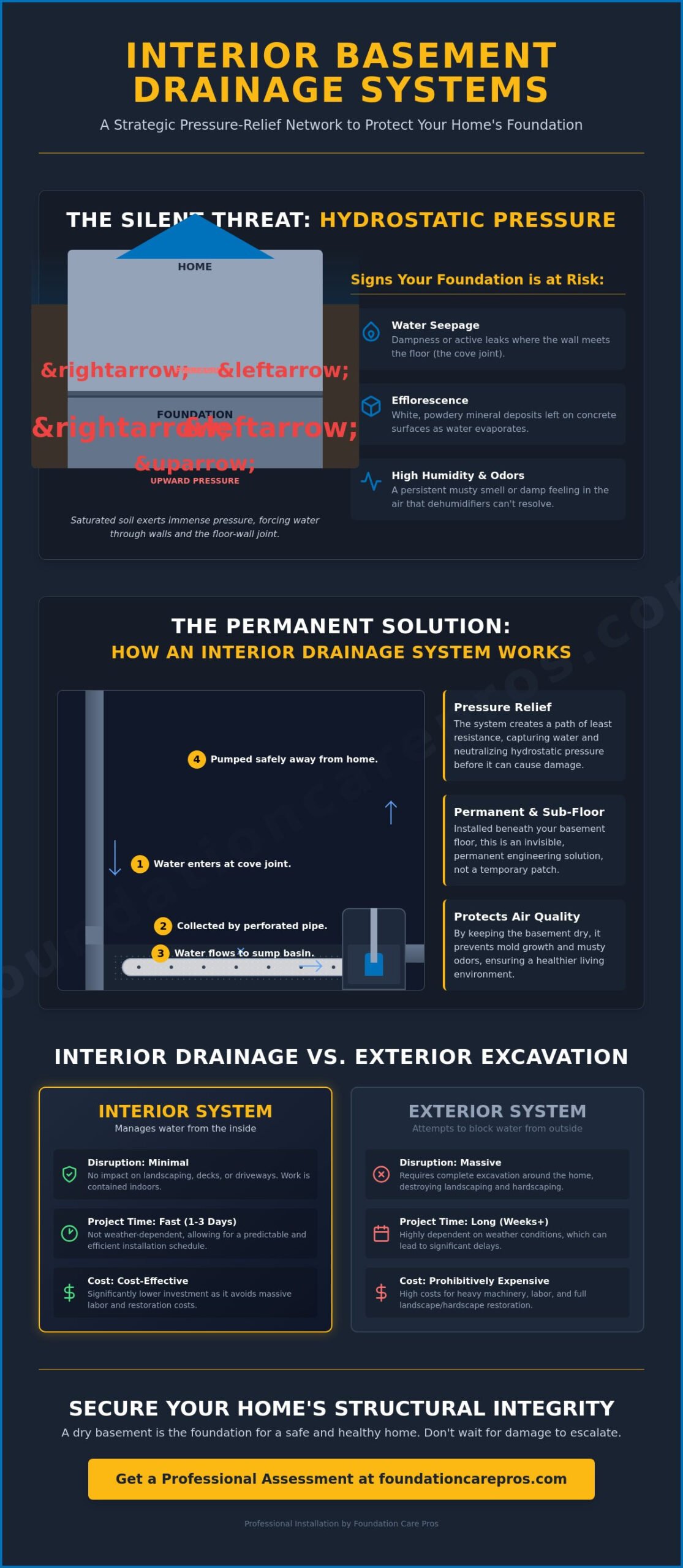
Interior basement drainage systems represent a sophisticated, sub-floor water management network. This isn’t a simple collection of buckets or surface-level patches. It is a permanent engineering solution designed to capture groundwater at the cove joint, which is the specific point where your foundation walls meet the floor. While you might hear these systems referred to as interior French drains, drain tiles, or perimeter drainage, the objective remains the same: neutralize water pressure before it enters your living space. By installing the system beneath the floor slab, you create a controlled environment that keeps your basement dry regardless of external weather conditions.
The Science of Hydrostatic Pressure
Your foundation is constantly battling the environment. When the soil surrounding your home becomes saturated, it exerts thousands of pounds of pressure against your basement walls. This force, known as hydrostatic pressure, pushes water through the smallest pores and hairline cracks in the concrete. Water naturally seeks the path of least resistance. In most residential basements, that path is the cove joint. Without a dedicated system to relieve this pressure, the water will eventually find a way inside. An interior system creates a controlled path for this water, directing it toward a sump pump for safe discharge away from the structure. This relief is critical for maintaining the structural integrity of your home’s footings and walls.
Signs Your Home Needs an Internal Drainage Network
Identifying the need for professional intervention early can prevent long-term structural damage. Look for specific indicators of groundwater infiltration:
- Seepage or dampness specifically at the floor-wall joint.
- Efflorescence, which appears as a white, powdery mineral deposit on the concrete walls.
- Persistent musty odors or elevated humidity levels that don’t respond to standard dehumidifiers.
You might also notice mold growth behind finished walls or under basement flooring. These invisible risks often stem from moisture vapor migrating through the slab. Many homeowners attempt to “patch” visible cracks with hydraulic cement or waterproof paint. These are temporary fixes. They do nothing to address the underlying hydrostatic pressure. Eventually, the pressure will simply force water through a new entry point or cause the patch to fail. A professionally installed interior drainage network addresses the root cause by providing a permanent exit for groundwater, ensuring your basement remains a functional and healthy part of your home.
To learn more about how expert teams implement these durable leak repair solutions, you can explore the methods used by professional contractors.
Interior vs. Exterior Waterproofing: A Strategic Comparison
Choosing between interior and exterior methods requires a clear understanding of your property’s logistics. Exterior waterproofing attempts to block water from the outside. This requires excavating the entire perimeter of your home down to the footers. While theoretically sound, it is often practically impossible or prohibitively expensive for existing homes. Interior basement drainage systems, by contrast, focus on managing water that has already reached the foundation wall. This method is significantly more efficient for established residences because it addresses the hydrostatic pressure at its source without the overhead of massive earth-moving operations.
Consider your home’s exterior features before committing to a strategy. Excavation destroys mature landscaping, removes decks, and often requires cutting through driveways or sidewalks. Restoring these features adds significant costs to the project that aren’t related to the actual waterproofing. Interior systems preserve your curb appeal. Because the work happens from the inside, your garden beds and outdoor living spaces remain untouched. This makes the interior approach a superior cost-to-value choice for most homeowners.
The Disruption Factor: Yard Excavation vs. Interior Access
Exterior projects are massive undertakings. They involve heavy machinery, massive soil removal, and weeks of open trenches around your home. These projects are also weather-dependent. Heavy rain can stall progress or cause trench collapses, extending the timeline indefinitely. Professional interior installation bypasses these risks. Our teams work in a controlled environment. This allows for a predictable schedule, with most projects completed in just a few days. If you are ready to secure your home without the chaos of a torn-up yard, you can consult with a specialist at Foundation Care Pros to evaluate your basement’s specific requirements.
Longevity and Serviceability of Internal Systems
Reliability over time is where the two methods diverge. Exterior drains are buried under several feet of soil. Over time, these pipes often clog with silt, sediment, or invasive tree roots. Once an exterior drain fails, you must repeat the entire excavation process to repair it. Interior systems remain accessible. Because the drainage channel is located just beneath your floor slab, it can be inspected or serviced with minimal effort. Modern interior designs also utilize a sealed configuration. This prevents moisture from evaporating into your basement, keeping humidity levels low and protecting your indoor air quality from mold and musty odors.
Core Components of a High-Performance Drainage Network
A high-performance drainage system relies on the seamless integration of several specialized parts. Think of the perforated drain pipe as the artery of the entire operation. This pipe sits within a trench carved into the perimeter of the basement floor. Its primary job is to collect groundwater and transport it away from the foundation footings. Unlike standard solid piping, these perforated variants allow water to enter from the bottom and sides. This effectively lowers the local water table beneath your home. The 2024 International Residential Code (IRC) Section R405.1 mandates foundation drains for masonry foundations that enclose habitable spaces. Our professional installations adhere to these standards to ensure long-term structural safety.
Surrounding the pipe is a layer of washed aggregate or stone. This stone acts as a natural filter. It prevents fine soil particles from entering and clogging the drainage pipe over time. This filtration is essential for the longevity of interior basement drainage systems. A wall flange or cove base is then installed at the junction where the wall meets the floor. This component captures any seepage that trickles down the foundation walls. It directs that moisture straight into the sub-floor channel before it can reach your basement floor or damage your belongings.
The Role of the Sump Pump and Battery Backup
Every effective drainage network requires a reliable collection point. The sump pit serves as this reservoir, gathering all the water captured by the perimeter pipes. A high-capacity sump pump acts as the engine of the system. It forces the collected water out of the home through a dedicated discharge line. Relying on a single pump is a risk. We strongly advocate for sump pump with battery backup installation to provide the redundancy needed to handle extreme volumes of water during peak hydrostatic pressure events. These units ensure your basement remains protected during severe storms when power outages are most likely to occur. A secondary pump provides the redundancy needed to handle extreme volumes of water during peak hydrostatic pressure events.
Advanced Moisture Barriers and Wall Drainage
Managing liquid water is only half the battle. You must also control moisture vapor. High-performance interior basement drainage systems often include a vapor barrier or drainage panel installed directly onto the foundation walls. These barriers prevent dampness from evaporating into the air. This evaporation is the primary cause of musty odors and mold growth. If your home has existing structural issues, like bowing or cracked walls, these panels integrate with our wall reinforcement solutions. This combination creates a unified defense. It lowers the water table directly under your floor while providing a clean, dry surface for future basement finishing projects.
The Professional Installation Process: What to Expect
A professional installation begins long before any concrete is broken. We perform a comprehensive diagnostic assessment to identify specific water entry points and hydrostatic pressure zones. This evidence-based approach ensures the system is tailored to your home’s unique footprint rather than relying on a generic layout. Precision is the priority throughout the project. Our teams use specialized equipment to remove the perimeter of the floor slab while minimizing dust and protecting your home’s air quality. This methodical preparation is what separates a high-performance network from a messy, unverified DIY attempt.
The efficiency of interior basement drainage systems depends on proper pitching. Every linear foot of the trench must be calculated to ensure gravity-fed water flow toward the collection point. Without this precise slope, water can stagnate in the pipes, leading to sediment buildup and eventual system failure. Our specialists verify these angles throughout the excavation to guarantee that groundwater moves quickly and consistently away from your foundation walls.
Perimeter Trenching and Sub-Floor Preparation
Creating the channel requires a delicate balance of force and accuracy. Our team excavates a trench along the interior perimeter, ensuring the drain is placed at the optimal depth relative to the footing. We take care to protect the structural integrity of the footing itself during this process. If a previous contractor installed a superficial fix that has since clogged or failed, we remove those materials entirely. This ensures the new system has a clean, unobstructed path. Once the trench is ready, we install the perforated piping and surround it with washed aggregate. This stone layer acts as the primary filter, keeping the system clear of fine soil particles for decades.
Concrete Restoration and System Testing
Once the technical components are in place, we begin the restoration phase. We backfill the trench with additional aggregate to provide a stable base for the new floor. High-strength concrete is then poured and finished to match your original floor specifications. This creates a seamless, durable surface that’s ready for storage or future basement finishing. Before we consider the project complete, we perform rigorous system testing. We introduce water into the network to verify that the flow is unobstructed and the sump pump activates as expected. This verification step provides you with the confidence that your home is fully protected against future storms. If you’re ready to secure your property with a validated solution, contact Foundation Care Pros to schedule a professional assessment of your basement.
Securing Your Home with Foundation Care Pros
Foundation Care Pros operates on a philosophy of permanence. We don’t believe in temporary patches that merely hide the symptoms of water infiltration. Our approach treats moisture control as the essential first step in ensuring the total health of your foundation. By installing interior basement drainage systems, we address the environmental stressors that lead to structural decay. We provide access to rigorously engineered solutions backed by comprehensive warranties. We ensure that every component we install has been thoroughly tested by structural engineers for long-term reliability and performance. You gain the peace of mind that comes from a professional, validated solution rather than a superficial fix.
Integrated Solutions: Pairing Drainage with Wall Stabilization
Excess moisture in the soil does more than just cause leaks. It triggers soil expansion, which exerts massive lateral force against your basement walls. Saturated clay soils can exert thousands of pounds of pressure per square foot. This force often results in bowing, cracking, or inward movement of your foundation. While interior basement drainage systems effectively manage water flow, they also act as a protective layer for structural repairs. For foundations showing signs of failure, we often combine drainage with professional I-beam wall braces installation. The drainage system relieves the hydrostatic pressure while the braces provide the necessary mechanical stabilization. This integrated strategy ensures that your structural reinforcements aren’t fighting against constant water saturation. By controlling the water table under your floor, we extend the life of every repair we perform on your property.
The Value of a Principled Specialist
Every home requires a unique diagnostic approach. We don’t apply one-size-fits-all solutions to complex structural problems. Our specialists use an evidence-based method to assess your basement’s specific vulnerabilities during every assessment. We’re committed to using high-performance, engineered products specifically designed for foundation environments. We avoid generic hardware store parts that lack the durability required for sub-floor applications. This disciplined focus on quality ensures that your system performs reliably for decades. You’re not just buying a drain; you’re investing in a methodical problem-solving process that values accuracy and results. Our goal is to lower your stress by projecting an image of unwavering stability and competence. Contact Foundation Care Pros for a professional basement assessment to start the process of securing your home’s future with a permanent, dry solution.
Take Control of Your Basement’s Structural Health
Your foundation requires a proactive defense against the relentless force of groundwater. Choosing interior basement drainage systems provides a strategic solution that manages hydrostatic pressure without the high costs and yard destruction of exterior excavation. You now understand how a high-performance network utilizes sub-floor channels and reliable collection points to maintain a dry, usable space. This methodical approach ensures your home remains structurally sound for decades.
Foundation Care Pros is a proud Supportworks Network Member. We specialize in comprehensive structural stabilization and moisture control. Our team utilizes an engineering-based diagnostic process to identify the root cause of your seepage issues. We don’t settle for temporary fixes. We provide permanent results. You can secure your home’s foundation with a professional drainage assessment today and eliminate the stress of recurring water damage. Protecting your property is a long-term investment that starts with professional-grade moisture management. You deserve the confidence that comes with a stable, permanently dry basement.
Frequently Asked Questions
Is an interior basement drainage system as effective as an exterior one?
Interior systems are highly effective because they manage hydrostatic pressure directly at the point of entry. While exterior systems attempt to block water from the outside, interior basement drainage systems capture and remove it once it reaches the foundation. This method is often more reliable over time because the pipes remain protected from soil clogs and invasive tree roots. Professional installation ensures the system effectively lowers the water table beneath your slab.
How much does it cost to install an interior drainage system?
Total project costs depend on the linear footage of your basement perimeter and the specific structural needs of your home. Factors such as the thickness of your concrete floor and the requirement for multiple sump pits will influence the final investment. You should consult a specialist for a detailed diagnostic assessment of your property. This ensures you receive a quote tailored to the specific engineering requirements of your foundation.
Will an interior drainage system lower the value of my home?
A professionally installed drainage network typically increases your home’s value by protecting its structural integrity. Potential buyers prioritize dry basements and look for evidence of professional moisture control. Documenting a permanent solution to groundwater seepage provides significant peace of mind during the resale process. It transforms a high-risk area into a functional space ready for storage or finishing, which is a major selling point for any property.
Can I finish my basement after an interior drain is installed?
Installing a drainage system is the best first step to take before finishing your basement. The system keeps the floor and walls dry, preventing moisture damage to studs, drywall, and flooring. We recommend using a vapor barrier in conjunction with the drain to manage humidity levels. This combination creates a stable environment that protects your renovation investment from mold and rot over the long term.
Does an interior drainage system require regular maintenance?
Periodic maintenance ensures your interior basement drainage systems remain at peak performance. You should inspect the sump pump annually to verify it activates correctly and clear any debris from the pit. Checking the discharge line for obstructions is also a vital step. While the sub-floor pipes are designed to be self-cleaning, a professional check-up validates that the entire network is ready to handle heavy seasonal rains.
How long does it take to install a perimeter drainage system?
Professional crews typically complete a full perimeter installation in just two to three days. The process involves precise floor removal, trenching, pipe placement, and concrete restoration. Because the work is performed indoors, weather conditions do not delay the timeline. This efficiency allows you to regain use of your basement quickly. A methodical team ensures the project moves from diagnostic assessment to final cleanup without wasted motion.
Will the installation process create a lot of dust in my home?
We utilize high-performance dust-control equipment to keep your home clean during the concrete removal phase. While some debris is inevitable during excavation, our team takes active steps to contain it within the work area. We prioritize protecting your indoor air quality and personal belongings throughout the project. A principled specialist ensures the basement is left in a clean, professional state once the concrete restoration is finished.
What happens if the sump pump fails during a power outage?
Sump pumps require electricity to function, so a power outage during a storm creates a significant risk for your basement. We strongly recommend a sump pump with battery backup installation to provide redundancy. This secondary power source ensures the pump continues to discharge water even if the main grid fails. It’s a critical component for maintaining a dry basement during the exact moments when hydrostatic pressure is at its highest.