
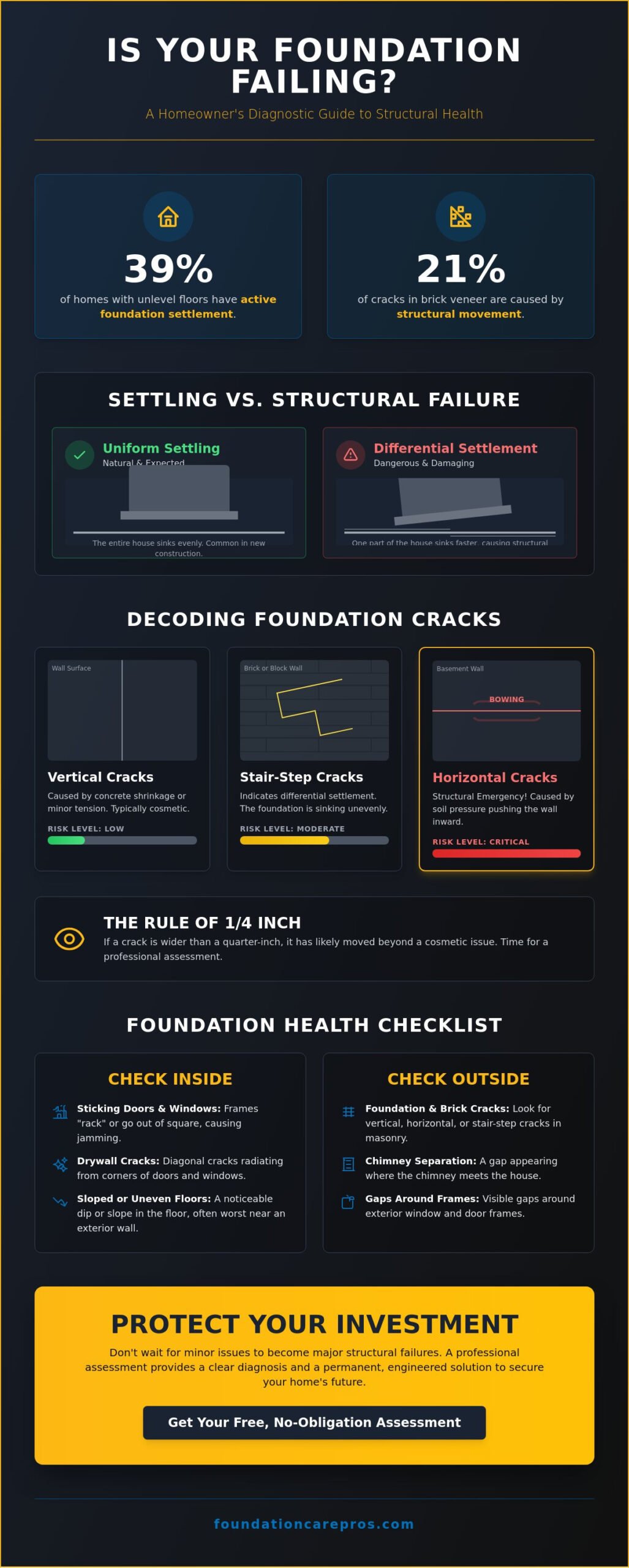
Recent industry data shows that 39% of homes with unlevel floors are experiencing active foundation settlement, while 21% of cracks in brick veneer are directly linked to structural movement. You’re likely staring at a hairline fracture in your drywall or a door that won’t quite latch, wondering how to know if foundation repair is necessary or if your house is simply settling. It’s a high-stakes question that carries a lot of anxiety, especially when you’re worried about the long-term safety of your family and the financial integrity of your property.
We understand the pressure of protecting your largest investment and the fear of being overcharged for unnecessary work. This article provides a definitive diagnostic checklist to help you separate minor cosmetic issues from critical structural failures. We’ll walk through the specific symptoms of foundation distress and explain exactly when it’s time to call a professional specialist. You’ll gain a clear understanding of your home’s structural health and the confidence to choose a permanent, engineered solution that ensures your property remains stable for decades.
Key Takeaways
- Distinguish between uniform house settling and dangerous differential settlement that compromises structural integrity.
- Use crack orientation as a diagnostic tool to separate minor cosmetic tension from critical foundation shifts.
- Learn how to know if foundation repair is necessary by following a prioritized checklist for your home’s interior and exterior.
- Identify secondary symptoms like chimney separation and “racking” frames that indicate advanced structural distress.
- Transition from temporary cosmetic fixes to permanent stabilization using engineered solutions like I-Beam wall braces.
Recognizing the Early Warning Signs of Foundation Distress
Your home is a massive structure resting on dynamic soil. Because of this, some movement is inevitable. Understanding the difference between natural house settling and structural foundation failure is the first step in protecting your property. Natural settling occurs when the weight of a new structure compresses the soil beneath it uniformly. This process usually finishes within the first few years of construction. Structural failure, however, happens when the ground can no longer support the building’s load, leading to shifts that compromise the frame.
Differential settlement is the primary concern for most homeowners. This occurs when one portion of the footer sinks deeper or faster than the rest. It creates uneven stress across the walls and floors. If you are wondering how to know if foundation repair is necessary, look for signs of this uneven movement. Doors that suddenly stick or windows that won’t slide are often the first indicators that the house is no longer level. These symptoms suggest that the foundation (engineering) is struggling to distribute the weight of the home properly.
Environmental factors drive these structural shifts. Soil shrinkage during dry spells and expansive clay during wet seasons create a cycle of instability. You should monitor any visible cracks using the Rule of 1/4 Inch. If a crack is wider than a quarter inch, or if you can fit the edge of a penny inside it, the issue has likely moved beyond cosmetic concern. Cracks of this size indicate that the soil movement is significant enough to pull the building materials apart, necessitating a professional diagnostic assessment.
Settlement vs. Subsidence: What Homeowners Need to Know
Uniform settlement is a standard part of a new home’s life cycle. The house finds its seat in the soil as materials dry and the ground compacts. Subsidence is different. It is a sudden downward shift of the ground beneath the footer, often caused by collapsing soil or decaying organic matter. Don’t assume an older home is immune to these issues. Changes in local water tables or nearby construction can trigger new foundation movement in a house that has been stable for fifty years. Determining how to know if foundation repair is necessary requires looking for these sudden changes in an otherwise stable structure.
The Role of Soil Moisture in Foundation Stability
Water is the most common cause of structural distress. Severe drought causes soil to shrink and pull away from the foundation walls, leaving the footer unsupported. Conversely, excessive rain creates intense hydrostatic pressure. This is the force of water-saturated soil pushing against your basement walls. Clay-rich soils act like a sponge, expanding and contracting with the seasons. This constant volume change puts immense stress on the masonry, eventually leading to bowing or structural cracks.
Decoding Foundation Cracks: Structural vs. Cosmetic Movement
Understanding crack orientation is the most reliable way for homeowners to determine how to know if foundation repair is necessary. Cracks are not just blemishes; they are visual records of the specific stresses acting upon your home. The direction and location of a fracture reveal whether the masonry is experiencing simple tension, vertical settlement, or dangerous lateral pressure from the surrounding soil. Analyzing these patterns is a vital step in learning how to know if foundation repair is necessary before the damage spreads to the rest of the frame.
Vertical cracks generally indicate that the building materials are pulling apart due to minor settlement or natural concrete shrinkage. These are common in many homes and often pose the least amount of structural risk. Stair-step cracks, which follow the mortar lines in brick or block walls, present a more serious concern. These patterns suggest that the footer beneath that specific section of the wall is sinking. This type of differential settlement requires professional monitoring because it indicates that the soil is no longer providing a stable base for the masonry.
Horizontal cracks represent a structural emergency. Unlike vertical cracks that result from the house pulling apart, horizontal fractures occur when the wall is being pushed inward by external forces. This is usually caused by hydrostatic pressure or soil expansion. When a wall develops a horizontal crack, its structural integrity is compromised. If you notice these symptoms, a professional foundation assessment can help you identify the exact level of risk before the wall begins to tilt or collapse.
Vertical and Diagonal Cracks: When to Monitor
Vertical fractures typically occur during the first few years of a home’s life as the concrete cures and shrinks. If the crack is uniform in width from top to bottom, it’s likely a cosmetic issue. Diagonal cracks, especially those that are wider at the top than the bottom, suggest a shifting corner or “heaving” soil. You can monitor these by marking the ends of the crack with a pencil and writing the date. If the crack extends past your mark or widens over several months, the movement is active and requires stabilization.
Horizontal Cracks and Bowing Walls: The Red Zone
Horizontal cracks indicate that your foundation wall is failing under lateral load. This pressure often causes the middle of the wall to “bow” or lean inward, a phenomenon known as an inward tilt. This is a critical failure point that cannot be fixed with simple mortar. Stabilization requires engineered solutions like I-Beam wall braces or carbon fiber straps to reinforce the masonry and prevent further movement. These systems transfer the load from the failing wall to the floor and joists, providing a permanent fix for a dangerous structural deficit.
The Frame Reaction: Sticking Doors and Windows
Door and window frames are designed to be perfectly square. When a corner of the foundation settles, the frame twists. This torque creates “sticky” doors that no longer latch properly. Look for daylight through the top corners of exterior doors or unexplained cracks in window glass. These fractures usually start at the corners of the frame and radiate outward. This indicates that the wooden or steel frame is under intense mechanical stress caused by the shifting base below.
Interior Finishes and Static Structures
Static structures like kitchen cabinets and baseboards provide excellent diagnostic benchmarks. If you see a widening gap between your upper cabinets and the ceiling, the wall itself may be tilting. Drywall “nail pops” are another common sign. These small, circular bumps occur when shifting studs push the fastener through the finish. If you notice a gap between the floor and the baseboard, it often points to a sinking interior slab or a failing support post in the crawl space. Each of these signs helps you determine how to know if foundation repair is necessary before the damage becomes a major disaster.
The Homeowner’s Essential Foundation Health Checklist
A methodical inspection is the only reliable way for you to determine how to know if foundation repair is necessary. You don’t need specialized engineering tools to conduct an initial survey of your property. By following a structured path around and through your home, you can identify patterns that indicate structural distress. Focus on the transition points where different materials meet. These areas often reveal the first signs of movement before they become visible in the main living spaces.
Perform the “Chimney Test” by inspecting the joint where the masonry stack meets the house siding. Most chimneys rest on a separate footer from the main house. If the soil is failing, the heavy chimney will often tilt away from the structure, creating a visible gap at the top. You should also check the roofline for Fascia Board Gaps. When a foundation wall rotates outward, the top of the wall pulls away from the rafters. This causes the trim boards to separate or pull loose. For interior checks, use a simple marble or a four-foot level for a “Floor Level Test.” Slopes that exceed one inch over a ten-foot span suggest that the interior support system or the slab itself is compromised.
Exterior Perimeter Walkthrough
Walk the entire perimeter of your home and inspect the parge coat, which is the visible concrete layer above the soil line. Look for “stair-stepping” cracks in the brick veneer or mortar joints. These patterns indicate that the footer is sinking in specific sections. Pay close attention to the soil line. If you notice gaps between the dirt and the foundation wall, or areas where water pools during rain, the soil is likely experiencing extreme moisture cycles. This imbalance is a primary driver of structural instability and requires immediate attention to prevent further settlement.
Basement and Crawl Space Inspection
Enter the lowest level of your home with a high-lumen flashlight. Shine the light directly into any cracks you find. If you can see light through the crack or if the area feels damp, you have full-wall penetration. Inspect the walls for bowing by looking down the length of the masonry from one corner to the other. A stable wall should appear perfectly straight. Identify “efflorescence,” which appears as white, powdery salt deposits on the blocks. This is a sign of chronic moisture infiltration that weakens concrete over time. If you find these symptoms during your walkthrough, you should schedule a professional foundation inspection to verify the severity of the movement.
From Diagnosis to Stabilization: Professional Repair Solutions
DIY foundation patching is a temporary cosmetic fix. While a homeowner can easily fill a crack with mortar or caulk, these materials lack the structural properties to stop active movement. Patching merely hides the symptom. It fails to address the underlying soil-to-structure relationship that causes the shift. Determining how to know if foundation repair is necessary is the first step toward protecting your home, but implementation requires engineered precision. Permanent stabilization focuses on transferring the weight of the home to stable soil or reinforcing the masonry against lateral pressure.
Settlement repairs represent approximately 36% of the total foundation repair market, highlighting the prevalence of sinking footers. Foundation Pier Systems are the industry standard for resolving this issue. Push piers and helical piers are driven deep into the earth, bypassing unstable surface soils to reach load-bearing strata or bedrock. These systems don’t just stop the sinking; they often allow for the controlled lifting of the foundation back toward its original position. By understanding how to know if foundation repair is necessary, you can act before this settlement compromises the entire wooden frame of your property.
Engineered Supports: I-Beams and Carbon Fiber
I-Beam wall braces provide a permanent solution for basement walls that have begun to bow or tilt inward. These high-strength steel beams are secured to the basement floor and the floor joists above. They apply consistent counter-pressure to stabilize the masonry without requiring any yard excavation. For walls in the early stages of bowing, carbon fiber straps offer a low-profile alternative. These straps have a high-tensile strength and are bonded directly to the wall with industrial epoxy. Both methods are superior to traditional foundation wall anchors in scenarios where exterior access is limited by landscaping or paved surfaces.
The Professional Evaluation Process
A Foundation Care Pros specialist conducts a data-driven structural evaluation during every diagnostic visit. We don’t rely on guesswork. We measure floor levels, map crack patterns, and analyze the surrounding soil conditions to identify the root cause of the distress. As a Supportworks Network Member, our team has access to rigorous engineering backing and proprietary stabilization products that have been tested in diverse geological environments. This methodical approach ensures that the proposed solution is tailored to the specific physics of your home’s movement.
Schedule your professional foundation assessment with Foundation Care Pros today.
Secure Your Home’s Structural Future
Identifying structural distress early is the most effective way to prevent minor settling from escalating into a total failure. You now understand how to distinguish between cosmetic drywall cracks and the high-risk horizontal fractures that indicate wall rotation. By using the diagnostic checklist provided, you can monitor your home’s exterior perimeter and interior frame for the subtle shifts that signal active soil movement. Determining how to know if foundation repair is necessary shouldn’t be a source of constant anxiety; it’s a technical assessment that leads to a permanent, engineered solution.
Foundation Care Pros has provided expert diagnostics since 2004. As a Supportworks Network Member, we specialize in high-performance I-Beam and pier systems designed to stabilize your property for the long term. Our methodical approach ensures you receive an accurate evaluation based on engineering standards rather than superficial observations. Get a Professional Foundation Evaluation from Foundation Care Pros to confirm the health of your home. Taking action now provides the validation you need to protect your investment and restore your peace of mind.
Frequently Asked Questions
Is a horizontal foundation crack always serious?
Horizontal cracks are a primary indicator of structural failure. They occur when external hydrostatic pressure exceeds the load-bearing capacity of the wall. This pressure causes the middle of the masonry to bow or tilt inward. Unlike vertical cracks that result from simple shrinkage, horizontal fractures require immediate engineering intervention. Stabilization usually involves installing I-Beam wall braces to reinforce the wall and prevent a total collapse of the structure.
Can I sell a house with foundation issues?
You can sell a house with foundation issues, but you must legally disclose the condition to all potential buyers. Most jurisdictions require a formal disclosure of known structural defects during a real estate transaction. Unrepaired foundation movement often complicates the sale because many mortgage lenders won’t approve a loan on a property with active structural failure. Addressing the stabilization before listing the home protects your equity and ensures a smoother closing.
How much does foundation repair usually cost?
Foundation repair costs depend entirely on the specific stabilization method and the severity of the structural distress. A single carbon fiber strap is a different investment than a full foundation pier system designed to stabilize a sinking footer. To determine how to know if foundation repair is necessary and what the associated costs will be, you should request a professional diagnostic evaluation. This assessment provides a clear scope of work based on your home’s unique geological conditions.
What happens if I ignore foundation problems?
Foundation problems never resolve themselves and will only worsen over time. Small cracks eventually allow water to enter the basement, leading to efflorescence and mold growth. As the structure continues to shift, doors will stop latching and the roofline may experience significant distortion. Ignoring these early warning signs increases the risk of a catastrophic wall failure and results in much higher repair costs in the future.
Does homeowners insurance cover foundation repair?
Standard homeowners insurance policies generally exclude coverage for foundation repair caused by soil settlement or earth movement. These issues are usually considered maintenance items rather than sudden, accidental losses. Coverage might apply if the damage is the direct result of a covered peril, such as a major plumbing leak. You should contact your insurance provider to confirm if your policy includes specific endorsements for structural stabilization or water management systems.
How long does a professional foundation repair take to install?
A professional crew can typically complete most residential foundation repairs within one to five business days. The exact timeframe depends on the complexity of the stabilization plan and the number of pier systems or wall braces required. Most projects are non-invasive and don’t require you to vacate your home during the installation process. Our team focuses on efficient execution to restore your home’s structural integrity with minimal impact on your schedule.
Can foundation issues cause mold in my home?
Foundation cracks are a major contributor to mold growth because they allow moisture to seep into the basement or crawl space. High humidity levels in these lower areas eventually migrate to the upper floors through the stack effect. This process can degrade your home’s air quality and damage organic materials like wooden floor joists. Effective moisture management often requires a combination of crawl space encapsulation and an interior basement drainage system.
Is it normal for a new house to have foundation cracks?
Hairline vertical cracks are common in new construction as the concrete cures and the building finds its seat in the soil. These cosmetic fractures are usually not a cause for alarm if they remain narrow. If you are trying to determine how to know if foundation repair is necessary for a new home, look for cracks wider than a quarter inch. Rapid movement or stair-step patterns in the brickwork indicate that the house is experiencing more than just standard settling.