
A single structural crack can slash your property’s market value by as much as 25% before you even list it. It’s a sobering reality that makes selling a house with foundation problems feel like an uphill battle against skeptical buyers and rigid lenders. You’re likely concerned about failing a home inspection or facing legal repercussions for undisclosed defects. These anxieties are valid, especially when your home’s equity is on the line.
This 2026 guide provides the technical clarity you need to navigate these complexities with confidence. We’ll outline how to protect your investment through strategic stabilization and transparent disclosure. You’ll learn how professional solutions like foundation pier systems or carbon fiber straps can restore financing eligibility for buyers using FHA or VA loans. We’ll also examine current legal requirements and the specific steps needed to pass a rigorous structural assessment. By the end of this article, you’ll have a methodical plan to maximize your sale price and ensure a clean, permanent closing.
Key Takeaways
- Learn why unrepaired structural issues alienate 80% of traditional buyers and how to maintain your home’s marketability in a competitive market.
- Discover how selling a house with foundation problems depends on satisfying strict lender requirements for safety and soundness to ensure a successful closing.
- Compare the cost of professional repair against the potential loss in equity to determine your most profitable exit strategy.
- Identify how specific stabilization methods, such as I-Beam Wall Braces, provide the permanent resolution needed to clear home inspections and secure buyer financing.
- Understand the role of transferable warranties in protecting your final sale price and shielding you from future legal liability.
The Reality of Selling a House with Foundation Problems
Homeowners often view structural defects as a total loss of property value. In the 2026 real estate market, this is a misconception. While structural issues are significant, they aren’t an automatic deal-breaker. Selling a house with foundation problems requires a methodical approach to manage the “structural stigma.” Statistics show that unrepaired issues scare off roughly 80% of traditional buyers. These individuals seek move-in-ready safety and predictable financing. When you ignore the problem, you limit your pool of buyers to opportunistic investors who specialize in low-ball offers.
Appraisers view your property through a lens of risk and stability. They distinguish between active, ongoing movement and a foundation that has been professionally stabilized. To grasp the technical stakes, it’s helpful to define the core structure: What is a house foundation? It’s the critical engineering element that transfers the entire weight of your home into the soil. If this element is compromised, the appraisal will reflect that risk. While some industry sources suggest a value drop of 10-15%, the actual loss can be much higher when buyers sense uncertainty. Stabilizing the structure before listing is the most effective way to protect your equity.
The Legal Requirement of Disclosure
Transparency is a legal necessity and a strategic advantage. State laws generally mandate that sellers disclose any known material defects. Attempting a cosmetic cover-up with paint or temporary patches is a dangerous strategy. If a buyer identifies hidden structural damage after the closing, you face a high risk of litigation and significant financial penalties. Providing a professional engineering report during the listing phase establishes you as a principled seller. It removes the element of surprise and provides a documented baseline for negotiations.
Identifying the Severity of the Issue
Distinguishing between minor settling and serious failure is essential when you’re selling a house with foundation problems. Hairline cracks in drywall or mortar are often cosmetic. However, horizontal cracks in basement walls or significant stair-step patterns are major red flags. These symptoms indicate that the soil is exerting excessive pressure or that the home is sinking. These issues will inevitably surface during a buyer’s home inspection. To understand the specific risks your home faces, review our diagnostic guide on Types of Foundation Cracks and What They Mean. Identifying these problems early allows you to implement a validated solution before the first showing.
The Financing Trap: Why Unrepaired Foundations Kill Deals
Banks prioritize the security of their collateral. If a home has active structural instability, it represents a liability that most traditional mortgage lenders won’t accept. When you’re selling a house with foundation problems, you aren’t just negotiating with a person. You’re trying to pass a rigorous financial audit. Most conventional loans require a clear home inspection. If the inspector flags structural movement, the lender will likely pause the deal until a licensed engineer provides a clearance report. This delay often causes buyers to walk away, fearing a “money pit” scenario.
FHA and VA Appraisal Requirements
Government-backed loans, such as FHA and VA, are even stricter. These programs serve a large portion of the buyer market, particularly first-time homeowners and veterans. To qualify, a property must meet the “Safe, Sound, and Secure” standards established by HUD. An appraiser will look for signs of foundation failure, such as significant bowing or large cracks. If these are present, the loan is often denied outright. You can restore this eligibility by installing validated solutions like Foundation Pier Systems or I-Beam Wall Braces. These repairs provide the permanence lenders require to approve the mortgage. If you’re unsure about your home’s current status, a professional structural assessment can clarify your path to a successful closing.
The Cash-Only Discount
If your home fails to qualify for traditional financing, your buyer pool shrinks to cash-only investors. This is where the “Financing Trap” becomes expensive. Cash buyers don’t need bank approval, so they can overlook structural issues. However, they expect a significant return for taking that risk. Most of these buyers will demand a 20-40% reduction below the home’s fair market value. They aren’t just deducting the cost of the repair. They’re also charging for the effort, the risk of hidden damage, and the loss of financing options.
Certified repairs change this dynamic. By addressing the issues with warrantied systems, you move the property back into the “marketable” category. This allows you to attract financed buyers who are willing to pay full market price. Investing in stabilization before listing is often the difference between a high-equity sale and a distressed liquidation. Restoring marketability when selling a house with foundation problems is ultimately about providing proof of permanence to the bank’s underwriters.
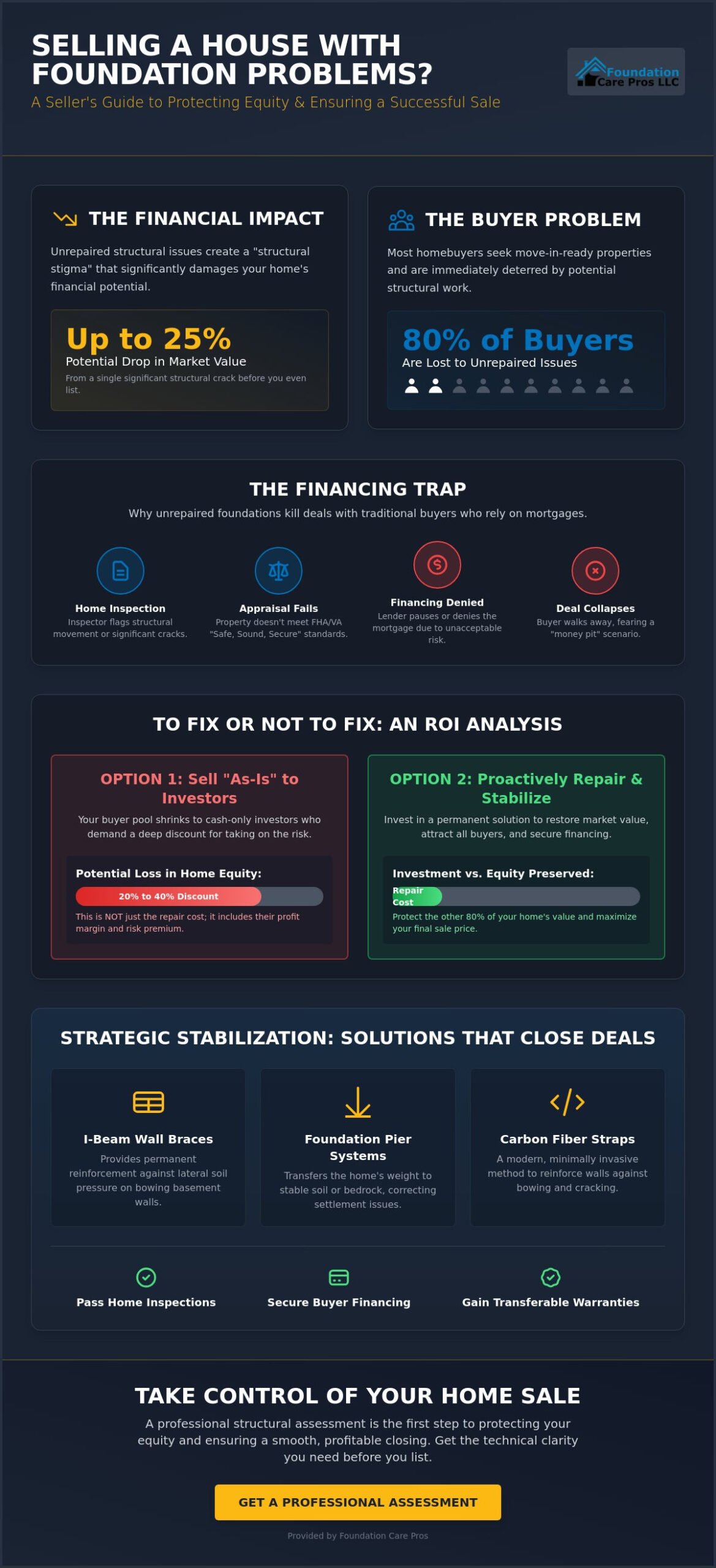
To Fix or Not to Fix: The ROI of Foundation Repair
Deciding whether to repair your home before listing is a critical financial choice. Most sellers fear the upfront cost of structural work. However, the cost of inaction is often higher. When selling a house with foundation problems, the market applies a heavy discount to account for the unknown. Professional stabilization acts as a value insurance policy. It replaces buyer fear with engineering proof. By addressing the issue early, you prevent the property from sitting on the market and accumulating a “stagnant listing” reputation.
A warrantied repair from a reputable company transforms a liability into a verified asset. This is especially true when you offer a transferable warranty. This document provides the new buyer with long-term security. It ensures they aren’t inheriting an immediate financial burden. Most buyers are willing to pay a premium for a home that has already been stabilized by experts. They see the repair as a completed task they won’t have to manage themselves. This peace of mind often results in faster closings and fewer last-minute demands for credits. In many markets, a documented repair can yield a 100% return on investment by preserving the home’s full market value.
Selling ‘As-Is’ vs. Selling ‘Stabilized’
The math of an “as-is” sale rarely favors the seller. Buyers typically over-estimate the cost of future repairs by a significant margin. If a buyer sees a foundation crack, they might assume the worst-case scenario. This leads to aggressive price negotiations and low-ball offers. Stabilization removes this “fear factor” during the inspection period. You can find detailed investment data in our Foundation Stabilization Cost Guide. This resource helps you compare the price of professional intervention against the potential loss in equity. Choosing to stabilize the structure ensures you attract the widest possible audience of qualified buyers.
Negotiating with Inspection Reports
Data is your best tool during negotiations. A pre-listing inspection allows you to set a realistic asking price from day one. It eliminates the risk of a deal falling through at the eleventh hour because of a surprise discovery. If you choose not to repair the foundation, you should still have a professional estimate in hand. This prevents the buyer from inflating the repair costs to justify a lower offer. If you decide to offer seller concessions instead of fixing the issue, use the estimate to cap the credit. This methodical approach keeps you in control of the transaction. It ensures that the final sale price reflects the actual condition of the home, not a buyer’s worst fears.
Strategic Stabilization: Professional Solutions That Close Deals
Implementing the correct repair method is the final hurdle in the sales process. When selling a house with foundation problems, your chosen solution must satisfy the buyer’s home inspector and their mortgage underwriter. A temporary patch will fail this level of scrutiny. You need a validated engineering approach that addresses the root cause of the structural movement. By selecting a permanent stabilization method, you provide the documentation required to remove all structural contingencies from the sales contract.
Carbon fiber straps are often the preferred choice for early-stage wall reinforcement. These high-tensile strength straps are bonded directly to the foundation wall. They prevent further bowing or inward movement without taking up valuable floor space. Because they’re low-profile, they can be easily painted over, making them an ideal solution for finished basements. This method offers a lean, efficient way to secure the structure while maintaining the home’s aesthetic appeal for potential buyers.
I-Beam Wall Braces for Bowed Walls
If a basement wall shows significant bowing or tilting, I-Beam Wall Braces provide immediate and permanent stabilization. These structural steel beams are anchored to the floor and the joists above, creating a rigid support system. One major advantage is that they don’t require exterior excavation. This saves time and prevents damage to your landscaping during the listing period. Modern I-Beam systems are designed to be space-efficient and can be adjusted over time if the soil continues to shift. You can explore the technical differences between these methods in The Comprehensive Guide to Basement Wall Stabilization Systems.
Foundation Piering for Settling Homes
Foundation Pier Systems are the gold standard for homes experiencing vertical settlement or sinking. This process involves driving helical or push piers deep into the ground until they reach load-bearing strata or bedrock. The weight of the home is then transferred onto these piers, providing a stable foundation that is independent of the shifting surface soil. This is a highly technical solution that requires professional execution and precise engineering data.
Documenting this process is vital for the buyer’s peace of mind. A successful piering installation should always be accompanied by a final engineering report. This report proves to the buyer and their lender that the home is now “safe and sound.” Providing this level of verification allows you to stand firm on your asking price. If you need to secure your home’s structural integrity before hitting the market, you can schedule a professional foundation inspection to identify the best stabilization path for your property.
Taking Control of Your Home Sale with Foundation Care Pros
Successful real estate transactions rely on certainty. When you’re selling a house with foundation problems, you must replace buyer doubt with engineering facts. Transforming a property from a “distressed” listing into a market-ready asset requires a disciplined, data-driven strategy. Our role is to provide the technical validation that satisfies lenders, appraisers, and the most cautious buyers. By addressing structural needs before the first showing, you regain control over the negotiation process and protect your home’s equity.
The most powerful tool in your sales arsenal is a transferable, lifetime warranty. In a real estate transaction, this document acts as a guarantee of permanence. It shifts the long-term structural risk away from the buyer and onto the specialist who performed the work. Buyers are often willing to overlook a history of foundation movement if they have a written assurance that the solution is permanent. This level of transparency builds immediate trust and keeps the closing on schedule.
Our Diagnostic and Repair Process
Our methodical approach ensures your home meets the highest standards of safety and soundness. The process begins with a comprehensive structural evaluation to identify the root cause of any movement. We look past the surface cracks to assess soil pressure and load-bearing integrity. Once we identify the specific needs, we implement validated solutions like Foundation Pier Systems or carbon fiber straps. After the installation is complete, we provide the final structural certification. This documentation is essential for clearing buyer contingencies and satisfying FHA or VA loan requirements. A clean, stabilized basement allows you to host walkthroughs with total confidence in your property’s value.
Next Steps for Sellers
Proactive preparation is the key to a successful closing. You should schedule a professional structural evaluation well before your target listing date. This timeline gives you the opportunity to complete any necessary stabilization without the pressure of a pending contract. Once the work is finalized, coordinate closely with your real estate agent to include the repair documentation and warranty information in the listing packet. Providing this data upfront prevents the “structural stigma” from taking hold. If you’re ready to secure your equity and move forward with your sale, contact Foundation Care Pros for a professional structural assessment. Taking this single step ensures that selling a house with foundation problems becomes a manageable, successful transition rather than a financial hurdle.
Secure Your Successful Closing Today
Navigating the real estate market requires more than just a listing. It requires engineering certainty. Professional stabilization restores buyer confidence and satisfies the strict safety standards required by FHA and VA lenders. By addressing structural movement before you list, you eliminate the risk of low-ball offers and protect your home’s market value. This proactive approach turns a potential deal-breaker into a documented asset that buyers can trust.
Successfully selling a house with foundation problems is a matter of providing proof of permanence. As a locally owned structural repair specialist and a member of the Supportworks Network, we offer the methodical assessment needed to move your property from distressed to market-ready. Our stabilization systems come with transferable lifetime warranties that provide the long-term security buyers demand. You can move forward with your home sale knowing your equity is protected by expert diagnostics and validated solutions.
Secure your home’s equity with a professional structural assessment from Foundation Care Pros. We’re here to ensure your transition is stable, transparent, and successful.
Frequently Asked Questions
Can I sell my house with foundation problems without fixing them?
Yes, you can sell a property “as-is,” but it usually results in a significantly lower sale price. Buyers will often deduct the estimated cost of repairs plus a risk premium from their offer. In most states, you’re legally required to disclose known structural defects. Selling a house with foundation problems without repairs typically limits your pool of buyers to cash investors who expect steep discounts.
Do foundation problems always show up on a home inspection?
Most significant structural issues will be identified during a standard home inspection. Inspectors look for secondary signs like stair-step cracks in masonry, gaps around window frames, or sloping floors. If an inspector finds these red flags, they’ll recommend a specialized assessment. Ignoring these signs before listing often leads to deals falling through during the due diligence period when the buyer’s inspector flags the movement.
How much does foundation repair typically decrease home value if not fixed?
Unaddressed structural issues can slash your property’s value by 10% to 25% depending on the severity. Buyers perceive foundation movement as a high-risk liability. This perception often leads them to over-estimate the cost of remediation during negotiations. Even after a professional repair, some homes may still see a minor “stigma discount” of 3% to 5% compared to properties with no history of structural movement.
Will a bank lend on a house with foundation issues?
Banks are generally hesitant to lend on homes with active foundation movement. Conventional and government-backed loans require the property to be structurally sound to serve as collateral for the mortgage. If an appraiser flags foundation failure, the lender will likely deny the loan until the issue is stabilized. Restoring financing eligibility is one of the primary reasons sellers choose to invest in professional repairs before listing.
Is a foundation warranty transferable to the new owner?
A professional foundation warranty is typically transferable to the new owner. This is a vital document when selling a house with foundation problems. It proves that the structural issues have been resolved by a specialist and are no longer a risk. Providing a transferable lifetime warranty removes the buyer’s fear of future costs and helps preserve your home’s full market value at the closing table.
Should I get a structural engineer report before selling my house?
Obtaining a structural engineer’s report before listing is a strategic move for any seller. It provides an unbiased, third-party evaluation of the home’s integrity. This report prevents buyers from using vague fears to negotiate a lower price. It also gives your real estate agent the data they need to justify your asking price to skeptical appraisers and lenders who require proof of stability.
What is the cheapest way to fix a foundation for sale?
The most economical repair depends on the specific structural need identified during an inspection. Carbon fiber straps provide a low-profile, permanent solution for bowing walls without the need for exterior excavation. For homes with minor settlement, professional crack injection might be the most affordable starting point. However, any fix must still be permanent enough to satisfy a buyer’s home inspector and secure their bank financing.
How do I disclose foundation repairs I’ve already completed?
You should disclose completed repairs by providing the original engineering plan and the final completion certificate. Transparency is your best defense against future legal liability. Include these documents in your initial listing packet so potential buyers see the stabilization as a completed maintenance task rather than a hidden defect. This proactive disclosure builds trust and demonstrates that you’ve maintained the home’s structural health with professional care.