
While a jagged crack in your basement wall feels like an immediate emergency, statistics show that less than 1% of homes with structural damage ever reach the point of total failure. You’re likely asking, can a house collapse from foundation issues? The answer is technically yes, but collapse is almost always a slow-motion process rather than a sudden event. It’s natural to feel a sense of dread when you notice a new gap in the brickwork or a door that won’t latch. You want to protect your family and your largest financial investment from a worst-case scenario without falling into unnecessary panic.
This guide helps you move past the anxiety of the unknown by providing clear, evidence-based diagnostics. You’ll learn to identify the critical tipping point where minor settling becomes a legitimate structural hazard. We’ll provide a checklist to help you differentiate between cosmetic flaws and signs that require professional stabilization. We also examine the engineered path to recovery, including the use of foundation pier systems and wall anchors to restore permanent integrity to your home. Understanding the transition from “settling” to “failure” is your first step toward a secure and stable property.
Key Takeaways
- Differentiate between rare total collapse and common partial structural failure to understand the true safety status of your home.
- Identify how hydrostatic pressure and expansive soil cycles exert the physical forces that threaten basement wall integrity.
- Follow our diagnostic triage to determine if your wall cracks are merely cosmetic or if you need to ask can a house collapse from foundation issues due to active structural failure.
- Recognize the structural tipping point where a wall’s center of gravity shifts, signaling the transition from a maintenance issue to a safety hazard.
- Learn how engineered systems like I-Beam wall braces and foundation piers provide the necessary reinforcement to permanently stabilize a failing structure.
The Reality of Foundation Collapse: Understanding the Structural Risk
Foundation collapse occurs when a home’s primary support system loses the ability to hold its own weight. It isn’t usually a catastrophic, Hollywood-style event that happens in seconds. Instead, it’s a slow degradation of the building’s skeleton. While you may wonder can a house collapse from foundation issues, the reality is typically a localized failure that makes the home uninhabitable or dangerous rather than a pile of rubble. Most foundation issues are slow-motion disasters. You might notice a door sticking in the spring or a small crack appearing in the winter. These are symptoms of a structure trying to adjust to an uneven base. Because the process is gradual, many homeowners assume they have years to address the problem. However, the longer the home remains in a state of stress, the more the internal framing warps.
Your foundation serves three critical purposes. It distributes the weight of the structure to the ground, protects the framing from soil moisture, and anchors the home against shifting earth. When one of these functions fails, the home’s structural integrity is compromised. Early intervention isn’t just about saving the concrete; it’s about protecting the entire house from permanent distortion. When the foundation stops providing a level, stable platform, every other system in the house begins to fail, from the plumbing lines to the roof trusses.
Total Collapse vs. Partial Structural Failure
Total collapse is the complete failure of the primary load-bearing system. In this scenario, the building’s frame can no longer resist gravity. Partial failure is far more common and just as concerning. This looks like a single basement wall bowing inward or a corner of the house sinking several inches. Partial failure is the more immediate threat to your home’s value. Even if the roof stays up, a failing wall or sagging floor indicates that the structural limits are being tested. Ignoring these signs leads to compounding damage that becomes exponentially more expensive to correct as the house continues to shift.
Why Foundations Fail: The Role of Gravity and Load
Gravity is a constant force. Your home’s weight is transferred from the roof to the walls, down to the floor systems, and finally into the concrete footings. These footings rely on the soil beneath them to remain stable. If the ground becomes saturated or shrinks due to drought, it can no longer support that load. This creates “unsupported spans.” These are sections of the foundation that are essentially hanging in the air without proper contact with the earth. The concrete then cracks under the immense stress of the home’s weight. This displacement is the root cause of the most severe foundation failures we see in residential properties.
The Anatomy of Failure: How Soil and Water Trigger Collapse
Soil conditions and water management are the primary drivers of structural instability. Most residential foundations fail because the environment surrounding the concrete changes, not because the concrete itself is weak. Expansive clay soils act like a sponge. They swell when saturated and contract during dry spells. This cycle creates a constant, rhythmic pressure that eventually fatigues the foundation. When these soils expand, they exert thousands of pounds of force against the exterior walls. When they contract, they leave gaps that allow the structure to shift. Homeowners often worry and ask can a house collapse from foundation issues, and the answer usually lies in how these soil cycles are managed. Forensic investigations into building collapses often point to these environmental fluctuations as the root cause of catastrophic failure.
Water management is equally critical to long-term stability. Poorly maintained gutters or misplaced downspouts concentrate water in specific zones. This saturation accelerates the freeze-thaw cycle. In colder climates, water trapped in the soil pores near the foundation freezes and expands. This expansion pushes against the concrete, creating hairline fractures that allow even more water to enter. Over time, these small cracks widen, compromising the wall’s ability to resist external pressure. Preventing this cycle requires keeping water away from the foundation perimeter to maintain consistent soil density.
Hydrostatic Pressure: The Silent Wall Crusher
Hydrostatic pressure is the lateral force exerted by water-saturated soil. When the ground around your basement becomes waterlogged, the weight of that water pushes inward against your foundation. Water weighs approximately 62.4 pounds per cubic foot. When soil is fully saturated, the combined weight of the earth and water creates a massive load. Thousands of pounds of pressure bear down on the center of the wall. You will typically see horizontal cracks appearing in the middle third of the masonry as the first sign of distress. If left unaddressed, these cracks evolve into a noticeable inward bow. At this stage, the risk of a wall cave-in increases significantly. Installing an interior basement drainage system helps manage this water level before the pressure reaches a critical threshold.
Soil Subsidence and Voids
Subsidence occurs when the soil beneath your foundation shrinks or is physically removed. During a drought, clay-heavy soils lose moisture and pull away from the footings. This creates voids, or empty pockets of air, where there should be solid support. Heavy rains can also cause subsidence by washing away loose, sandy soil. When a footing hangs over a void, it lacks the necessary upward force to stay level. This leads to sudden drop settlement. While many homeowners ask can a house collapse from foundation issues, they are often describing the results of these voids. The foundation essentially snaps under the weight of the home because it has nowhere to rest. This type of failure requires immediate stabilization to prevent the entire corner of a structure from detaching.
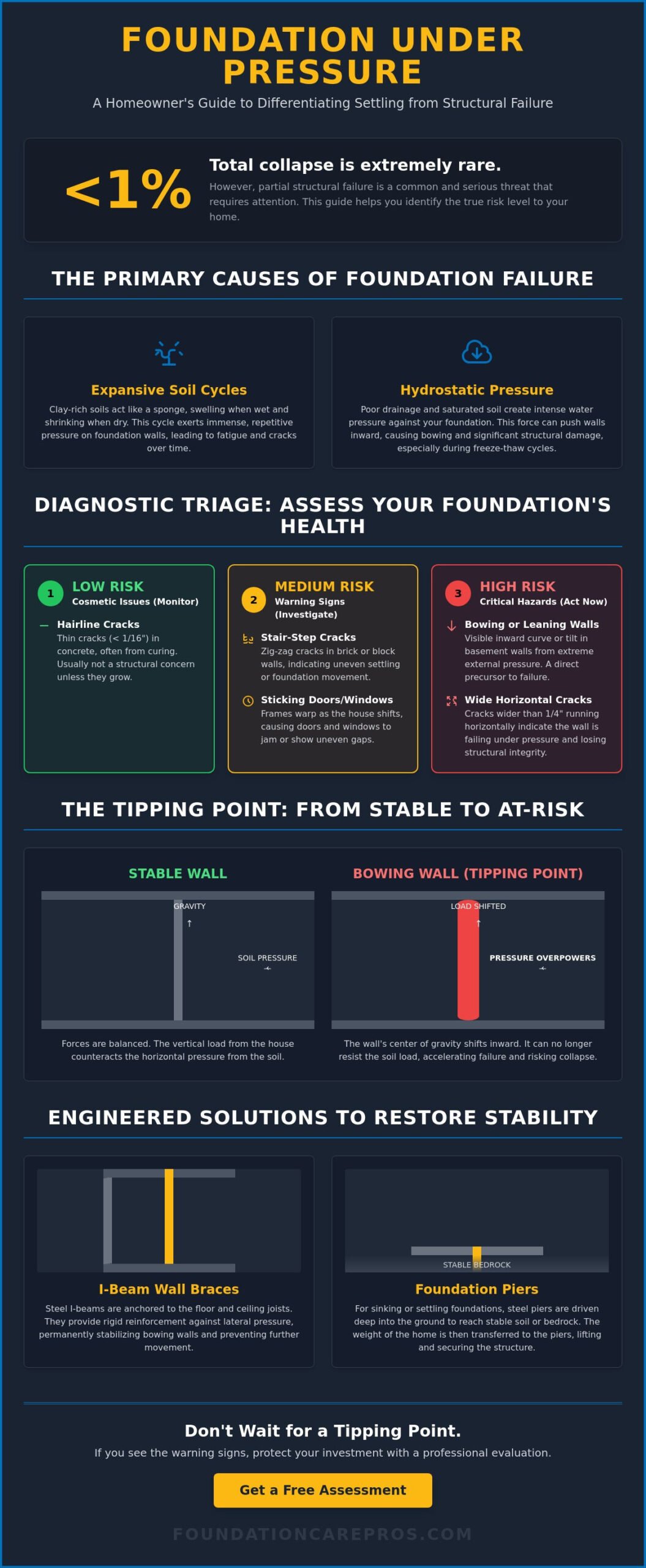
Critical Warning Signs vs. Cosmetic Settling
Distinguishing between a minor cosmetic flaw and a structural emergency is the first step in home maintenance. Every house settles over time, but not every settlement is a threat. You need a reliable triage system to evaluate whether your foundation requires immediate intervention or simple observation. While you might wonder can a house collapse from foundation issues, the risk is identified by specific patterns in the masonry and framing. Analyzing these patterns allows you to act before the damage compromises your safety. Most structural failures provide ample warning if you know how to read the signs.
Cracks are the most visible indicators of structural stress. However, their orientation and width tell different stories about the forces at play. Horizontal cracks are almost always a sign of significant structural distress. They indicate that the wall is bowing inward under the weight of saturated soil, a condition that requires engineered solutions to prevent a total cave-in. Stair-step cracks in brick or concrete block signify differential settlement. This happens when one part of the foundation sinks faster than the rest, creating a shearing force that pulls the mortar joints apart. Monitoring these signs prevents a manageable repair from becoming a total loss. It’s better to verify the stability of your home now than to find out later that the question “can a house collapse from foundation issues” has become a reality for your property.
The ‘Red Flag’ Crack Directory
- Horizontal cracks: These are critical. They indicate that hydrostatic pressure is pushing the wall inward. This is a primary precursor to wall failure.
- Stair-step cracks: Found in block or brick, these follow the mortar lines. They indicate that the soil beneath a specific section of the footing has failed, causing that corner to sink.
- Vertical cracks: These are often the result of concrete shrinkage during the curing process. They are usually minor, but you should monitor them if they become wider than 1/8 inch or if water is seeping through.
Interior Symptoms of Foundation Failure
The foundation is the base for the entire wooden skeleton of your home. When the base shifts, the skeleton twists. This often manifests as doors that suddenly pop open or refuse to latch properly because the frame is no longer square. You might also notice gaps appearing between the wall and the ceiling or floor. Nail pops in the drywall are another common indicator. These occur when the wooden studs shift or warp, pushing the nail head through the finished surface. If a chimney begins to pull away from the exterior siding, it’s a clear sign that the heavy masonry footing is failing independently of the house.
The Tipping Point: When Settling Becomes a Collapse Risk
Waiting another year to address structural movement is the most common mistake homeowners make. Many people assume that if a crack hasn’t changed in six months, the house is stable. This logic ignores the compound interest of foundation damage. Structural issues do not accumulate at a steady, linear rate. Instead, they accelerate as the building’s resistance weakens. Each fraction of an inch a wall moves makes it less capable of resisting the next cycle of soil expansion. While we established that total failure is rare, the question of can a house collapse from foundation issues becomes much more urgent once a wall reaches its structural tipping point.
The structural tipping point occurs when a wall’s center of gravity shifts beyond its base of support. At this stage, gravity stops being a stabilizing force and begins to pull the wall downward and inward. A compromised foundation might hold for years under normal conditions, but it lacks the safety margin to survive an extreme event. Heavy rainfall, a sudden flash flood, or a minor seismic shift can provide the final push that a weakened wall cannot withstand. If you notice your basement walls are no longer vertical, you should schedule a professional structural assessment to determine your current risk level before the next seasonal weather cycle.
Measuring the Bow: The 2-Inch Rule
A foundation wall bowing inward by more than 2 inches is in a state of active failure. At this level of deflection, the wall’s internal reinforcement is stretched to its limit. The concrete or masonry loses its vertical load-bearing capacity. This means the wall can no longer reliably support the weight of the floor joists and the stories above it. Once a wall bows past this 2-inch threshold, it has reached the point of no return where simple monitoring is no longer a safe option. Professional stabilization using I-Beam wall braces or foundation wall anchors becomes a requirement to prevent a localized cave-in.
The Danger of Foundation Shearing
Shearing occurs when the bottom row of blocks or the base of a poured wall slides inward on the footer. This is distinct from bowing, where the top and bottom of the wall stay put while the middle pushes in. Shearing is significantly more dangerous because it indicates a total disconnection between the wall and its base. When a wall shears, the entire vertical support system can kick inward instantly. This leads to a catastrophic drop where the house loses its primary connection to the ground. Because shearing often happens silently behind finished basement walls, it remains one of the highest risks for sudden structural failure.
Engineered Solutions: Halting Collapse and Restoring Stability
Stabilizing a home is a matter of physics and engineering, not guesswork. While the fear of whether can a house collapse from foundation issues is valid, modern technology allows us to halt structural movement with surgical precision. We move from identifying risks to implementing validated, permanent fixes. These solutions address the root cause of the failure, whether it’s lateral pressure from the soil or vertical settlement from poor load-bearing capacity. By reinforcing the existing concrete and anchoring it to more stable environments, we restore the safety margin your home requires.
Stabilizing the Skeleton: I-Beam Wall Braces
I-Beam Wall Braces serve as a high-strength internal skeleton for failing basement walls. We anchor these steel beams to the concrete floor slab and the heavy floor joists above. This configuration stops inward movement immediately. Unlike temporary fixes, these braces use a tensioning bolt system. This mechanism allows for gradual adjustments that can sometimes pull a bowed wall back toward its original position over time. Steel reinforcement provides a permanent solution that doesn’t rely on the strength of the compromised masonry alone.
Reaching Solid Ground: Helical and Push Piers
Foundation Pier Systems solve the problem of sinking footings by transferring the building’s weight to stable, load-bearing strata deep underground. Helical piers are screwed into the earth until they reach a predetermined torque. Push piers are driven down using the actual weight of the house as a counter-force. Both systems bypass the “active zone” of expansive clay that causes settlement. In many cases, these piers allow for a controlled lift, which can level uneven floors and close structural cracks. For homes with minor bowing, carbon fiber straps provide a low-profile alternative that bonds directly to the wall to prevent further deflection without taking up basement space.
Moisture Control: Preventing Future Failure
Mechanical stabilization is only half of the solution. You must also manage the environmental factors that triggered the failure. Interior Basement Drainage Systems and Sump Pump Installation are critical for keeping hydrostatic pressure low. These systems collect groundwater before it can press against your walls. Additionally, crawl space encapsulation protects the wooden girders and joists from moisture-related rot, ensuring the upper structure remains sound. Don’t wait for the tipping point. Get a professional structural assessment from Foundation Care Pros today to secure your home’s future.
Protecting Your Home Through Proactive Stabilization
Structural integrity is the result of consistent monitoring and timely intervention. While homeowners often worry and ask can a house collapse from foundation issues, the answer depends on your willingness to address warning signs before they reach a critical tipping point. Soil pressure and water mismanagement are the primary culprits behind bowing walls and sinking footings. Recognizing the difference between cosmetic settling and active failure allows you to protect your investment without unnecessary anxiety.
Permanent stability is achievable through a methodical, evidence-based diagnostic process. As a Supportworks Network Member, we utilize specialized I-Beam and piering systems designed to bypass weak soil and reinforce failing masonry. These engineered solutions provide the permanence and reliability your property requires for long-term safety. Don’t let minor cracks evolve into a structural emergency.
Secure your home’s future with a professional foundation inspection. Taking action today ensures your home remains a stable environment for your family for decades to come.
Frequently Asked Questions
How long does it take for a house to collapse from foundation issues?
Total collapse usually takes years or even decades of progressive structural movement. It’s a gradual process driven by seasonal soil cycles and water accumulation. While the question of can a house collapse from foundation issues is serious, sudden failure is rare. Rapid changes typically only occur during extreme weather events or seismic shifts that push an already weakened structure past its limit.
Can a house really collapse from just one crack?
A single hairline crack won’t cause a collapse, but a large horizontal breach indicates a significant structural threat. Horizontal cracks signify that hydrostatic pressure is actively pushing against the masonry. If a wall shears at the base or bows significantly from a single point of failure, the risk of localized cave-in increases. Most failures involve multiple signs of distress across the building’s skeleton.
Is it safe to live in a house with foundation problems?
Most homes with minor foundation issues remain safe for daily occupancy, but safety margins decrease as movement continues. You should seek a professional diagnostic if you notice bowing walls or sinking floors. Living in a home becomes hazardous once a wall moves past the two-inch tipping point. At this stage, the wall loses its ability to support the vertical load of the house.
What are the first signs that a foundation is failing?
The earliest indicators are often found in the home’s finishing’s rather than the concrete itself. You might notice doors that stick in their frames or windows that no longer latch properly. Inside, small nail pops in the drywall or gaps between the baseboards and the floor suggest the house is shifting. These symptoms indicate that the foundation is no longer providing a level platform for the structure.
Does homeowners insurance cover foundation collapse?
Standard homeowners insurance policies typically exclude foundation repair caused by earth movement or poor maintenance. Coverage is usually limited to sudden and accidental perils, such as a pipe bursting or a vehicle hitting the structure. Because can a house collapse from foundation issues is often a question of long-term soil cycles, most providers view these repairs as a maintenance responsibility rather than an insurable event.
Can a bowing basement wall be fixed without replacing the whole wall?
Bowing basement walls can be permanently stabilized using engineered systems like I-Beam wall braces or foundation wall anchors. These solutions reinforce the existing masonry and stop further inward movement without the need for total wall replacement. In some cases, these systems even allow for the gradual straightening of the wall over time. This approach is more cost-effective and less invasive than excavation.
How much movement in a foundation is considered ‘normal’?
Minor seasonal settling of less than 1/4 inch is considered normal for many residential structures. Soil naturally expands and contracts with moisture changes, causing slight shifts. However, movement is no longer normal when it produces structural cracks, causes doors to pop open, or creates visible bowing in basement walls. Any movement that compromises the building’s airtight seal or structural frame requires a professional assessment.
What happens if I ignore foundation cracks for too long?
Ignoring cracks leads to a “compound interest” effect where the damage accelerates and repair costs rise. A small vertical crack can allow water to enter, which worsens the freeze-thaw cycle and leads to horizontal shearing. As the wall’s center of gravity shifts, the risk of a sudden failure during a heavy storm increases. Early intervention with carbon fiber straps or pier systems prevents these manageable issues from becoming total losses.